Attention Extraction: How Platforms Monetize Your Focus
In short: One more post, one more clip, one more thread—until time disappears and you surface surprised by how late it is.
Endless scrolling rarely feels like a decision. It can feel like a soft slide: one more post, one more clip, one more thread—until time disappears and you surface surprised by how late it is. For many people, that experience lands as self-judgment. But the pattern is less about personal weakness and more about what happens when a human regulation system meets a design that doesn’t end.
What if the hard part isn’t self-control, but the absence of a natural stopping cue?
Infinite feeds are built around anticipation: the sense that the next swipe might contain something important, relieving, or rewarding. This keeps attention engaged without delivering the kind of completion that lets the body stand down. Understanding that structure can restore dignity: the loop isn’t your identity; it’s a nervous system doing what nervous systems do when “done” never arrives.
One of the clearest signatures of endless scrolling is the moment you look up and feel a jolt: How did that much time pass? It can feel like you were present the whole time—yet not fully tracking your body, the room, or the clock. That isn’t mysterious; it’s what happens when attention is repeatedly captured by novelty and micro-updates without an external endpoint. [Ref-1]
In older environments, attention moved with friction: you reached the end of a path, a conversation paused, daylight changed, hunger arrived. Those cues naturally helped the nervous system mark segments as complete. Infinite feeds remove many of those segment markers, so experience can become continuous without feeling complete.
It’s not that you chose “hours of scrolling.” It’s that the environment didn’t offer your brain a reliable moment to stop.
Stopping cues are biological. They help the brain close a loop: task finished, search completed, enough information gathered. A page that ends, a chapter that concludes, a show that credits out—these are not just cultural habits; they’re regulatory punctuation.
Infinite scroll disrupts that punctuation. Instead of reaching the end, you receive a seamless continuation. The reward system stays organized around anticipation—maybe the next one—and anticipation is energizing in a way that completion is not. Without completion, the system is less likely to downshift. [Ref-2]
Endless scrolling maps neatly onto ancient foraging circuitry. Foraging is the act of scanning the environment for resources—food, safety cues, social information—and it’s powered by intermittent payoff. Sometimes you find something valuable; often you don’t. The nervous system learns to keep scanning because the next find could matter.
Digital feeds mimic this structure: quick samples, uncertain reward, rapid switching, occasional “hits.” You’re not doing anything wrong when your attention sticks; your system is engaging a survival-shaped pattern in a modern landscape. [Ref-3]
In a foraging brain, “keep looking” can feel like “stay safe.”
Scrolling can also function as a fast state change. When the day has been dense—socially, cognitively, emotionally—an infinite feed offers immersion. It can temporarily soften urgency, blur sharp edges, and replace complex life signals with simpler ones: swipe, watch, react.
This is not a character flaw. It’s a predictable response when the nervous system is loaded and wants a quick reduction in friction. The feed provides stimulation and repetition that can mute competing signals for a while. But because it doesn’t complete anything, relief tends to be brief and followed by a return of pressure—sometimes with added fatigue. [Ref-4]
Scrolling often feels voluntary: you can stop anytime. Yet the environment is engineered to reduce the likelihood that you will. The feed is personalized, continuously refreshed, and optimized for continuation. This creates a “capture zone” where choice exists, but the cost of choosing increases over time.
That cost isn’t just willpower. It’s the friction of exiting an active loop: the moment you stop, all the sidelined signals return—hunger, tiredness, loneliness, unresolved tasks, unanswered messages, the quiet of the room. Under high load, the nervous system often prefers the predictable micro-rewards of continuation to the complexity of re-entry. [Ref-5]
Stopping isn’t only about leaving the screen. It’s about re-meeting everything the screen helped you not have to organize for a while.
In a classic reward cycle, there’s a search, a find, and then a settling. The body gets a “done” cue—enough food, enough information, enough connection. Infinite scroll is different. It amplifies the search and delays the settling.
This is why it can feel both pleasurable and oddly unsatisfying. The loop offers constant “almost”—almost informed, almost entertained, almost connected—without the completion that would let the nervous system close the file. It’s pleasure organized around continuation rather than arrival. [Ref-6]
Anticipation can keep you moving long after satisfaction would have let you rest.
Long sessions often come with a specific phenomenology: reduced awareness of posture, thirst, blinking, even discomfort. It’s not uncommon to notice stiffness or headache only after the phone is put down. This isn’t about “ignoring your needs.” It’s about attention being repeatedly re-anchored to the feed faster than body signals can recruit action.
People also describe needing an external interruption to stop: a notification from someone else, a battery warning, an appointment, a partner walking into the room. When the environment provides no endpoint, the exit ramp frequently comes from outside the loop. Research linking mindless scrolling with goal conflict and guilt echoes this “autopilot” quality—behavior continuing past the point of alignment. [Ref-7]
The cost of endless scrolling is not only time. Over time, rapid novelty and constant switching can make slower experiences feel flat: a book, a conversation, even a walk may register as “not enough.” This isn’t because life became less meaningful. It’s because the nervous system has been trained to expect faster reward.
Many people report a kind of emotional flattening afterward—less interest, less drive, less appetite for ordinary pleasure—paired with restlessness. When stimulation is frequent and easy, the baseline can shift, and everyday signals have to compete harder to be felt as rewarding. Literature discussing digital overexposure and attention/motivation effects reflects this broader concern. [Ref-8]
When the brain lives in high-frequency reward, normal life can start to feel like it isn’t “loading.”
Brains learn from patterns. When you repeatedly engage with an environment that never ends, the nervous system receives a consistent message: continuation is the default. Over time, “keep going” becomes the trained posture, and stopping starts to feel like interruption rather than completion.
This matters because search mode is energizing. It’s a ready state—eyes scanning, mind sampling, hand moving. If your day already contains high evaluation pressure, uncertainty, or incomplete tasks, the feed can become a parallel loop that keeps the system activated while offering the illusion of progress. Educational resources describing infinite scroll often highlight how the missing endpoint itself is the hook. [Ref-9]
When “done” is never presented, the body can forget how “done” feels.
A quiet shift happens when attention moves from what’s on the screen to what the scrolling is doing in the body. Not as a self-monitoring project, but as a recognition of the loop’s signature: the micro-surge before the next swipe, the slight dissatisfaction after a clip ends, the reflex to refresh.
This isn’t integration by insight. It’s simply naming the structural experience: the feed is built to keep the nervous system oriented toward the next unit. In that frame, the question changes from “Why am I like this?” to “What state is being maintained right now?” Research on mindless scrolling and well-being points to the relevance of goal conflict and guilt—signals that the behavior can drift away from one’s own orientation. [Ref-10]
Sometimes the most clarifying detail isn’t what you watched—it’s the feeling of “not yet” that kept you watching.
People often assume stopping should come from motivation: a strong internal decision that overrides the pull. But motivation is a volatile resource, especially under stress load. In a loop designed for continuation, relying on inner pressure can create a second layer of strain—effort on top of activation.
What tends to interrupt autopilot more reliably is structure: conditions that create an endpoint, a pause, or a context shift. Research on problematic scrolling and doomscrolling patterns often discusses behavioral boundaries and environmental factors alongside individual traits—because the loop lives in the interaction between person and platform. [Ref-11]
In other words, the system doesn’t need harsher self-talk. It needs clearer punctuation.
When the feed is interrupted, there can be an initial wave of discomfort: restlessness, irritability, a sense of emptiness, or a rebound of previously muted signals. This isn’t evidence that the phone was “necessary.” It’s often the nervous system re-encountering unclosed loops—fatigue, uncertainty, loneliness, unfinished tasks—without the buffering effect of constant novelty.
And then, for many people, something else becomes available: a clearer sense of time, more stable attention, and a quieter internal tempo. Not a dramatic transformation—more like the mind is no longer being repeatedly yanked into the next preview. Accounts of doomscrolling and dissociation-like absorption describe this arc: immersion that temporarily blunts, followed by disorientation, followed by a gradual return of presence and time awareness. [Ref-12]
At first, stopping can feel like falling off a moving walkway. Later, it can feel like getting your feet back under you.
The deeper issue with endless scrolling isn’t screen time alone. It’s the way passive consumption can thin out personal coherence: your day fills with fragments that don’t integrate into identity, memory, or values. You saw a hundred things, but nothing “landed.”
When engagement becomes more coherent, digital content starts to relate to a life again—curiosity has an endpoint, information has a place to go, connection has reciprocity. Research examining mindless scrolling links it with lower daily well-being and goal conflict, suggesting that the mismatch between behavior and personal aims matters as much as the content itself. [Ref-13]
Coherence isn’t about using the internet less. It’s about the internet fitting into a life that can finish things.
In an environment built to continue, stopping is not a simple preference—it’s a regulatory act. The nervous system needs endpoints to settle, digest input, and return to baseline. Without those endpoints, activation can become the background setting, and the body will seek relief wherever it can find it.
So if endless scrolling has been part of your days, it can help to hold the right meaning: not “I failed,” but “my system met an infinite loop.” This is one reason public health and clinical sources increasingly describe doomscrolling and related patterns in terms of stress and mental load rather than morality. [Ref-14]
When the world offers no stopping cues, choosing a stop becomes a form of care for your biology.
Endless scrolling is persuasive because it keeps the mind near reward without requiring completion. But humans don’t stabilize on stimulation alone. We stabilize when experiences close, when actions connect to values, and when the day contains moments that genuinely feel finished.
Agency, in this frame, isn’t a heroic inner force. It’s what tends to reappear when the nervous system is no longer trapped in “next, next, next,” and when attention has somewhere coherent to go. The loop can be countered—not by becoming a different person, but by changing what the environment makes effortless, and by letting life contain more true endpoints. [Ref-15]
From theory to practice — meaning forms when insight meets action.
Because attention is repeatedly captured by novelty and micro-updates without an external endpoint. In older environments, friction marked segments as complete — a path ended, daylight changed, hunger arrived. Infinite feeds remove those segment markers, so experience becomes continuous without feeling complete. The 'time shock' you feel afterward isn't because you weren't present; it's because the environment didn't offer your brain a reliable moment to stop. The Done Signal that would let the body track elapsed time and reassess never arrived. It isn't that you chose hours of scrolling. It's that the loop was engineered without endings.
Because endless scrolling maps onto ancient foraging circuitry. Foraging is scanning for resources — food, safety cues, social information — powered by intermittent payoff. Sometimes you find something valuable; often you don't. The nervous system learns to keep scanning because the next find could matter. Digital feeds mimic this exactly: quick samples, uncertain reward, rapid switching, occasional hits. You're not doing anything wrong when attention sticks; your system is engaging a survival-shaped pattern in a modern landscape. In a foraging brain, 'keep looking' can feel like 'stay safe,' which is why willpower alone has trouble overriding it.
Because stopping isn't only leaving the screen — it's re-meeting everything the screen helped you not have to organize for a while. Hunger, tiredness, loneliness, unresolved tasks, unanswered messages, the quiet of the room. Under high load, the nervous system often prefers the predictable micro-rewards of continuation to the complexity of re-entry. There can also be an initial wave of restlessness, irritability, or rebound when the loop is interrupted — the system re-encountering open loops without the buffering of constant novelty. Later, clarity tends to return: more stable attention, quieter internal tempo, getting your feet under you again.
The article is direct that it isn't. Motivation is a volatile resource, especially under stress load, and in a loop designed for continuation, relying on inner pressure adds a second layer of strain — effort on top of activation. What tends to interrupt autopilot more reliably is structure: conditions that create an endpoint, a pause, or a context shift. The loop lives in the interaction between person and platform, so the most useful intervention is changing what the environment makes effortless. The system doesn't need harsher self-talk; it needs clearer punctuation. Stopping is a biological necessity, not a discipline test.
From Science to Art.
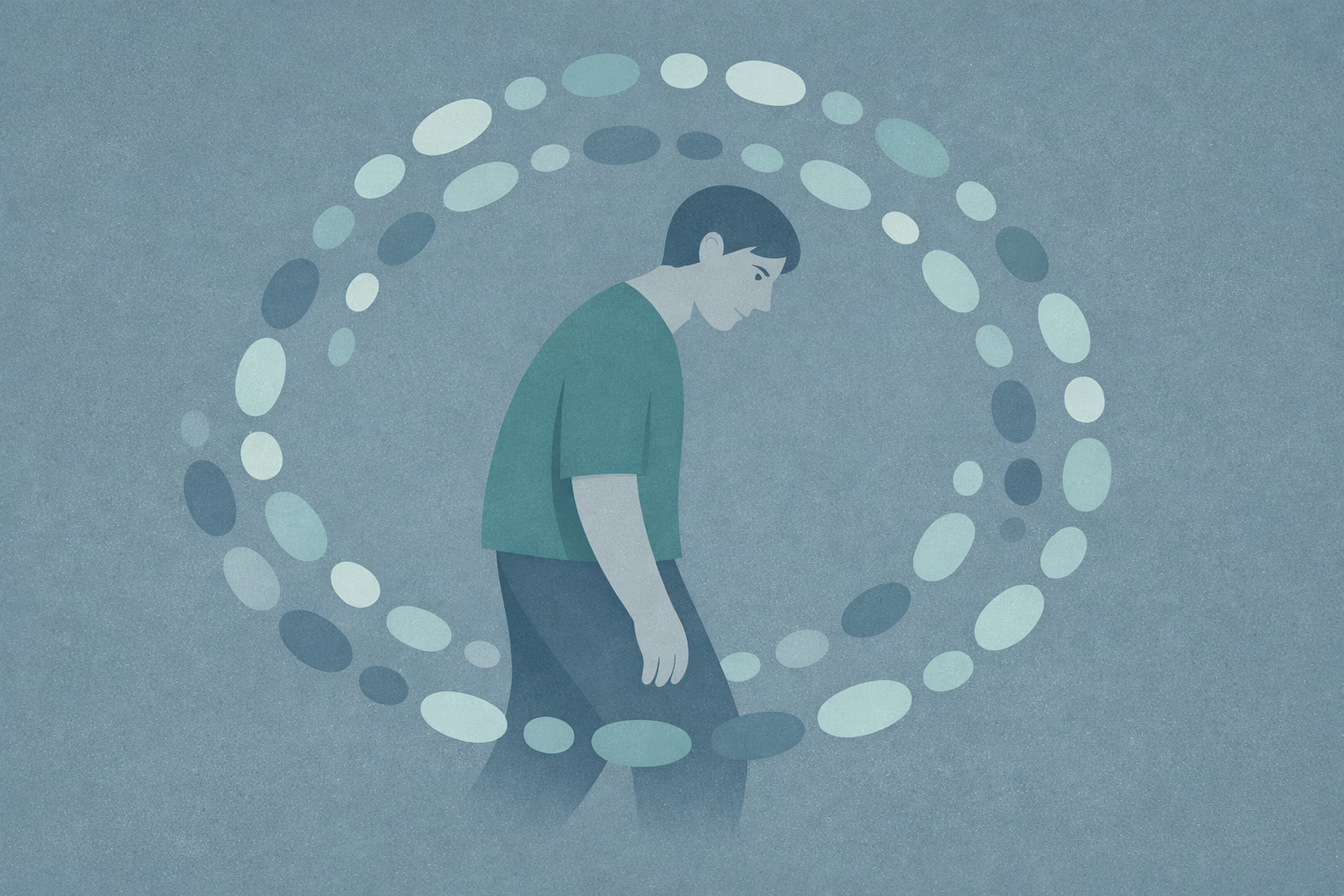
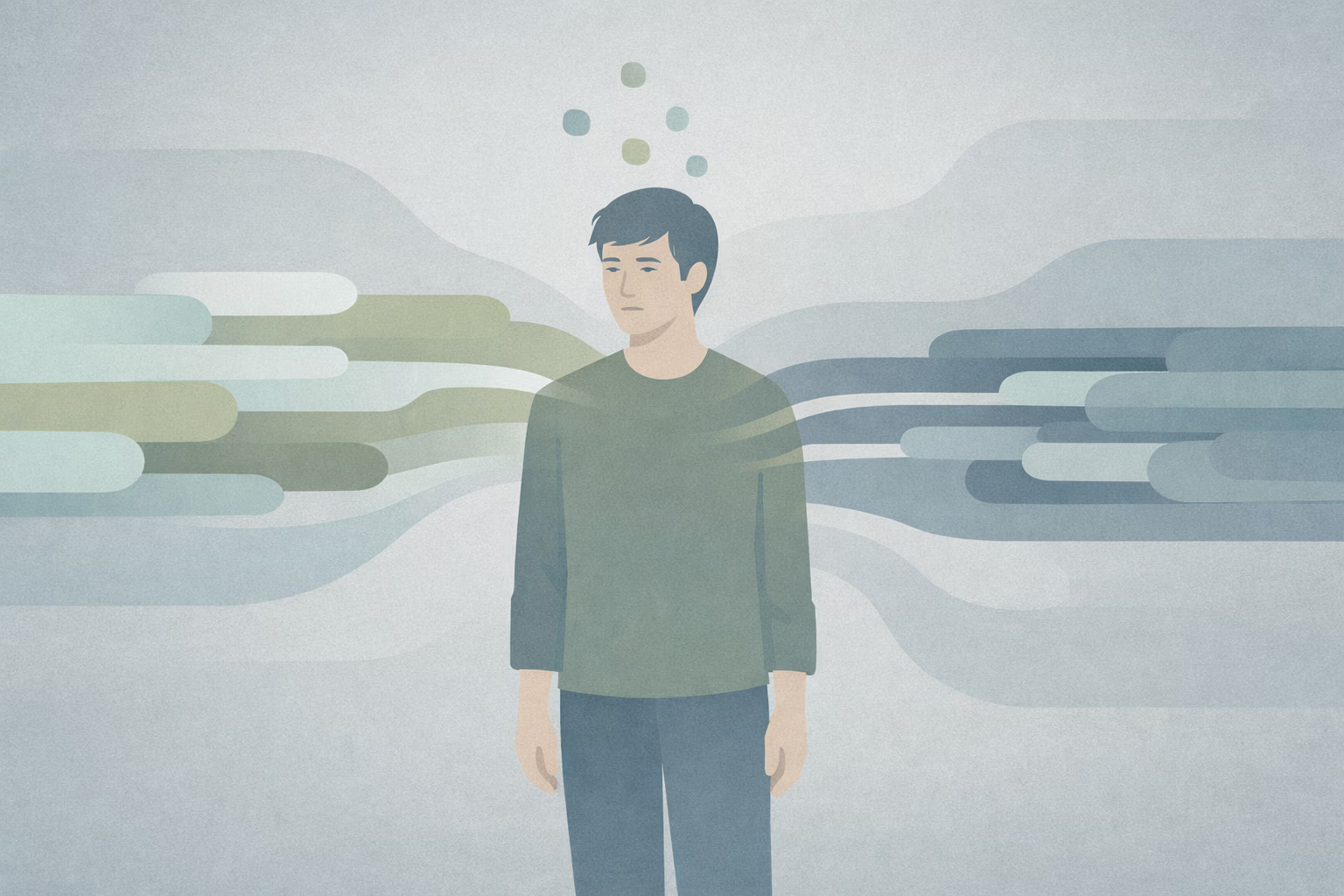
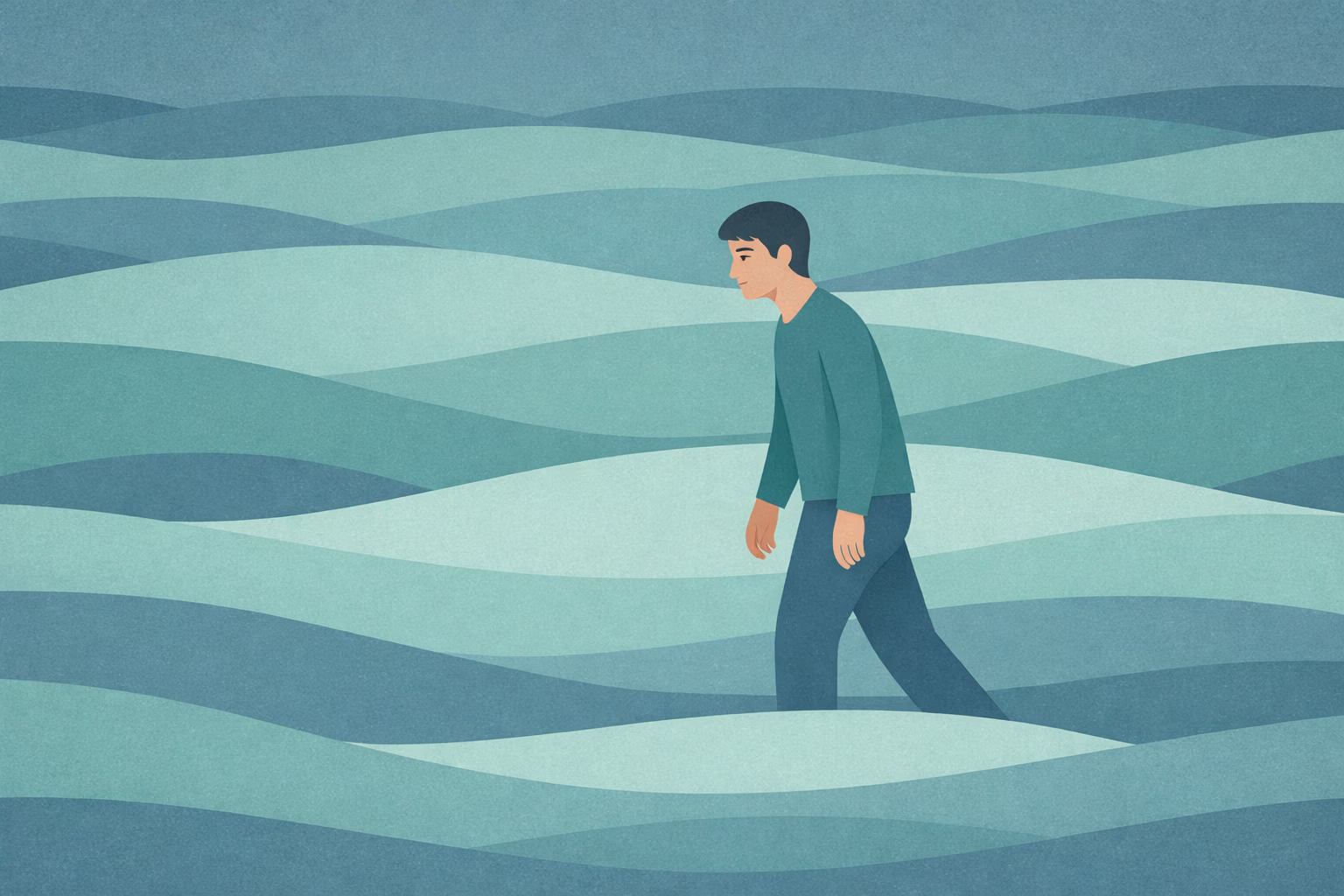
Understanding explains what is happening. Art allows you to feel it—without fixing, judging, or naming. Pause here. Let the images work quietly. Sometimes meaning settles before words do.
One Quiet Window, one insight, one reflection — every Sunday