Digital Entrepreneurship Burnout: The Hidden Cost of “Be Your Own Boss”
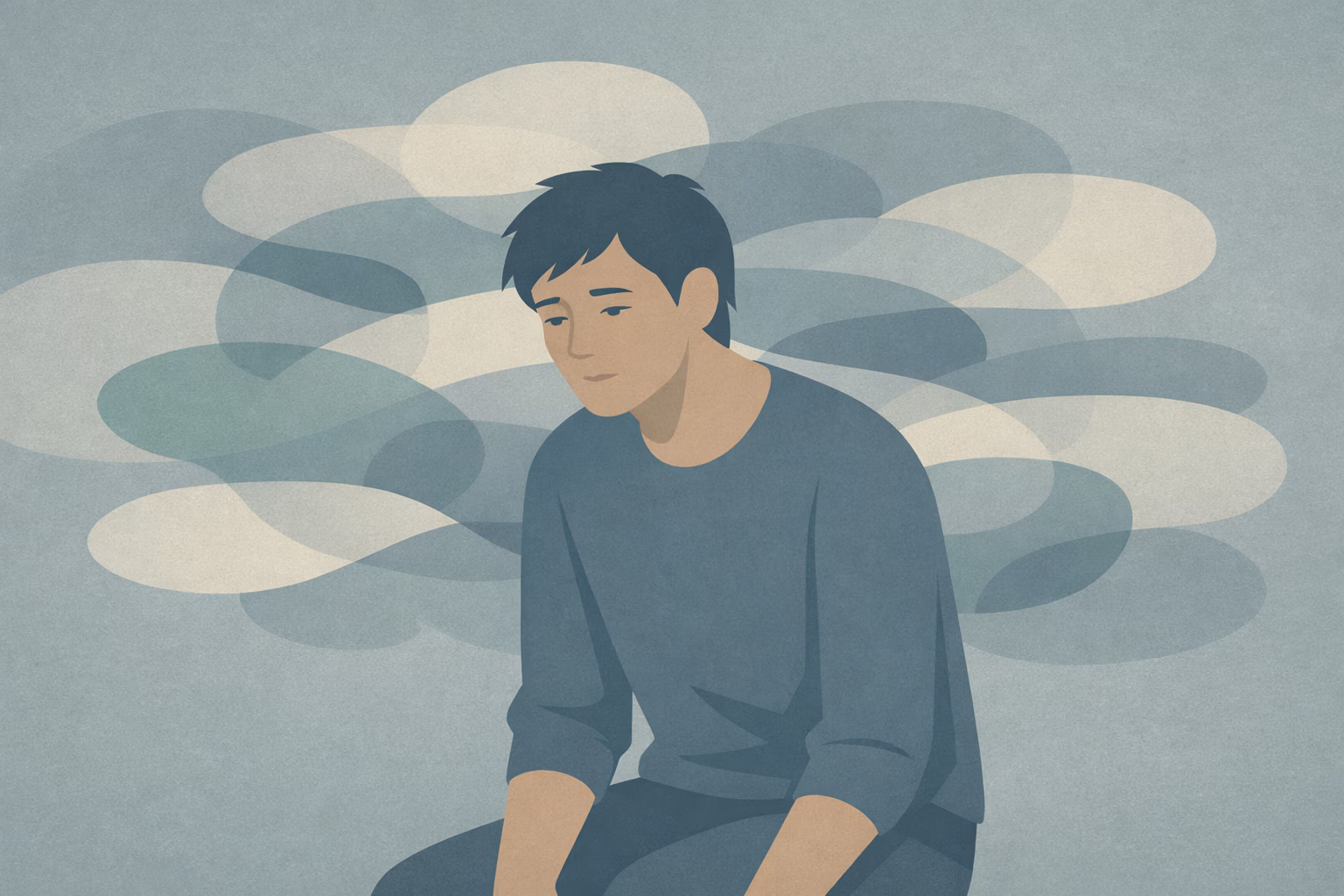
In short: There’s a particular kind of burnout showing up in creative work right now: you can generate more than ever—more drafts, more concepts, more versions—yet feel oddly hollow inside the process. Not because you “lost your talent,” but because the system around you has changed the rhythm your nervous system uses to make meaning.
There’s a particular kind of burnout showing up in creative work right now: you can generate more than ever—more drafts, more concepts, more versions—yet feel oddly hollow inside the process. Not because you “lost your talent,” but because the system around you has changed the rhythm your nervous system uses to make meaning.
AI tools can reduce friction in valuable ways. But when the environment rewards constant production, your creative life can start to run on acceleration rather than completion. That shift matters, because creativity isn’t only output—it’s also a biological process that needs time to settle, consolidate, and feel internally “done.”
What if the problem isn’t your motivation—what if it’s that your creative loops aren’t getting closure anymore?
Creative burnout in the AI era often looks like this: your calendar is full, your folders are full, your metrics might even be fine—and yet your work feels thinner, less personal, more interchangeable. You might notice a subtle disconnection from your own voice, as if you’re supervising production rather than inhabiting it.
This is not a character flaw. Burnout is increasingly understood as a stress-and-load state that changes energy, attention, and health over time. [Ref-1] When that load lands in the creative domain, the symptoms can be especially confusing because the output can continue even as the sense of authorship fades.
“I’m creating constantly, but I don’t feel like I’m actually making anything.”
Many people picture creativity as a burst: an idea appears, then gets executed. In real nervous systems, it’s more cyclical. There’s generating, selecting, shaping, revising, pausing, returning—plus quieter background processing that supports originality.
When rapid ideation becomes the default (prompt, output, prompt, output), there’s less time for incubation—the period where attention can release and recombine material in less linear ways. Incubation is not “doing nothing”; it’s part of how novel connections become available. [Ref-7]
Under sustained speed, attentional systems can get overdrawn. The result isn’t always obvious fatigue—it can be a flattening: fewer surprising angles, less patience with ambiguity, and a stronger pull toward whatever resolves fastest.
Humans did not evolve to produce high volumes of novelty on demand, indefinitely. Novelty requires discriminating attention, energy allocation, and recovery. When the demand for “new” becomes constant, the body treats it like an ongoing load problem—not a personal challenge to rise to.
Over time, chronic load can accumulate as allostatic strain—wear from prolonged adaptation—changing how easily your system mobilizes and how quickly it can stand down. [Ref-3] In creative work, that can look like being able to start quickly but struggling to finish in a satisfying way, or finishing while still feeling internally unfinished.
The point isn’t that creativity is fragile. It’s that it has a tempo. When the tempo is repeatedly overridden, the system compensates.
AI assistance often provides immediate relief: fewer blank-page moments, faster scaffolding, quicker problem-solving. That relief is real. Reducing effort can temporarily soften the strain of performance pressure and decision load—especially when you’re already stretched.
In the short term, faster generation can feel like regained control: you can meet the deadline, satisfy the request, keep the channel alive. That “I can handle it” signal is regulating.
But relief and closure are not the same. Relief changes state right now; closure is what allows the nervous system to stop checking the loop later. When speed becomes the main regulator, it can quietly trade long-term settling for short-term throughput.
Modern creative environments can confuse speed with depth. If something can be produced in minutes, it can start to feel as if it should be produced in minutes. But depth is not simply more material—it’s immersion, selection, and an internal sense that the work has metabolized into something coherent.
Attention is limited capacity. When it’s split, rushed, or repeatedly reset, the mind tends to rely on the most available patterns rather than the most fitting ones. [Ref-5] In practice, that can mean more output with less resonance.
When did “good enough to publish” quietly replace “done enough to belong to me”?
In this frame, “avoidance” doesn’t mean fear or emotional suppression. It means a structural bypass: speed replaces presence, and immediate production replaces the slower friction where craft and identity form.
AI tools can make it easy to skip the parts of process that feel inefficient—wandering, questioning, testing edges, tolerating partial drafts. Over time, those skipped steps don’t disappear; they simply don’t complete. The system keeps a quiet tab open: something is still unresolved.
Multitasking and rapid switching also nudge the brain toward shallower processing and reduced creative flexibility. [Ref-6] The loop becomes: generate quickly to reduce pressure, then feel less anchored, then generate more quickly to regain footing.
Creative burnout in the age of AI isn’t only “tired.” It often shows up as recognizable adaptations—ways your system tries to keep functioning under acceleration.
Notice how these patterns aren’t laziness. They’re efficiency strategies in an environment that rewards speed and constant availability—and that often shortens incubation time, which is linked to creative problem-solving. [Ref-7]
Confidence in creative work often comes from a specific kind of evidence: “I can stay with this long enough for it to become mine.” When cycles shorten, you lose opportunities to build that evidence. You may still ship work, but the internal sense of authorship weakens.
Intrinsic motivation tends to thrive when the work supports immersion, autonomy, and a felt relationship to the task—conditions often associated with flow states. [Ref-8] Prolonged acceleration can interfere with those conditions by keeping attention in evaluation mode: Is it fast enough? Is it good enough? Is it comparable?
The result is a subtle identity shift: from maker to manager, from explorer to operator. Not because you chose it, but because the environment made it the easiest way to keep going.
Once output becomes the main proof of value, tool reliance can become a stabilizer: it helps you keep up, stay visible, reduce the risk of falling behind. But the very efficiency that helps you survive can also compress the time needed for creative closure.
This is where the loop tightens. The more pressure you feel, the more you depend on faster production; the more you depend on faster production, the less time there is for intrinsic signals—interest, satisfaction, “this fits”—to return. Over time, motivation becomes externally tethered: deadlines, feedback, numbers, comparisons.
Research on motivation and well-being emphasizes that when autonomy and internal endorsement are supported, people tend to sustain engagement more effectively. [Ref-9] When those signals get crowded out by constant evaluation, the nervous system leans toward whatever reduces uncertainty fastest—often more output.
What many people call “getting your creativity back” isn’t a sudden insight or a better mindset. It’s often a physiological return: your attention becomes less fragmented, your internal signals become easier to detect, and your system can finally stand down after a creative cycle completes.
Digital overload and constant task switching are associated with stress and strain in knowledge work. [Ref-10] In creative work, this strain can look like urgency without direction—energy that mobilizes but doesn’t land. Slower cognitive rhythms matter because they allow selection, consolidation, and completion to occur without being interrupted by the next demand.
When closure is available, the body stops needing to keep the project “hot.” That’s not emotional catharsis; it’s load reduction and a restored capacity for signals to return—interest, discernment, and a steadier sense of what matters.
Creativity is rarely only private. Even solo work is shaped by audiences, collaborators, editors, clients, peers. When the surrounding culture values process—not just deliverables—it becomes easier for a nervous system to complete loops rather than live in perpetual pre-launch.
Information overload and technostress can impair creativity, especially when demands are high and attention is repeatedly pulled. [Ref-11] In contrast, environments that protect depth and reduce constant evaluation act as safety cues: they tell your system it can take the time required for something to become coherent.
Shared meaning also reduces the lonely pressure of having to prove yourself through volume. When the “why” is mutually held, the “how fast” becomes less absolute.
“When someone cares about the process with me, the work stops feeling like a performance.”
When acceleration eases—whether through fewer simultaneous demands, fewer resets, or a more humane pace—certain capacities often reappear in a recognizable order. Not as a dramatic breakthrough, but as a steadying.
Reviews of technology-induced burnout describe how sustained digital strain can reduce engagement and contribute to exhaustion. [Ref-12] As that strain lowers, engagement can become possible again—not because you force it, but because capacity returns.
This is what coherence feels like: less chasing, more settling; less proving, more inhabiting.
Over time, a healthier relationship with tools tends to look less like dependence and more like alignment. Tools become supportive instruments, not the source of creative direction. The work is still efficient where it can be—but it isn’t built entirely on compression.
Time pressure is known to shape stress and performance in accelerated work contexts. [Ref-13] When pressure is constant, the nervous system prioritizes speed and certainty. When pressure is not the only organizing principle, values can re-enter the driver’s seat: what you want to stand for, what kind of craft you’re building, what you’re willing to repeat for years.
Intentional creation is not slower for the sake of slow. It’s paced so that experiences can complete and integrate into identity: “This is how I work. This is what my work means. This is mine.”
AI can be a powerful assistant. But creativity tends to stabilize when tools serve expression rather than replace inner engagement. When your system is allowed to complete creative loops—start, shape, finish, rest—the work becomes more than content. It becomes something your nervous system can file as coherent.
Rest and recovery matter here not as self-improvement, but as conditions that allow detachment and completion signals to occur, which supports creative performance over time. [Ref-14] In other words: a regulated system doesn’t need to keep generating to feel okay.
Agency often returns as a quiet recognition: you are not behind—you are recalibrating to a tempo where your work can actually belong to you.
Sustainable creativity rarely comes from acceleration alone. It comes from depth, presence, and purpose—the kind that builds a life where your work can settle into you, not just leave you. And often, it’s supported by relationships and contexts that carry shared meaning, not constant evaluation. [Ref-15]
When the pace allows completion, your nervous system stops bracing. Your attention returns. Your voice becomes recognizable again—not because you forced it, but because the conditions finally let it arrive.
From theory to practice — meaning forms when insight meets action.
There's a particular creative burnout showing up right now: you can generate more drafts, concepts, and versions than ever, yet feel oddly hollow inside the process. Not because you lost your talent, but because the system around you has changed the rhythm your nervous system uses to make meaning. AI tools reduce friction, but when the environment rewards constant production, your creative life runs on acceleration rather than completion. The output continues even as the sense of authorship fades. What you may be experiencing isn't a motivation problem — it's that your creative loops aren't getting closure anymore, so the work never lands as yours.
Many people picture creativity as a burst — idea appears, gets executed. In real nervous systems it's cyclical: generating, selecting, shaping, revising, pausing, returning, plus quieter background processing that supports originality. When rapid prompt-output-prompt-output becomes the default, there's less time for incubation, the period where attention can release and recombine material in less linear ways. Incubation isn't doing nothing; it's part of how novel connections become available. Under sustained speed, attention systems get overdrawn and the result is a flattening — fewer surprising angles, less patience with ambiguity, and a stronger pull toward whatever resolves fastest.
AI assistance provides immediate relief and an I can handle it signal that's regulating in the short term. But relief and closure are not the same. Relief changes state right now; closure is what allows the nervous system to stop checking the loop later. When speed becomes the main regulator, it quietly trades long-term settling for short-term throughput. This is a Power Loop dynamic from the Status & Control root: control the output, prove the value, repeat — while internal signals like interest and satisfaction get crowded out. Faster generation feels like regained control, but the system never receives the Done Signal that would let craft and identity actually form.
When acceleration eases — through fewer simultaneous demands, fewer resets, or a more humane pace — capacities reappear in a recognizable order. Curiosity returns: questions arise without needing immediate answers. Patience returns: an idea can stay unfinished without feeling like a threat. Discernment returns: you can sense what's not it without spiralling. Staying power returns: attention can remain with a piece long enough for depth to form. This isn't a dramatic breakthrough; it's a steadying. Tools become supportive instruments rather than the source of direction. Meaning Density grows because experiences can complete and integrate into identity: this is how I work, this is mine.
From Science to Art.
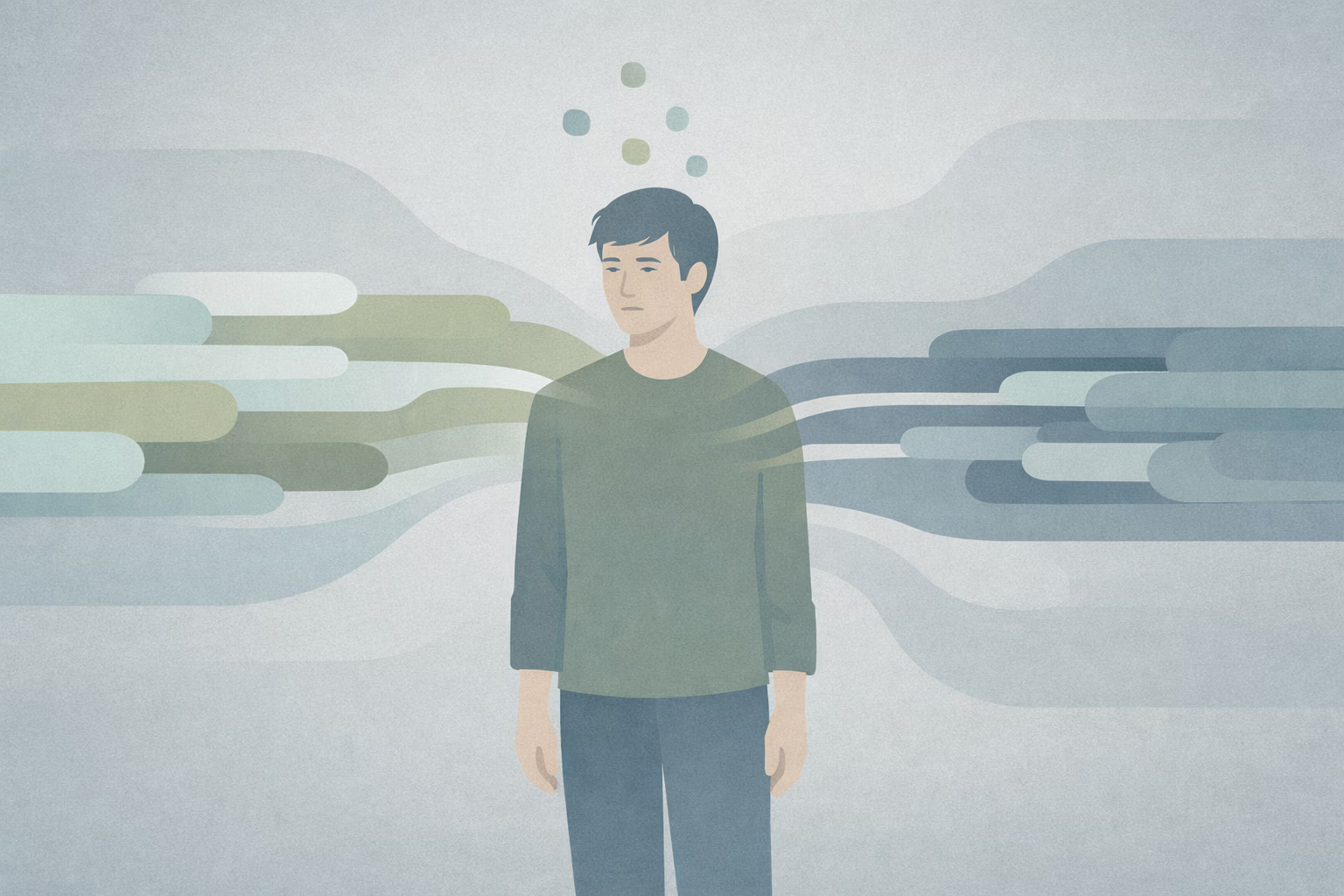
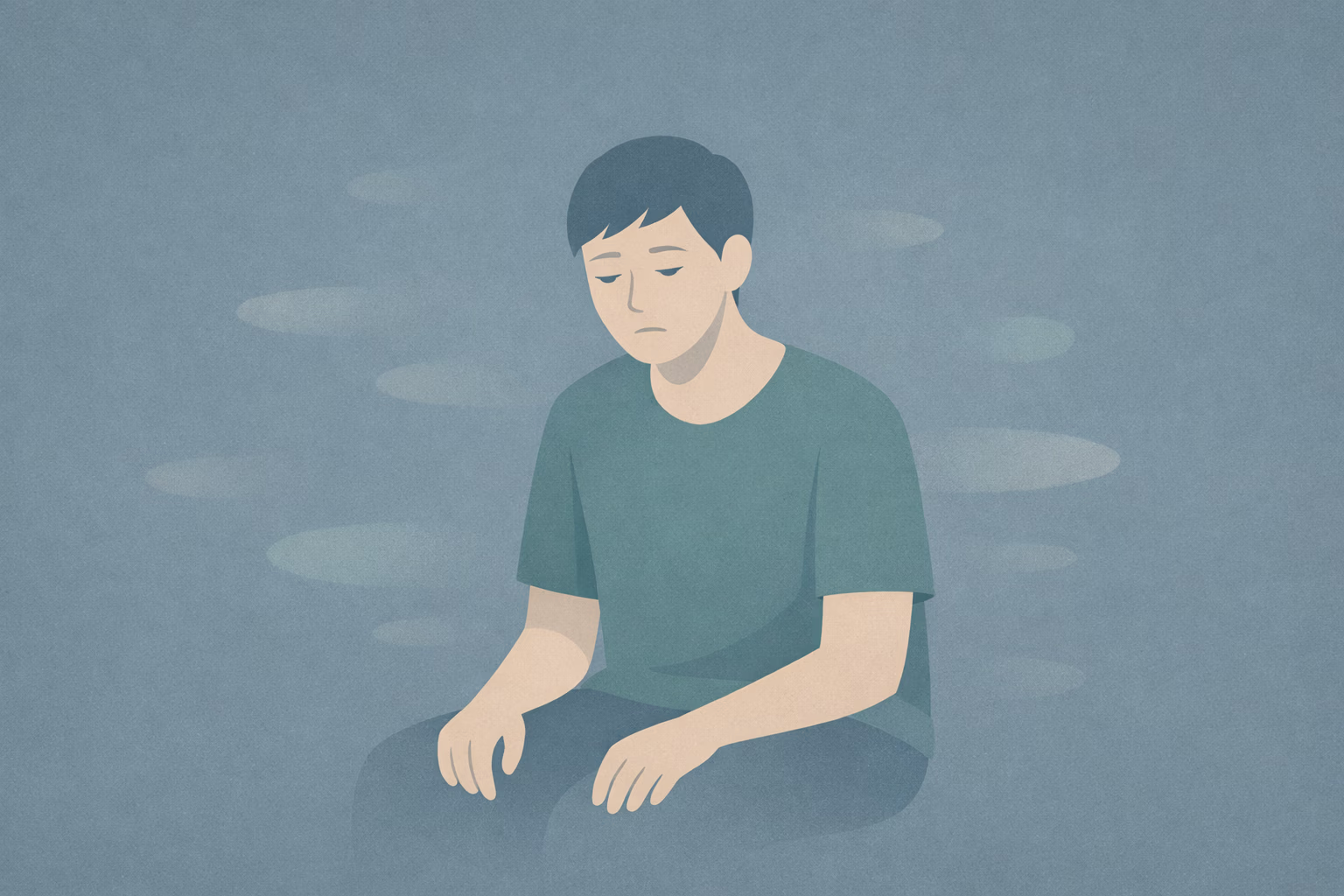
Understanding explains what is happening. Art allows you to feel it—without fixing, judging, or naming. Pause here. Let the images work quietly. Sometimes meaning settles before words do.
One Quiet Window, one insight, one reflection — every Sunday