Multiple Options Anxiety: Dating in an Infinite Marketplace
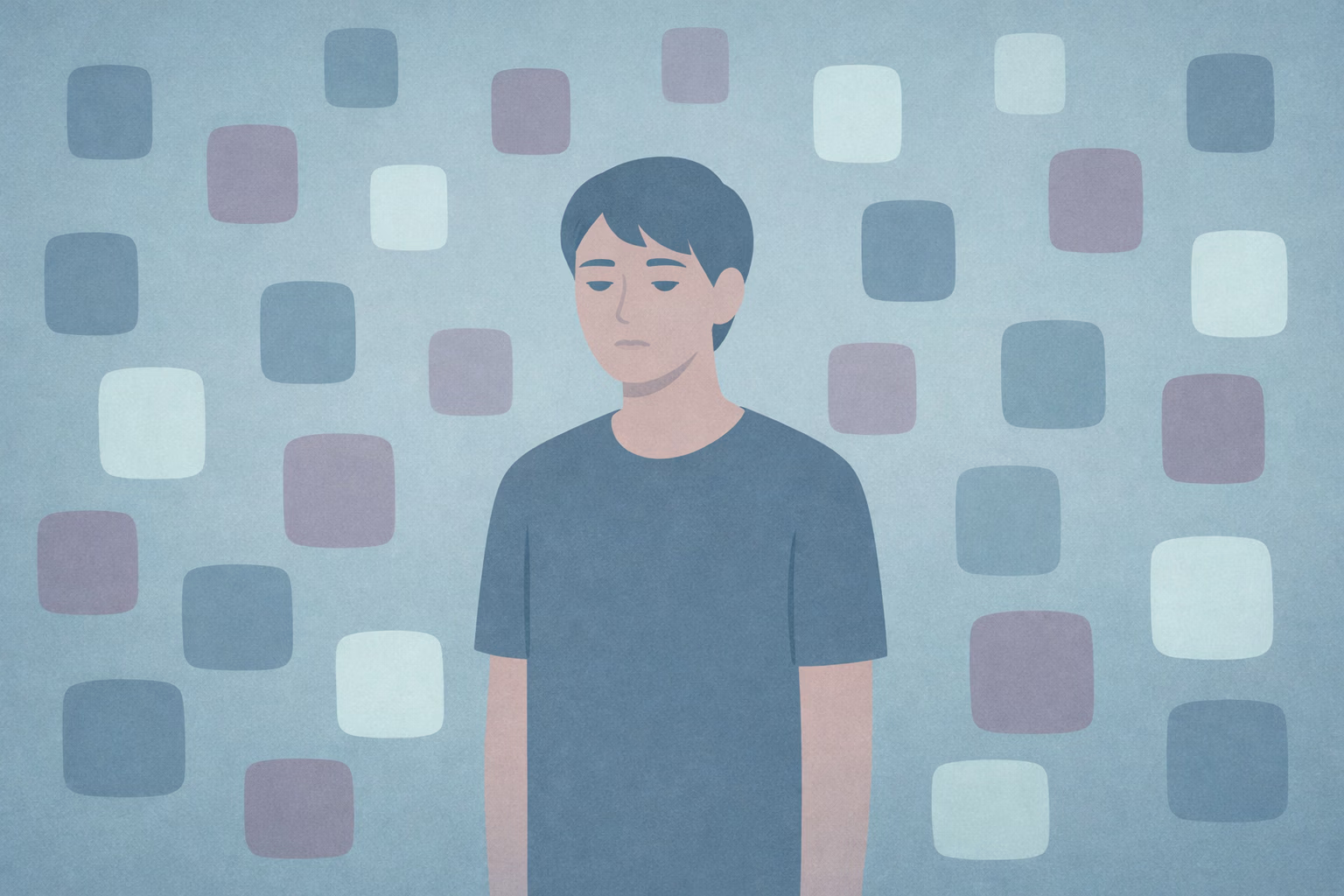
In short: Dating apps can offer a sense of access—more people, more chances, more potential. And yet many people describe a confusing shift over time: attraction becomes brief, interest doesn’t stick, and even a “good match” can feel strangely hard to care about.
Dating apps can offer a sense of access—more people, more chances, more potential. And yet many people describe a confusing shift over time: attraction becomes brief, interest doesn’t stick, and even a “good match” can feel strangely hard to care about.
What if the numbness isn’t a personal flaw—but a predictable nervous-system response to too much unfinished choice?
Choice overload isn’t only about indecision. It’s about what happens when your brain is repeatedly cued toward novelty and evaluation, without enough closure to let any one connection complete into a stable sense of meaning.
Choice overload often shows up as a particular blend of sensations: quick attraction, quick doubt, and a mild emotional blankness that’s hard to explain. You might find yourself scanning profiles with intensity, feeling a momentary “yes,” and then watching it dissolve into “maybe” before anything has a chance to land.
Many people describe it as boredom, pickiness, or a sudden inability to feel impressed. But beneath those labels is often a nervous system that’s staying in a high-evaluation state—tracking, comparing, and preparing to move on—rather than shifting into the slower state where interest consolidates. Research and reporting on online dating repeatedly note that more available choices can be linked to lower satisfaction and more dissatisfaction with selections. [Ref-1]
When everything is potentially next, nothing gets the signal to become real.
Swipe-based dating is built around rapid novelty: new faces, new micro-stories, new possibilities. Novelty tends to activate dopamine-linked “seeking” circuitry—systems that help humans explore, learn, and pursue opportunities. The important detail is that seeking is not the same as settling.
In an environment of near-infinite choice, the reward system can stay oriented toward “keep looking” rather than “this is enough.” That can reduce the brain’s ability to assign lasting value to any single option, because the context keeps signaling that evaluation should remain open. Design and information density on dating platforms has been discussed as a factor that can amplify this effect, increasing cognitive load and comparison rather than helping decisions feel complete. [Ref-2]
It’s not that you can’t appreciate someone.
It’s that appreciation often requires a closure signal—an internal “done” that lets the system stop scanning long enough for meaning to form.
Humans evolved to choose partners within constrained social ecosystems: a village, a neighborhood, a network of known people with shared context. In those settings, choice existed—but it was naturally limited, slower, and embedded in consequence and reputation.
Dating apps simulate abundance without the stabilizing features that help the nervous system complete an evaluation. Instead of “meeting a person in a place,” you’re often meeting a stream of options in a high-speed environment. Studies on online dating have found that excessive choice can reduce satisfaction and shape behavior in ways consistent with overload rather than improved matching. [Ref-3]
So the mismatch isn’t a moral one (“people are shallow now”). It’s structural: systems designed for limited, contextual choice are being asked to metabolize endless, decontextualized possibility.
Abundance brings a particular kind of relief: the sense that you don’t have to risk much, because another option is right there. That relief is real. It lowers the immediate stakes.
But it also creates a setup where stimulation is available without the cost of completion. Commitment—whether it’s a conversation that deepens, a date that clarifies, or a choice that closes off alternatives—tends to create vulnerability and consequence. Endless browsing allows the nervous system to stay in possibility without crossing into the “this counts” zone where things have to integrate into identity.
Clinical and popular psychology writing on online dating has noted that more choices can paradoxically reduce connection, in part because the experience becomes more about browsing than bonding. [Ref-4]
The idea of a better match is not irrational. In a large pool, better matches do exist. The difficulty is what constant better-potential does to the nervous system’s satisfaction circuitry.
When the environment keeps presenting new alternatives, the mind learns to delay closure. That delay can feel like being “careful” or “selective,” but the body often experiences it as low-grade activation: perpetual evaluation without resolution. Over time, people commonly report less satisfaction with the people they do match with, not because those people are worse, but because comparison pressure has become the background noise. This paradox has been widely discussed in dating and matchmaking commentary on choice overload. [Ref-5]
In other words, the promise of more can quietly train the system to feel less.
Choice overload often behaves like a pleasure loop: the system keeps seeking the next hit of possibility, while the deeper reward of attachment remains out of reach. Stimulation changes state quickly. Connection takes time, context, and repetition.
In a pleasure loop, the person isn’t “addicted to dating.” The nervous system is responding to an environment where the easiest available completion is a micro-completion: a match, a message, a new profile, a small spike of novelty. That kind of closure is momentary, so the system returns to seeking. This pattern is frequently described in discussions of online dating’s psychology: more choice can sustain engagement while weakening depth. [Ref-6]
The loop isn’t longing for love—it’s longing for an endpoint that never arrives.
When choice overload is running the show, people often develop predictable regulatory patterns. These are not character traits. They’re the body’s way of managing ambiguity, load, and incomplete closure.
Psychology-oriented writing on the paradox of choice in dating often describes these themes as outcomes of overload: too many options can undermine satisfaction and follow-through. [Ref-7]
Intimacy isn’t created by intensity. It’s created by continuity—small moments that accumulate until the nervous system registers a person as safe, known, and consequential. Overstimulation disrupts that accumulation.
When attention keeps fragmenting, the body struggles to build the steady internal map that supports trust. Not because someone is “afraid of closeness,” but because the environment keeps interrupting the conditions that allow closeness to register as real. Behavioral science discussions of online dating often highlight this paradox: expanded choice can reduce satisfaction and make it harder to feel settled into a selection. [Ref-8]
If meaning comes from completion, what happens when nothing completes?
Relational meaning can start to feel thin—not because you’re incapable of it, but because the system is rarely allowed to finish a loop long enough to integrate an experience into identity.
Once satisfaction drops, the most available relief is often more searching. It makes sense: if nothing feels good, the mind reaches for the thing that promises a better feeling. But in a high-novelty environment, the “better feeling” often comes from stimulation, not from completion.
This can create a structural spiral: reduced satisfaction leads to more scanning; more scanning increases comparison and load; increased load further reduces the capacity to feel depth. Commentary on choice overload—especially among younger daters—frequently notes this feedback loop of fatigue and continued searching. [Ref-9]
The more the system searches for a feeling, the more it resets the conditions that would allow feeling to settle.
There’s a difference between being excited and being oriented. Excitement is a spike. Orientation is a steady “this matters” signal that can hold over time.
In choice overload, attraction often keeps resetting because the context keeps re-opening evaluation. When reward sensitivity is constantly being pinged by new options, the system doesn’t get enough quiet to register a single connection as complete enough to stand on. Research on choice overload and romantic outcomes describes how too many options can undermine satisfaction and follow-through, which fits this idea of repeated resetting rather than stable valuation. [Ref-10]
Stabilization isn’t an act of forcing yourself to want someone. It’s what can emerge when the body gets fewer competing inputs and more opportunity for a single experience to reach its natural endpoint.
Bonding is a physiological process as much as a psychological one. It tends to require repetition, predictability, and time in a narrower field of attention. When comparison cues are constant, the nervous system stays in assessment mode.
Sustained interaction changes the data the body can use: not just photos and prompts, but timing, repair, follow-through, tone, and the subtle ways someone affects your baseline. This kind of information often can’t be gathered in a rapid-choice environment.
Work on choice overload in online dating has described how excessive options can undermine satisfaction—suggesting that fewer comparison cues and more continuity can support the conditions where a choice feels real enough to settle. [Ref-11]
As overload decreases, many people notice a quiet return of capacity: less urgency, less scanning, more genuine curiosity. Not an emotional “breakthrough,” but a practical shift—your system can stay with what’s in front of you long enough to register it.
Interest can start to feel less like a performance and more like a signal. Conversations become less interchangeable. You may notice more warmth, more specific appreciation, and a greater ability to be impacted by another person’s presence. Writing on the mental impact of constant swiping often describes how reducing swipe fatigue can be associated with improved mood and self-perception—consistent with a system carrying less load. [Ref-12]
When the noise drops, the signal doesn’t have to shout.
When desire stabilizes, choice can shift from “What feels most exciting right now?” to “What fits the life I’m building?” That’s not a moral upgrade. It’s a coherence upgrade—values, identity, and action start to align without constant internal debate.
In that state, “choosing someone” can feel less like shutting doors and more like creating a path. You’re no longer relying on novelty to generate movement; you’re guided by orientation: what you want your days to feel like, what kinds of connection you recognize as stabilizing, what you want to become true about your life.
Public discussion of swiping fatigue increasingly points to how dating app dynamics can reshape attention and satisfaction—making the return to intentional choice feel like regaining agency rather than finding the perfect option. [Ref-13]
If dating apps have started to make everything feel flat, it may not mean you’re incapable of love, commitment, or depth. It may mean your system has been carrying an environment that keeps it evaluating without finishing—activated without closure.
In that light, numbness isn’t a verdict. It’s a signal: that your attention has been stretched across too many incomplete loops, and your capacity for meaning is waiting on conditions that allow completion.
As researchers and commentators explore how app dynamics relate to loneliness and disconnection, it becomes easier to view this experience as a public-health-shaped context—not a private deficiency. [Ref-14]
More options can increase possibility, but possibility alone rarely becomes belonging. Belonging tends to arrive when attention is oriented, experiences complete, and a relationship has enough continuity to settle into “this is part of my life.”
When that settling happens, it often feels surprisingly simple—not because it’s effortless, but because the nervous system finally receives a “done” signal. And from that closure, meaning can grow in a way that endless scrolling can’t replicate. [Ref-15]
From theory to practice — meaning forms when insight meets action.
Because attraction is repeatedly resetting before it can land. Choice overload keeps the nervous system in a high-evaluation state — tracking, comparing, preparing to move on — rather than shifting into the slower state where interest consolidates. Excitement is a spike; orientation is a steady this matters signal that can hold over time. When the context keeps re-opening evaluation, reward sensitivity gets pinged constantly by new options and never gets enough quiet to register a single connection as complete enough to stand on. The flatness isn't apathy — it's a system that hasn't received a Done Signal.
Because the easiest available completion in this environment is a micro-completion — a match, a message, a new profile, a small spike of novelty. That kind of closure is momentary, so the system returns to seeking. The Pleasure Loop here isn't longing for love; it's longing for an endpoint that never arrives. Swipe-based dating is built around rapid novelty, which activates seeking circuitry but not settling. The reward system stays oriented toward keep looking rather than this is enough, which reduces the brain's ability to assign lasting value to any single option.
No — chronic swiping, rapid loss of interest after an initial spark, difficulty committing to one conversation, comparison pressure that makes everyone feel almost right: these aren't personality defects. They're regulatory patterns the body develops to manage ambiguity, load, and incomplete closure. Humans evolved to choose partners within constrained social ecosystems where choice was naturally limited and embedded in consequence. Dating apps simulate abundance without the stabilizing features that help the nervous system complete an evaluation. The mismatch is structural, not moral — finite organisms in an infinite feed.
Bonding is a physiological process as much as a psychological one. It requires repetition, predictability, and time in a narrower field of attention — not just photos and prompts, but timing, repair, follow-through, tone, the subtle ways someone affects your baseline. When comparison cues are constant, the system stays in assessment mode and that data can't be gathered. Reducing the noise lets the signal stop having to shout. Choice can shift from what feels most exciting right now to what fits the life I'm building — values become louder than stimulation, and choosing someone feels less like shutting doors and more like creating a path.
From Science to Art.
Understanding explains what is happening. Art allows you to feel it—without fixing, judging, or naming. Pause here. Let the images work quietly. Sometimes meaning settles before words do.
One Quiet Window, one insight, one reflection — every Sunday