Emotional Overwhelm: When Life Feels Too Loud Inside

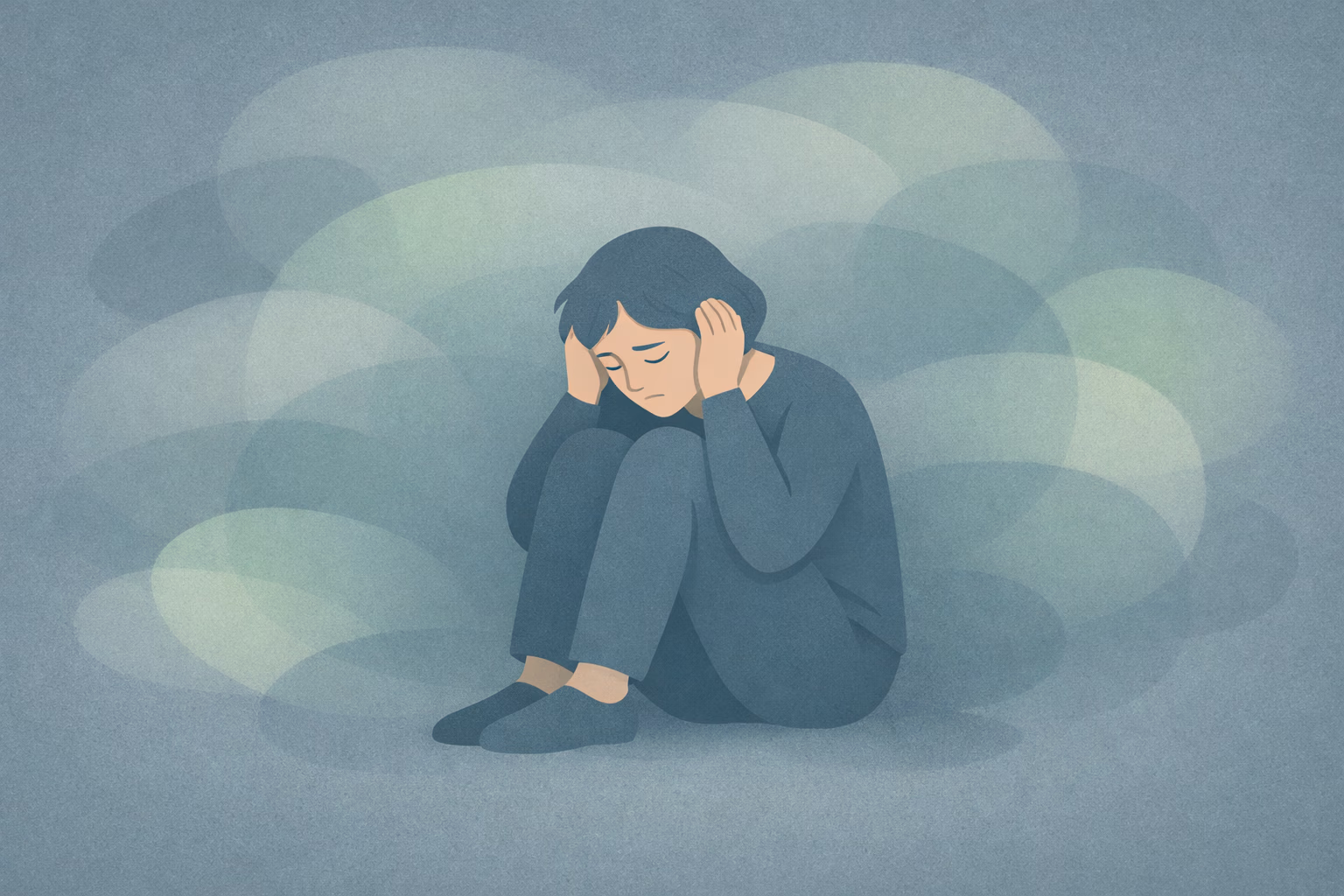
In short: Moments of emotional chaos can feel oddly physical: your mind splinters into fast fragments, your body gets loud or goes quiet, and your sense of “me” becomes hard to locate. In those moments, it’s common to assume something is wrong with you—when what’s actually happening is a protective shift in your nervous system’s operating mode.
Moments of emotional chaos can feel oddly physical: your mind splinters into fast fragments, your body gets loud or goes quiet, and your sense of “me” becomes hard to locate. In those moments, it’s common to assume something is wrong with you—when what’s actually happening is a protective shift in your nervous system’s operating mode.
What if “grounding” isn’t a technique to control emotions, but a way your system finds its way back to safety and coherence?
Emotional grounding, in this view, is not suppression and not performance. It’s the re-establishment of contact with stable signals—inside the body and in the immediate environment—so the threat cascade can downshift and the self can re-form around something steady.
Emotional chaos often arrives as a sudden loss of continuity. Attention stops moving smoothly and starts skipping: one thought, one image, one sentence, one remembered moment—each demanding a full-body response. It can feel like “too much is happening,” even if the room is quiet.
From a biological standpoint, this isn’t a character flaw. It’s a safety system reallocating resources toward scanning, rapid prediction, and immediate reaction—processes that prioritize survival over nuance. When that shift happens, your sense of self can feel temporarily “unpinned,” because selfhood depends on steadier pacing, reliable context, and a felt sense of safety. [Ref-1]
When the system is busy protecting you, it doesn’t spend as much energy maintaining a calm, continuous story.
Grounding is often described as “coming back to the present,” but what’s underneath that phrase is more specific: it’s a re-orientation of attention toward concrete, time-stamped sensory information. The nervous system treats immediate sensory cues as data—signals that help it decide whether mobilization is still necessary. [Ref-2]
This is why grounding can interrupt escalation even when the situation isn’t fully resolved. The system isn’t being argued out of distress; it’s being updated by contact with stable inputs. When attention returns to what is directly detectable (rather than what is rapidly simulated), the threat cascade has less fuel.
Not “What should I do?” but “What is actually here, right now?”
Stress biology is built around prediction. When the brain can’t confidently predict what’s happening—or what’s about to happen—it tends to increase arousal to prepare for multiple outcomes. That increase can show up as racing thoughts, agitation, urgency, or a frozen kind of stillness. [Ref-3]
Stable sensory contact functions like a reference point. When the body and environment provide consistent signals—temperature, pressure, sound, visual edges—those signals reduce ambiguity. Less ambiguity means less need for high alert. The goal is not to “feel better” on command; it’s that the system has enough reliable information to stand down.
When grounding begins to work, the first shift is often not emotional insight—it’s a change in intensity and tempo. Breathing may become less jagged. Muscles may soften in small areas. The mind may regain sequencing: one thought at a time, rather than all of them at once.
This downshift can happen quickly because autonomic patterns can change quickly when safety signals become available. In panic-like escalation, for example, the body can misread internal sensations as danger and amplify them; re-contact with steadier cues can reduce that feedback loop. [Ref-4]
In chaotic moments, many people default to control: clamp down, reason harder, fix the feeling, force calm. That impulse makes sense—control is a fast attempt to regain traction. But under acute stress load, top-down control can become another demand layered onto an already stressed system. [Ref-5]
Control also tends to keep the body in a “still on duty” state. Even if the face looks composed, the internal message can remain: this is not allowed or we must manage this immediately. The nervous system doesn’t interpret that as safety; it often interprets it as continued urgency.
Grounding is different in structure. It doesn’t depend on winning an internal argument. It relies on re-establishing contact with signals that don’t require effortful persuasion.
When emotions escalate, it isn’t only “a feeling.” It’s a disruption in meaning coherence—your system can’t easily tell what matters most, what is happening now, and what identity should be organizing the response. In that scramble, reactions can become bigger than your values, not because you don’t have values, but because the organizing signal temporarily drops out.
Grounding works like a reset in the meaning loop by restoring the most basic form of orientation: embodied presence. Interoceptive and sensory pathways link body state with emotional meaning; when those pathways regain clearer signal, experience becomes more organized and less chaotic. [Ref-6]
Coherence isn’t created by trying harder. It returns when enough of the system is no longer alarmed.
People often notice chaos only after it’s intense. But there are recognizable patterns that tend to appear when grounding is dropping out. These patterns are regulatory responses—ways the system copes when it can’t reach closure fast enough.
These signs don’t mean you’re broken. They usually mean the body–attention system is carrying more load than it can integrate in real time. Research connecting body awareness and emotion regulation helps explain why losing contact with bodily cues can intensify dysregulation rather than relieve it. [Ref-7]
When chaos happens repeatedly, the system can start treating internal shifts themselves as a warning sign: a faster heartbeat, a heavy chest, a blank mind, a surge of energy. Not because you’re “afraid of feelings,” but because previous episodes didn’t reach a clean “done” signal. Without closure, the body learns: this state leads somewhere unsafe.
Over time, that learning can make emotional states feel like traps. The system may respond by accelerating out of them (compulsions, distractions, overexplaining) or by dulling them (numbing, shutting down). These are not identities; they are strategies that reduce immediate load when integration hasn’t been possible.
Practices associated with mindfulness-based approaches are often studied for stress reduction; one plausible pathway is that repeated re-contact with present-moment signals reduces the sense that internal experience is inherently destabilizing. [Ref-8]
A nervous system is a prediction system. If dysregulation happens often enough—especially without recovery time—it may start preloading stress responses before anything “big” occurs. That can look like waking with dread, bracing before conversations, or feeling reactive in situations that used to be neutral.
This is not imagination and not weakness. It’s conditioned expectation: the body preparing for what it has repeatedly had to endure. Physiological rhythms (including breathing patterns and autonomic balance) influence how easily the system returns to baseline once activated. [Ref-9]
If your body is expecting overwhelm, it’s because overwhelm has been a frequent teacher—not because you’re failing a character test.
One of the quiet shifts that can occur with consistent grounding over time is not constant calm, but increased confidence in recoverability. The core message changes from “this will take me over” to “this can move through and resolve.” That is a meaning shift, but it is not just a thought—it’s a learned bodily expectation formed by repeated experiences of returning to steadier state.
Importantly, this is not the same as insight. Understanding why you escalate can be helpful, but it doesn’t automatically create the physiological “stand-down” that restores capacity. The settling happens when the loop completes: activation rises, safety cues arrive, and the system registers closure.
Trauma-informed research and clinical observations often emphasize that the body holds patterns of protection; stability grows as the system gains more experiences of safe completion, not as you pressure yourself into being unaffected. [Ref-10]
Humans regulate in relationship. A steady voice, a non-rushed presence, and predictable responsiveness can function as external safety cues—especially when your own internal cues are noisy. This isn’t dependence; it’s biology.
When someone is attuned, your nervous system can borrow their steadiness long enough for your own signals to reorganize. This is one reason why chaotic moments can feel worse in isolation: there are fewer stabilizing cues, fewer reminders of pacing, fewer anchors of continuity.
Work on trauma and memory highlights how stress states shape what is accessible and how experience is encoded; supportive context can reduce threat load and make stabilization more reachable. [Ref-11]
As grounding and stabilization become more available, people often notice practical changes: perception sharpens, time feels more linear, and decisions become easier to sequence. The world becomes less “all at once.” This is not a personality makeover; it’s what happens when load decreases and the system can process signals in order again.
Coherence has a particular flavor. It can feel like being back in your own body, back behind your eyes, back in the room. Not necessarily happy—just organized. Social buffering research suggests that supportive contexts can measurably reduce stress responses, helping the system return to a steadier baseline. [Ref-12]
When you’re ungrounded, the system tends to select options that rapidly reduce threat load: escape, argue, appease, numb, control. These choices aren’t irrational; they are fast solutions in a narrow bandwidth state.
When grounding returns, bandwidth returns. That increased capacity is where values become usable again—not as motivational slogans, but as an organizing signal for what matters. Safety-signal research helps explain why cues of safety can inhibit fear responses and reopen flexible responding. [Ref-13]
In a stabilized state, you don’t become a different person—you regain access to the parts of you that were offline.
Emotional grounding is sometimes talked about like a “coping skill,” but it can be understood more respectfully: it’s the process of reclaiming your center when conditions have pushed your system past coherence. In moments of chaos, the goal is not to perform calmness—it’s to reestablish enough safety and orientation for the self to re-form.
When this framing lands, shame often softens. Chaos stops meaning “I’m unstable,” and starts meaning “my system is overloaded and seeking closure.” That shift doesn’t solve everything, but it restores dignity—and dignity is a powerful stabilizer.
Broader overviews of nervous system regulation emphasize that regulation is not about erasing stress, but about supporting return—again and again—until return becomes more available. [Ref-14]
Grounding is not stepping away from life. It’s the return to the internal place where life can be met without being swallowed by it.
Over time, that return can become part of identity: not “I never get overwhelmed,” but “I can come back.” And when the body trusts that coming back is possible, it spends less energy bracing against the next wave.
Research on self-attunement and restored self-trust aligns with this arc: steadiness grows when your system repeatedly experiences you as a reliable place to land. [Ref-15]
From theory to practice — meaning forms when insight meets action.
It's re-orienting attention toward concrete, time-stamped sensory information — the floor under your feet, the temperature of the air, the edges of an object. The Threat & Safety System treats those immediate sensory cues as data, signals that help it decide whether mobilization is still necessary. Grounding doesn't argue with distress; it updates the system through contact with stable inputs. When attention returns to what is directly detectable rather than what is rapidly simulated, the threat cascade loses fuel. Not 'what should I do' but 'what is actually here, right now.' That's why it can interrupt escalation even before the situation resolves.
Because it's a Power Loop trap. Forcing calm tells your Threat & Safety System that the current state is unacceptable, which adds pressure on top of pressure. Top-down control under acute load becomes another demand on an already stressed system. The face may look composed while the internal message remains 'this isn't allowed' or 'we must manage this immediately' — which the body reads as continued urgency, not safety. Grounding works differently. It supplies present-moment evidence the body can verify, so calm arrives as a byproduct of cues. Calm doesn't get argued into existence; it arrives when the system has enough reliable information to stand down.
Recognizable patterns appear when grounding drops out. Overwhelm — too many inputs, no prioritization, urgency without a clear task. Emotional flooding — sensations and thoughts arriving as one undifferentiated wave. Panic-like activation — breath changes, racing heart, fear of what the body is doing. Dissociation or numbness — muted sensation, unreality, not quite here. Loss of orientation — forgetting why you walked into a room, losing track of time. These aren't moral failures or character defects; they're regulatory responses when the body-attention system carries more load than it can integrate in real time. They're signs the window of tolerance has narrowed.
Through repeated experiences of safe completion. The shift isn't constant calm — it's increased confidence in recoverability. The core message changes from 'this will take me over' to 'this can move through and resolve.' That's a learned bodily expectation formed by repeated cycles where activation rises, safety cues arrive, and the system registers closure. Co-regulation matters: a steady voice and non-rushed presence supply external safety cues your noisy internal system can borrow. Over time, identity reorganizes around 'I can come back,' not 'I never get overwhelmed.' When the body trusts return is possible, it stops bracing against the next wave.
From Science to Art.
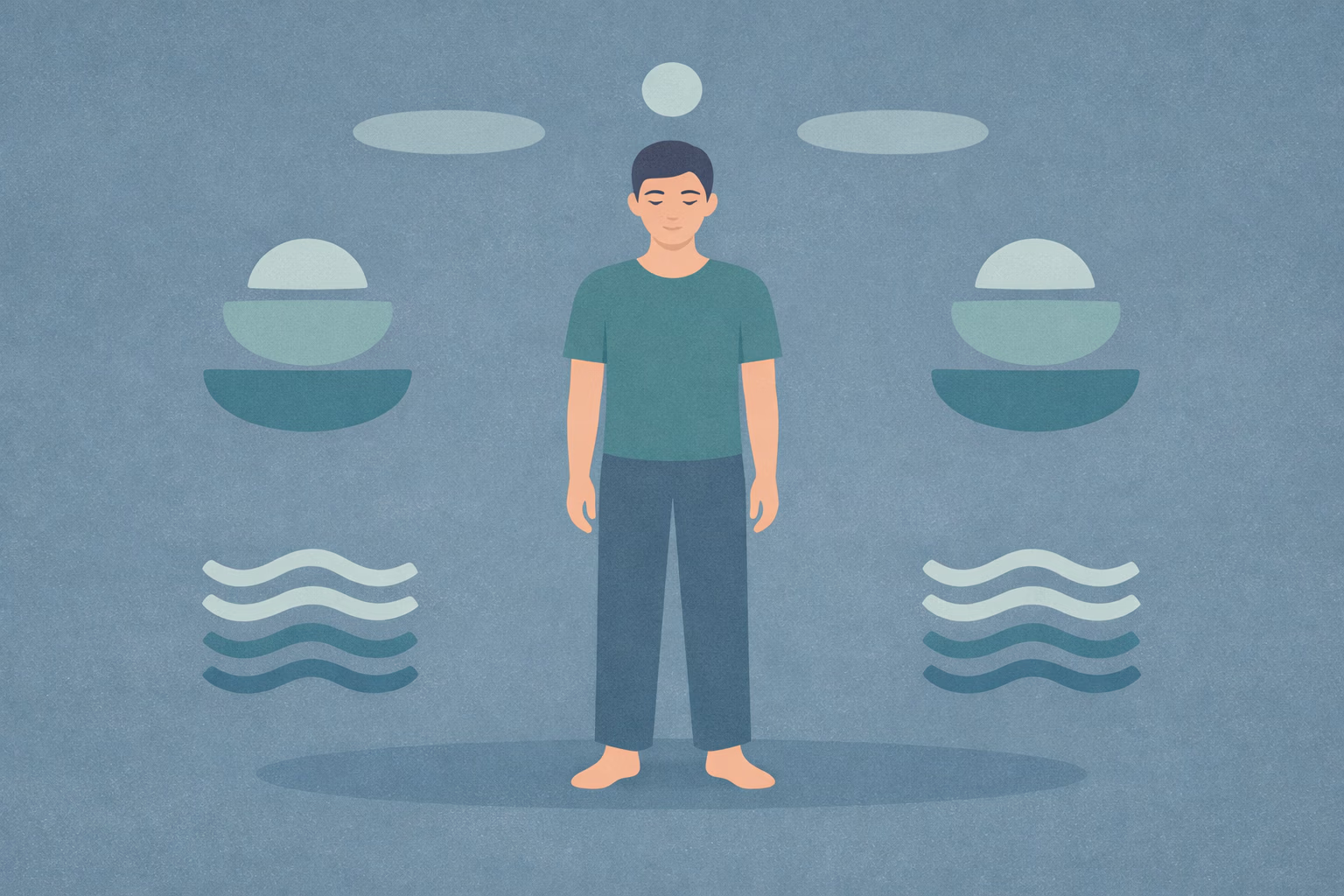
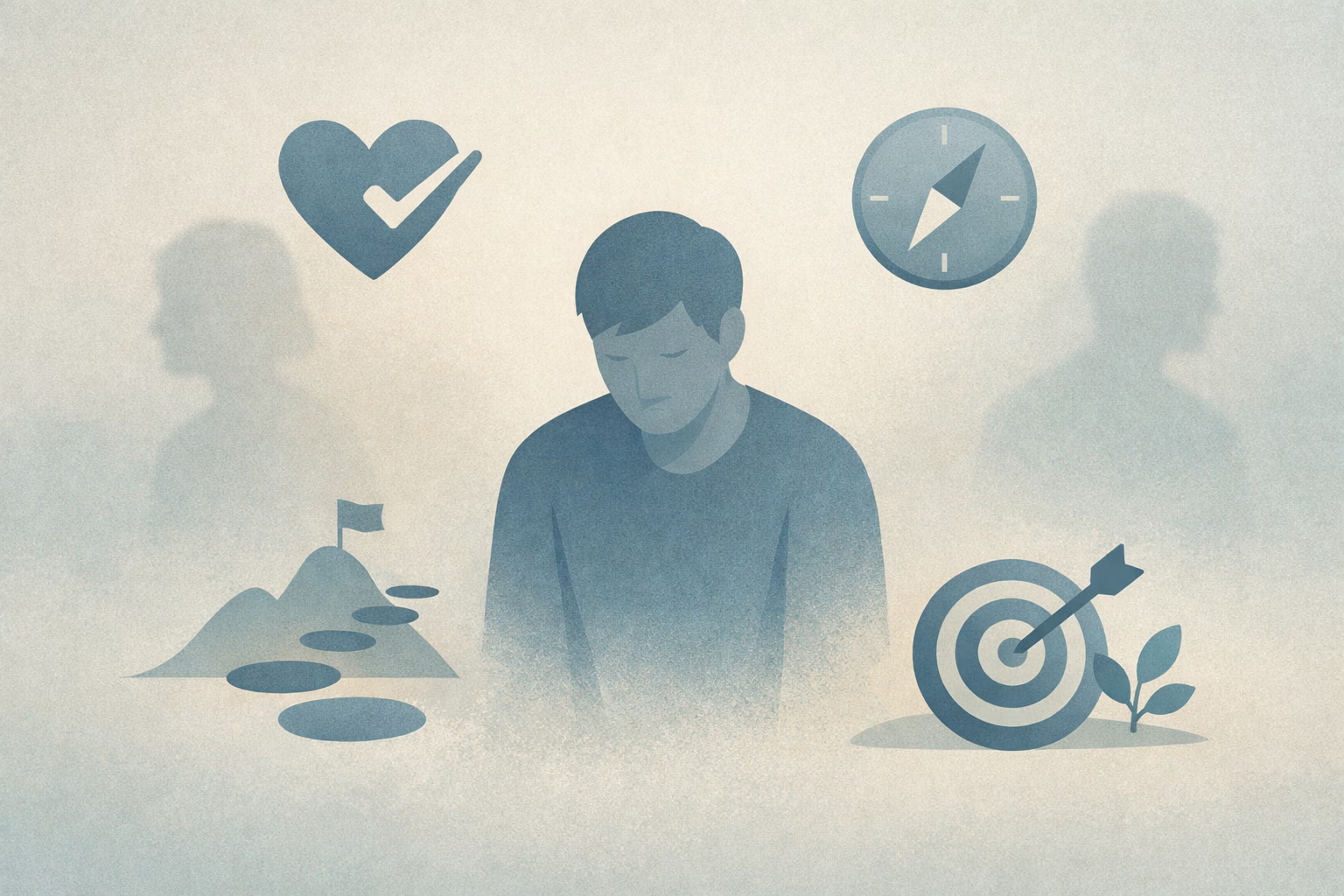
Understanding explains what is happening. Art allows you to feel it—without fixing, judging, or naming. Pause here. Let the images work quietly. Sometimes meaning settles before words do.
One Quiet Window, one insight, one reflection — every Sunday