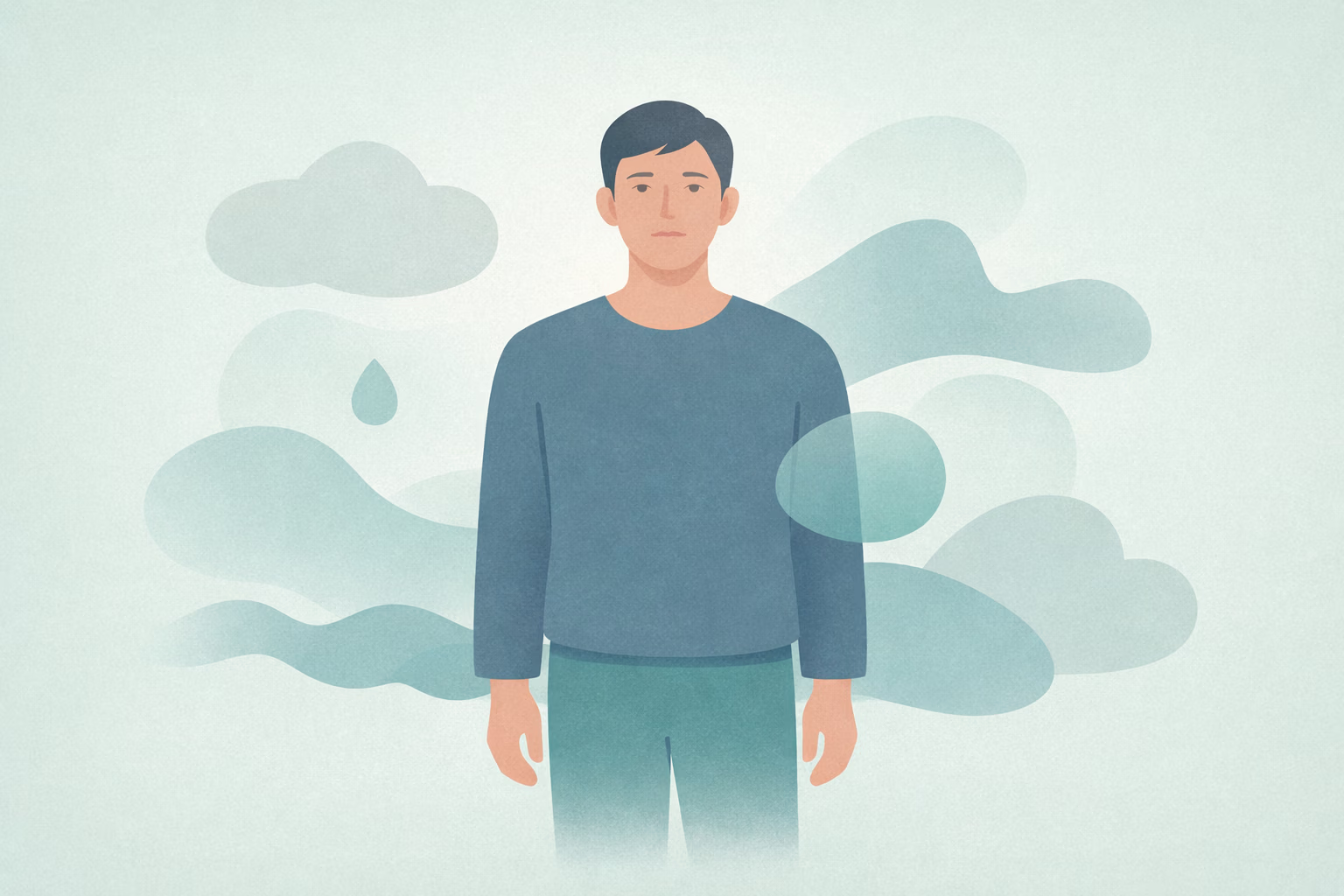
Emotional Maturity: The Skill of Feeling Without Escaping

In short: Many people don’t fear emotion itself—they fear what emotion seems to do to their stability. A wave of grief can feel like it will erase the rest of life. A burst of anger can feel like it will rewrite who you are.
Many people don’t fear emotion itself—they fear what emotion seems to do to their stability. A wave of grief can feel like it will erase the rest of life. A burst of anger can feel like it will rewrite who you are. Even joy can feel risky if your system has learned that intensity equals fallout.
In that context, “staying regulated” can start to look like keeping everything at a distance. Not because you are unwilling to feel, but because your body has learned that certain feelings arrive without a clear endpoint.
What if the goal isn’t to feel less, but to let feeling complete—so your system can stand down?
When emotions have previously come with consequences—conflict, collapse, shame, confusion—the nervous system can treat emotional activation as a destabilizing event rather than useful information. In those conditions, the protective move isn’t “avoidance because fear,” it’s a structural attempt to prevent a surge from turning into a spiral.
It can feel like there are only two settings: contained and functional, or flooded and fragmented. That binary isn’t a personality trait; it’s a sign that the system hasn’t been getting reliable completion signals after activation. Without completion, the body keeps preparing for “more.” [Ref-1]
When emotion doesn’t come with an ending, the nervous system treats it like an open tab.
Emotional integration isn’t the same as insight, analysis, or being able to name what you feel. It’s not even the same as “allowing” emotion. Integration is what happens when emotional activation can move through the body while the system maintains enough stability to register context, consequence, and resolution.
Biologically, emotion is inseparable from body state: breath, heart rate, gut signals, muscle readiness, temperature shifts. When those signals can be held within a tolerable range, the brain can link them to time (“this is happening now”), to meaning (“this matters because…”), and to identity (“this fits with who I am and what I value”). [Ref-2]
Without that linkage, emotion becomes either raw intensity or forced management—neither one delivers closure.
Emotions evolved to help organisms orient, prioritize, connect, and protect. They mobilize energy for action and then—when the situation resolves—allow a return to baseline. The return is not a moral achievement; it’s a biological “done” signal.
Stress research consistently shows that when activation becomes chronic or contextless, regulation gets harder: arousal runs high, attention narrows, and the system becomes more reactive to smaller cues. That shift is less about “being sensitive” and more about prolonged load without completion. [Ref-3]
Integration, in this frame, is the nervous system getting to finish what it started: mobilize, orient, respond, and settle.
Suppressing, intellectualizing, or compartmentalizing emotions often works in the short term because it reduces immediate activation. It creates a kind of artificial closure: the body receives a message that expression is off-limits, attention moves away, and the day continues.
But the nervous system doesn’t necessarily interpret that as true completion. If the underlying loop remains unresolved—if the social rupture wasn’t repaired, the loss wasn’t metabolized, the boundary wasn’t established—activation can persist underneath the surface, showing up as tension, irritability, fatigue, or sudden surges that seem to come “out of nowhere.” [Ref-4]
So the strategy is understandable: it buys function. The cost is that the internal pressure can quietly rise because the system never fully stands down.
Emotional flooding can look like “feeling fully,” but it often lacks the key ingredient of integration: a stable enough platform for the experience to complete. Flooding is high activation without sufficient orientation—too much signal, too little containment.
In flooding, the body can behave as if the event is still occurring. Sensations and images can override time, and the system may struggle to locate “here and now.” In that state, emotion doesn’t resolve; it repeats. [Ref-5]
Integration is quieter than flooding. It’s the difference between being taken over by a wave and feeling the wave move through while you remain connected to context, relationship, and choice.
When emotional activation doesn’t complete, many people end up in an oscillation. On one side is overwhelm: too much arousal, too fast. On the other side is avoidance: not a psychological refusal, but a structural bypass that reduces immediate load and postpones consequence.
The loop can become self-reinforcing because each side makes sense in the moment. Overwhelm signals “this is too big,” and the system clamps down. Avoidance provides relief, but relief isn’t completion—so the activation returns, often stronger or more diffuse. [Ref-6]
What looks like inconsistency is often the nervous system searching for an endpoint.
Non-integration doesn’t always look dramatic. Often it looks like subtle, persistent management—small maneuvers meant to keep activation from tipping into chaos. These patterns are not identities; they’re regulatory responses under load. [Ref-7]
Each of these can be understood as the system trying to stay intact when it doesn’t trust the arc of activation → completion.
When a nervous system repeatedly blocks or reroutes emotion to prevent overwhelm, it can also reduce access to the fuller spectrum of experience. The goal becomes “stay manageable,” and the body learns to pre-empt intensity—whether the intensity is painful or beautiful.
Over time, this can affect resilience and meaning. Not because you “refuse feelings,” but because meaning emerges when experiences are allowed to reach a settled conclusion and become part of lived identity. Chronic suppression is associated with increased physiological strain and reduced well-being, in part because the body stays engaged in effortful management rather than resolution. [Ref-8]
In a narrowed range, life can start to feel flat or overly effortful: fewer moments land, fewer experiences feel complete, and motivation has to do the work that coherence used to do.
Emotions tend to recur when their original sequence was interrupted: activation without completion, signal without response, rupture without repair, loss without integration into the story of “what now.” Repetition isn’t pettiness or weakness. It’s how nervous systems keep a priority item available until it can be resolved.
Importantly, repetition doesn’t stop just because you understand the emotion cognitively. Understanding can be useful orientation, but integration is the body recognizing completion—less urgency, fewer rebound spikes, more capacity for the signal to rise and fall without rearranging the whole self.
Practices associated with body-aware regulation often emphasize this link between present-moment physiological cues and emotion regulation, supporting the conditions under which completion can occur. [Ref-9]
One of the most stabilizing reframes is subtle: emotions are not problems to solve; they are sequences to complete. Completion is not intensity. It’s pacing, context, and enough safety cues for the nervous system to stay online while the experience runs its course.
Words like grounding, pacing, and reflection point to conditions rather than commands. They describe what tends to be present when integration happens: a slower tempo, less evaluation, fewer simultaneous demands, and more room for the body to register “that happened, and now it is ending.” Psychological flexibility research similarly highlights the role of adaptability in relating to internal experiences without getting stuck in rigid control or collapse. [Ref-10]
Stability isn’t the absence of emotion. It’s the presence of enough coherence for emotion to finish.
Humans are social regulators. Many emotions—especially grief, shame, fear, tenderness—were designed to be processed in connection, not in isolation. This isn’t about depending on others for rescue; it’s about how the body recognizes safety through cues of attunement.
When another person can stay present without escalating, dismissing, or trying to control the outcome, the nervous system often finds it easier to move through activation and reach closure. Attachment and emotion regulation research describes how responsive presence supports regulation capacity, especially under stress. [Ref-11]
Even brief moments of being accurately “met” can reduce the sense that emotion equals danger, because the system receives evidence that activation can occur without relational rupture.
When integration becomes more available, people often describe not “more emotion,” but more steadiness around emotion. The signal can rise, communicate, and fall—without commandeering the whole day or collapsing the sense of self.
This is emotional solidity: not hardness, but structural integrity. Stress-buffering research shows that supportive conditions reduce physiological stress responses and help restore baseline more efficiently. [Ref-12]
Coherence is recognizable because it creates a quieter kind of confidence: the body expects completion.
Integrated emotions don’t disappear; they change function. Anger becomes boundary information rather than a threat. Sadness becomes an honoring of attachment rather than an undertow. Fear becomes a cue for preparation rather than a mandate to shrink.
As experiences integrate, they also feed identity in a stabilizing way: “This happened, it mattered, and I know what it means for how I live.” That kind of narrative coherence reduces fragmentation because it links feeling to values and next-right orientation, not to shame or urgency.
Research on self-compassion points toward a stance that supports resilience and steadier self-relating, which can make emotional information easier to hold without turning it into self-attack. [Ref-13]
Emotional integration is not a performance of insight and not a demand to be endlessly expressive. It’s the quiet biological and identity-level reality of experiences reaching completion—so they can take their place in your life story without continually reopening.
When feelings can be meaningfully held, they stop needing to shout. Agency returns not through pressure, but through coherence: the sense that your inner signals connect to your values, your relationships, and your sense of self in a way that actually resolves. Narrative identity research describes how meaning is constructed as experiences are organized into a coherent self-story over time. [Ref-14]
That is what “feeling fully without losing stability” can point to: not more intensity, but more completion.
If your system has treated emotion as dangerous, that learning likely came from real conditions—too much, too fast, too alone, or too unresolved. The move to contain was an intelligent attempt to stay intact.
Over time, stability becomes less about keeping emotion away and more about trusting your capacity to hold experience until it completes. Not perfectly, not constantly—just enough that the nervous system can recognize an ending and return. As self-attunement strengthens, self-trust tends to restore in practical, embodied ways. [Ref-15]
You don’t have to choose between depth and steadiness. Coherence is what makes room for both.
From theory to practice — meaning forms when insight meets action.
Integration isn't insight, analysis, or being able to name what you feel — and it's not the same as allowing emotion. Integration is what happens when emotional activation can move through the body while the system maintains enough stability to register context, consequence, and resolution. Emotion is inseparable from body state: breath, heart rate, muscle readiness. When those signals stay within a tolerable range, the brain can link them to time (this is happening now), meaning (this matters because), and identity (this fits who I am). Without that linkage, emotion becomes either raw intensity or forced management — neither delivers closure. Integration is activation plus regulation plus meaning together.
When emotions previously came with consequences — conflict, collapse, shame — the nervous system can treat emotional activation as destabilizing rather than informative. The protective move isn't avoidance because of fear; it's a structural attempt to prevent a surge from becoming a spiral. It can feel like there are only two settings: contained and functional, or flooded and fragmented. That binary isn't a personality trait; it's a sign the system hasn't been getting reliable Done Signals after activation. When emotion doesn't come with an ending, the Threat & Safety System treats it like an open tab and keeps preparing for more.
When emotional activation doesn't complete, many people end up oscillating. On one side: overwhelm — too much arousal, too fast. On the other: avoidance — not psychological refusal but a structural bypass that reduces immediate load and postpones consequence. The loop becomes self-reinforcing because each side makes sense in the moment. Overwhelm signals this is too big and the system clamps down. Avoidance provides relief, but relief isn't completion — so activation returns, often stronger or more diffuse. What looks like inconsistency is often the nervous system searching for an endpoint. Loop Sovereignty here begins with recognizing the oscillation as a search, not a flaw.
People often describe not more emotion, but more steadiness around emotion. Signals can rise, communicate, and fall without commandeering the whole day or collapsing the sense of self. This is solidity — not hardness, but structural integrity. Less fear of the next wave because waves have ended before. More room for nuance (two feelings can exist at once). Cleaner transitions after difficult moments. A stronger sense of I'm still me even when activated. Integrated emotions change function: anger becomes boundary information, sadness becomes honouring of attachment, fear becomes preparation. Co-regulation through attuned presence speeds this — the body learns activation can occur without relational rupture.
From Science to Art.
Understanding explains what is happening. Art allows you to feel it—without fixing, judging, or naming. Pause here. Let the images work quietly. Sometimes meaning settles before words do.
One Quiet Window, one insight, one reflection — every Sunday