Trauma Responses in Daily Life: Signs You Don’t Notice
In short: Many people know the experience: your body reacts before your mind can make sense of it. Your chest tightens in a meeting that seems ordinary. You feel a surge of urgency while reading a neutral message.
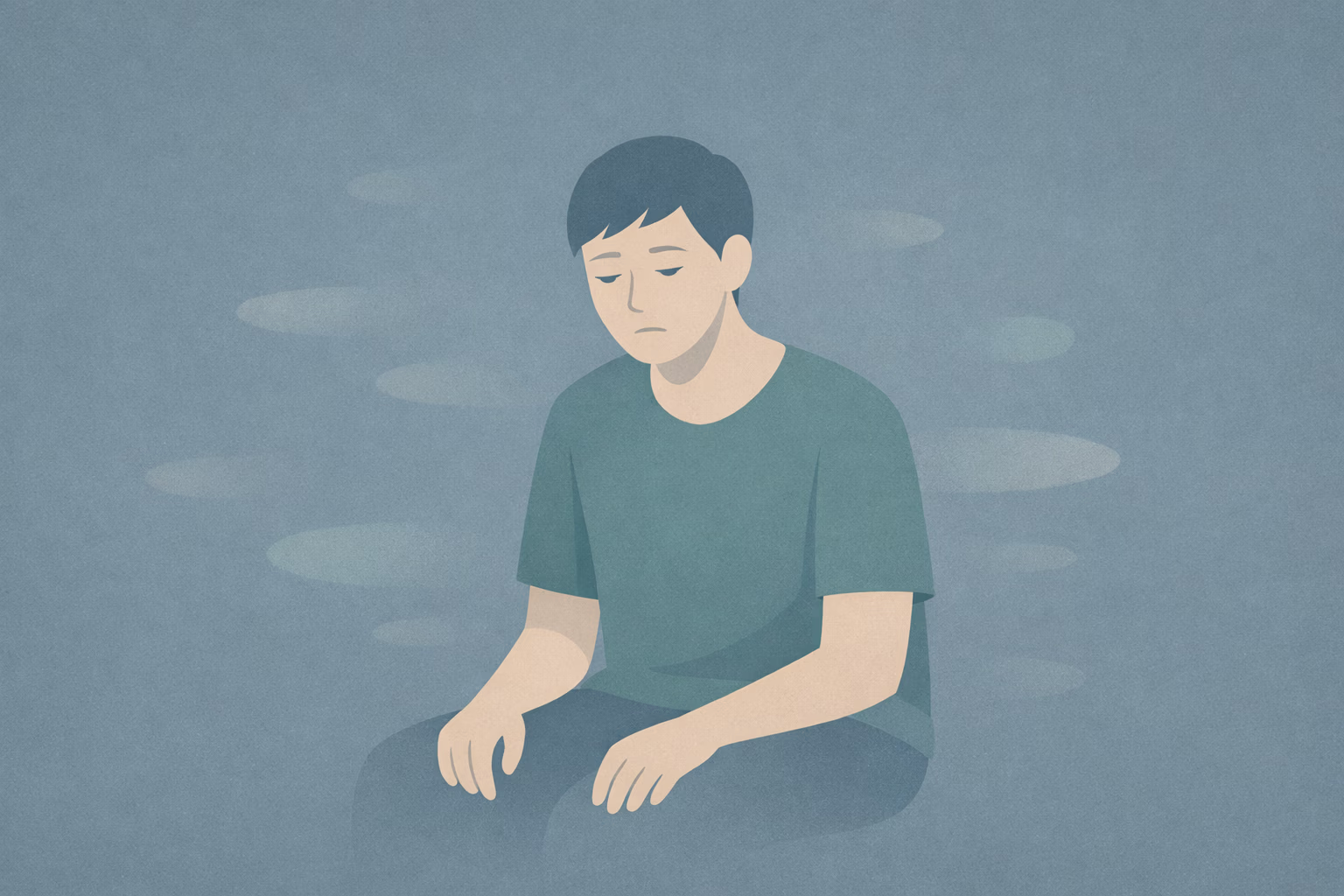
Many people know the experience: your body reacts before your mind can make sense of it. Your chest tightens in a meeting that seems ordinary. You feel a surge of urgency while reading a neutral message. You go numb during a conversation you actually care about.
What if the reaction isn’t “irrational”—but simply older than your words?
Emotional memory is one way the nervous system carries what wasn’t fully completed at the time. Even when conscious recall is faint or absent, the body can still hold patterns of readiness, protection, or shutdown. This isn’t a sign that you’re broken; it’s often evidence that your system learned quickly, under pressure, and kept the learning available.
A strong reaction without a clear reason can create a particular kind of distress: confusion layered with self-doubt. People often describe it as “I don’t know what’s wrong with me,” even when nothing is actually wrong—something is simply happening faster than conscious interpretation.
Because the reaction feels immediate, it can also feel like identity. Not “I had a stress response,” but “I am too much,” “I’m unstable,” or “I can’t handle things.” That slide from event to identity is one of the quiet ways shame takes hold. Yet many of these moments are better understood as the nervous system applying stored protection in the present. [Ref-1]
“I’m not choosing this reaction. It’s like my body decided before I even arrived.”
Human memory isn’t one single system. Alongside autobiographical memory (the kind you can describe), there are implicit pathways that store patterns: sensations, reflexes, body postures, orienting responses, and “this is safe / this is not safe” tags. These can be learned with little language and retrieved with little language. [Ref-2]
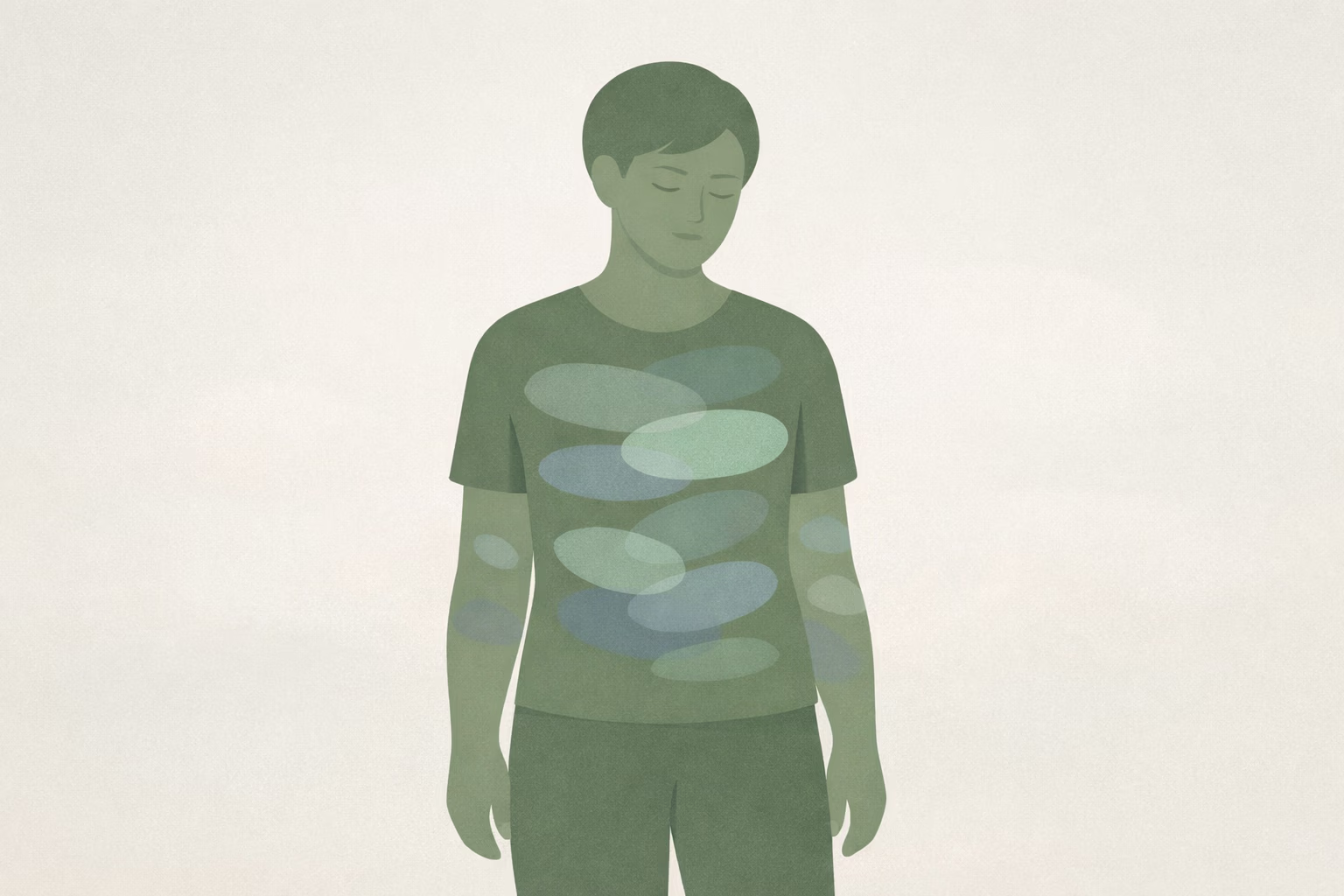
In emotional memory, the “data” is often physiological. A certain facial expression, tone of voice, smell, or social dynamic can cue a body response—heart rate shifts, muscle tension, stomach changes, heat, cold, or a sudden drop in energy—without producing a clear picture of the original context. The body doesn’t need the full story to initiate protection; it only needs a match to a stored pattern.
From an evolutionary angle, rapid learning kept organisms alive. When something carried threat or high consequence, it made sense to encode it strongly and retrieve it quickly later. Emotion amplifies memory systems because it marks information as important for survival, not because it’s “dramatic.” [Ref-3]
This is why highly charged moments can leave strong residues even when the timeline is fuzzy. Under high arousal, attention narrows and the brain prioritizes action and detection over reflection. The body becomes the primary recorder: “When X happens, prepare.”
Many protective reactions happen before conscious evaluation. This is not a character issue; it’s architecture. The nervous system is designed to respond first and explain later, because in true danger, waiting for a thoughtful narrative would be costly. [Ref-4]
So the body may mobilize (speed up, brace, scan), immobilize (freeze, go blank), or shift into social management (people-pleasing, over-agreeing) as a fast route to safety. These are not “bad habits” in the moral sense. They are shortcuts that once reduced risk—and may still be running even when the present situation does not require them.
It’s common to assume that forgetting equals resolution. But the nervous system doesn’t measure completion by recall. It measures completion by closure: whether the experience reached a settled endpoint that signaled “done.” When closure is missing, the body may keep a partial response on standby.
Research on somatic markers describes how bodily signals can guide decisions and behavior outside of conscious reasoning, especially when rapid evaluation is needed. In daily life, this can look like an unexplained “no,” a sudden urge to leave, or an instant sense of danger that arrives without an accessible story. [Ref-5]
When emotional memory is active, the system can start to rely on automatic protection rather than present-time processing. Not because someone is “avoiding feelings,” but because the body is prioritizing efficiency: it runs a known pattern to reduce uncertainty and load.
This is how an avoidance loop forms structurally. The body’s fast reaction produces relief or distance (leaving, shutting down, controlling, scrolling, numbing). That relief acts like a “worked” signal, even if it also prevents completion. The loop stays incomplete, so the imprint remains available for the next similar cue. Implicit emotional learning supports this kind of repetition without conscious intention. [Ref-6]
In other words: the loop repeats not because you lack insight, but because the system never receives a true “done” signal.
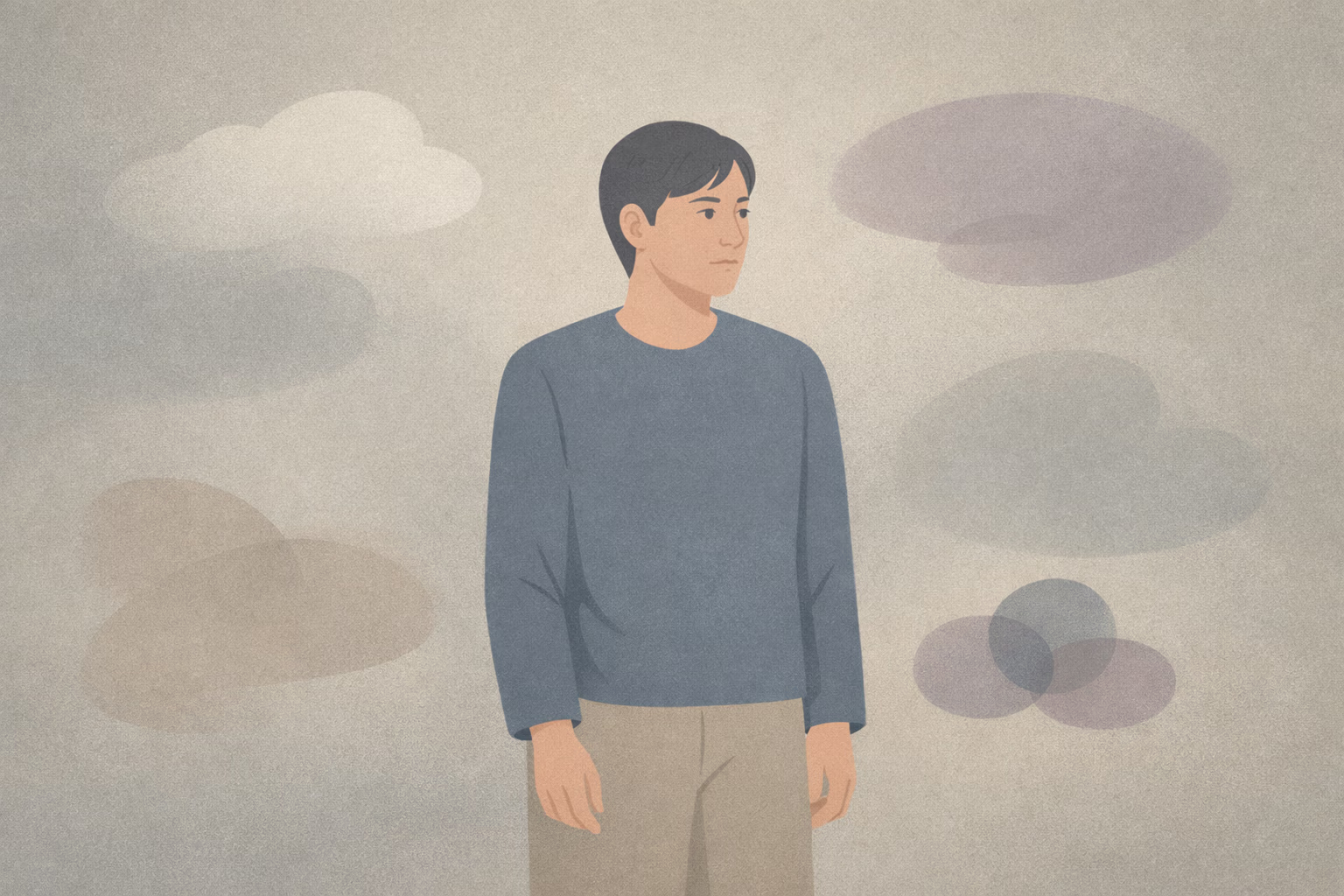
Emotional memory often shows up less as a clear recollection and more as a mismatch: your reaction doesn’t fit the current moment’s actual stakes. This can be unsettling, especially if you’ve been told to “just let it go.”
Some recognizable patterns include: [Ref-7]
These are not proof of fragility. They are often proof of learning under pressure—learning that is still being applied.
When the body is running an old pattern, it narrows the field of options. Attention becomes less flexible, not because you’re unwilling to be present, but because interoceptive signals (internal body cues) are loud and insistent. The system organizes around regulation first. [Ref-8]
In that narrowed state, choices can start to look like only two lanes: escape or control. You may find yourself over-explaining, over-working, withdrawing, complying, numbing, or seeking quick relief. The important point is structural: when the nervous system is loaded, it prioritizes immediate stabilization over nuance.
People often ask, “Why do I understand this, but my body still does it?” Because understanding and integration are not the same process. Reflection can create a good map, but if the body remains in a protective state, the map doesn’t become a stand-down signal.
When autonomic pathways detect threat, the system can shift into modes where social engagement and flexible thinking are less available. In those states, the body may prioritize scanning, bracing, or shutting down—and the reaction can bypass the pause where meaning gets updated. [Ref-9]
This is one reason emotional memory can persist even in highly self-aware people: the imprint is stored in circuits designed to move before language.
A quieter, more stabilizing frame is to treat these reactions as information about load and incomplete closure rather than evidence of defect. “My body is remembering” is different from “I’m overreacting.” The first keeps dignity intact and makes room for coherence.
When stress is chronic, the nervous system can become more easily triggered and slower to return to baseline. This doesn’t mean you’re failing; it means your adaptive range is being asked to do too much for too long. Over time, the body keeps protective patterns closer to the surface because it’s expensive to rebuild safety from scratch each time. [Ref-10]
“My reactions make more sense when I remember they were built to protect me, not to impress anyone.”
Humans regulate in relationship. When another person is reliably present—attuned, non-escalating, non-shaming—the nervous system receives safety cues that are difficult to generate through pressure alone. Over time, this can reduce allostatic load: the cumulative wear of repeated activation without enough recovery. [Ref-11]
Being witnessed also provides context. Not as a forced “reframe,” but as an environment where the body can register, through repeated experience, that present-time contact does not automatically lead to danger. That repeated contact can help protective responses lose their job description.
When an old imprint begins to settle, the change is often practical and specific. Not constant calm, not permanent clarity—more like increased capacity to pause. The same trigger may still register, but it doesn’t take over the whole system.
People often describe signs of restored self-trust as: more accurate timing, less urgency, fewer “spikes,” and a clearer sense of what matters in the moment. It can feel like your body is no longer obligated to relive the past in order to keep you safe. [Ref-12]
Unintegrated emotional memory pulls attention backward: the system keeps checking for repetitions of what once hurt. As closure develops, the body no longer needs to allocate so much energy to prediction and defense. That freed capacity can return to exploration, connection, and future planning.
This shift is not just mental optimism—it’s physiological permission to reorient. When stress is buffered by reliable social and environmental safety cues, regulation becomes easier and the future becomes thinkable again. [Ref-13]
Coherence often feels like this: the present moment carries enough safety and meaning that the past doesn’t have to keep interrupting.
Emotional memory is often evidence of resilience: your system learned, adapted, and kept the learning available. The problem is rarely that the body “won’t let go.” The problem is that modern life offers many activations and few completions—many cues and few real endpoints.
A non-shaming stance changes the whole landscape. Instead of battling your responses, you can hold them as signals of an organism doing its best under load. Self-compassion isn’t indulgence here; it’s a way of removing extra threat from the system so closure can become possible. [Ref-14]
“If my body learned this, my body can also learn that it’s over.”
You don’t have to remember everything for your system to move toward completion. What matters is not perfect insight, but the gradual return of a “done” signal—an identity-level settling where old protections are no longer required in the same way.
What your body remembers is not a life sentence. It’s a record of how you stayed intact. And with enough safety, support, and coherence, the present can become less of a reenactment and more of a direction. [Ref-15]
From theory to practice — meaning forms when insight meets action.
Human memory isn't one system. Alongside autobiographical memory, implicit pathways store patterns: sensations, reflexes, body postures, this is safe / this is not safe tags. These can be learned with little language and retrieved with little language. A certain tone of voice, smell, or social dynamic can cue heart rate shifts, muscle tension, or a sudden drop in energy without producing a clear picture of the original context. The body doesn't need the full story to initiate protection — only a match to a stored pattern. Your reaction isn't irrational; it's just older than your words. The Threat & Safety System is applying stored protection in the present.
It's common to assume forgetting equals resolution, but the nervous system doesn't measure completion by recall — it measures completion by closure. Whether the experience reached a settled endpoint that signalled done. When closure is missing, the body keeps a partial response on standby. Somatic markers can guide decisions and behaviour outside conscious reasoning, especially when rapid evaluation is needed. In daily life this looks like an unexplained no, a sudden urge to leave, or an instant sense of danger that arrives without an accessible story. The body learned quickly under pressure and kept the learning available — that's resilience, not malfunction.
People often ask why they understand a pattern but their body still does it. Because understanding and integration aren't the same process. Reflection creates a good map, but if the body remains in a protective state, the map doesn't become a stand-down signal. When autonomic pathways detect threat, the system shifts into modes where social engagement and flexible thinking are less available. The reaction bypasses the pause where meaning gets updated. This is why emotional memory persists even in highly self-aware people — the imprint is stored in circuits designed to move before language. Integration requires safety cues the body can verify, not arguments it can follow.
Co-regulation. Humans regulate in relationship: when another person is reliably present — attuned, non-escalating, non-shaming — the nervous system receives safety cues that are difficult to generate through pressure alone. Over time this reduces allostatic load. Being witnessed also provides context — not as a forced reframe, but as repeated experience that present-time contact does not automatically lead to danger. As old imprints settle, the same trigger may still register but it doesn't take over the whole system. More room between cue and response, less need to explain yourself to earn safety, a quieter baseline that returns more easily after stress. If your body learned this, your body can also learn that it's over.
From Science to Art.
Understanding explains what is happening. Art allows you to feel it—without fixing, judging, or naming. Pause here. Let the images work quietly. Sometimes meaning settles before words do.
One Quiet Window, one insight, one reflection — every Sunday