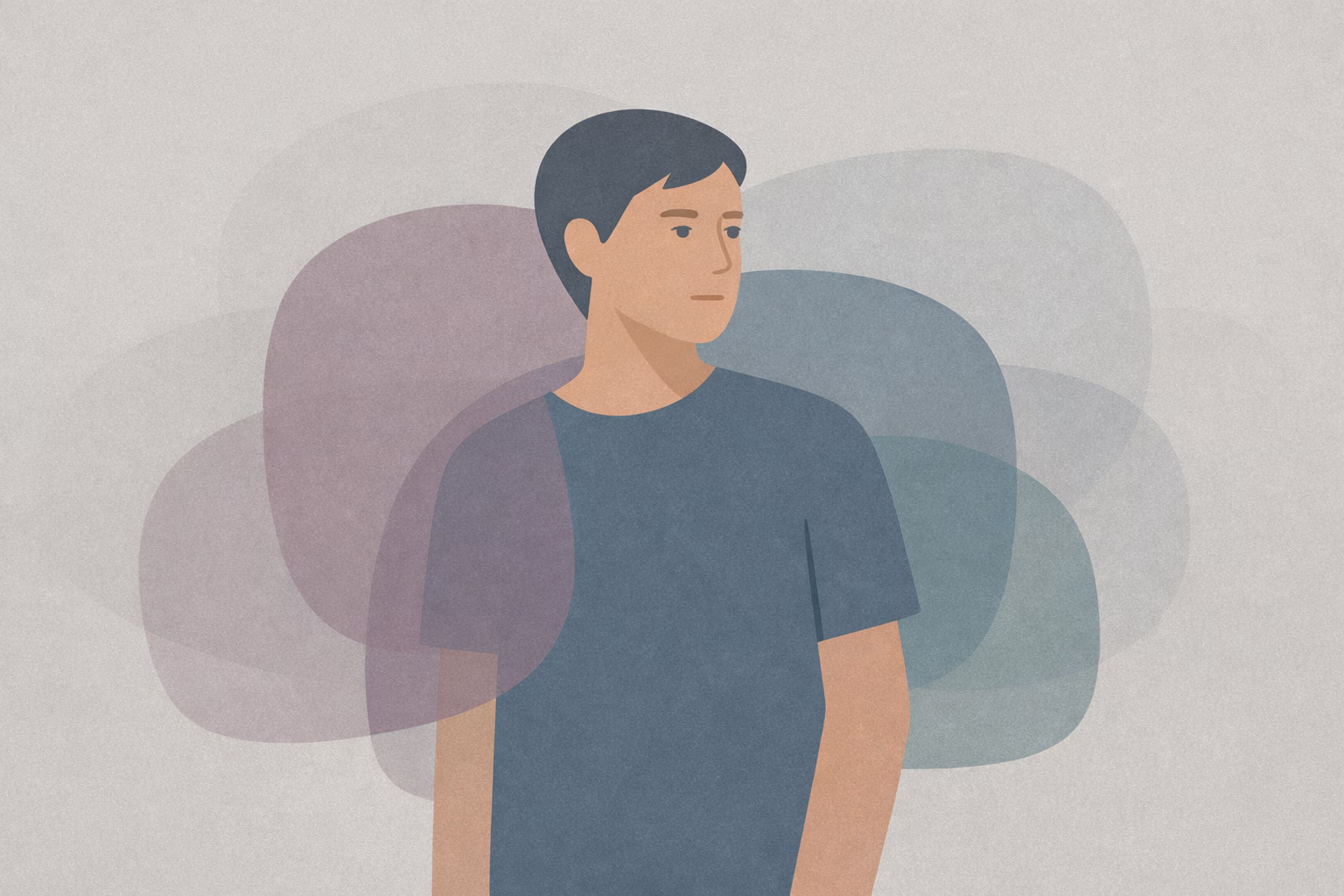
Mixed Emotions & Inner Confusion: Understanding Ambivalence
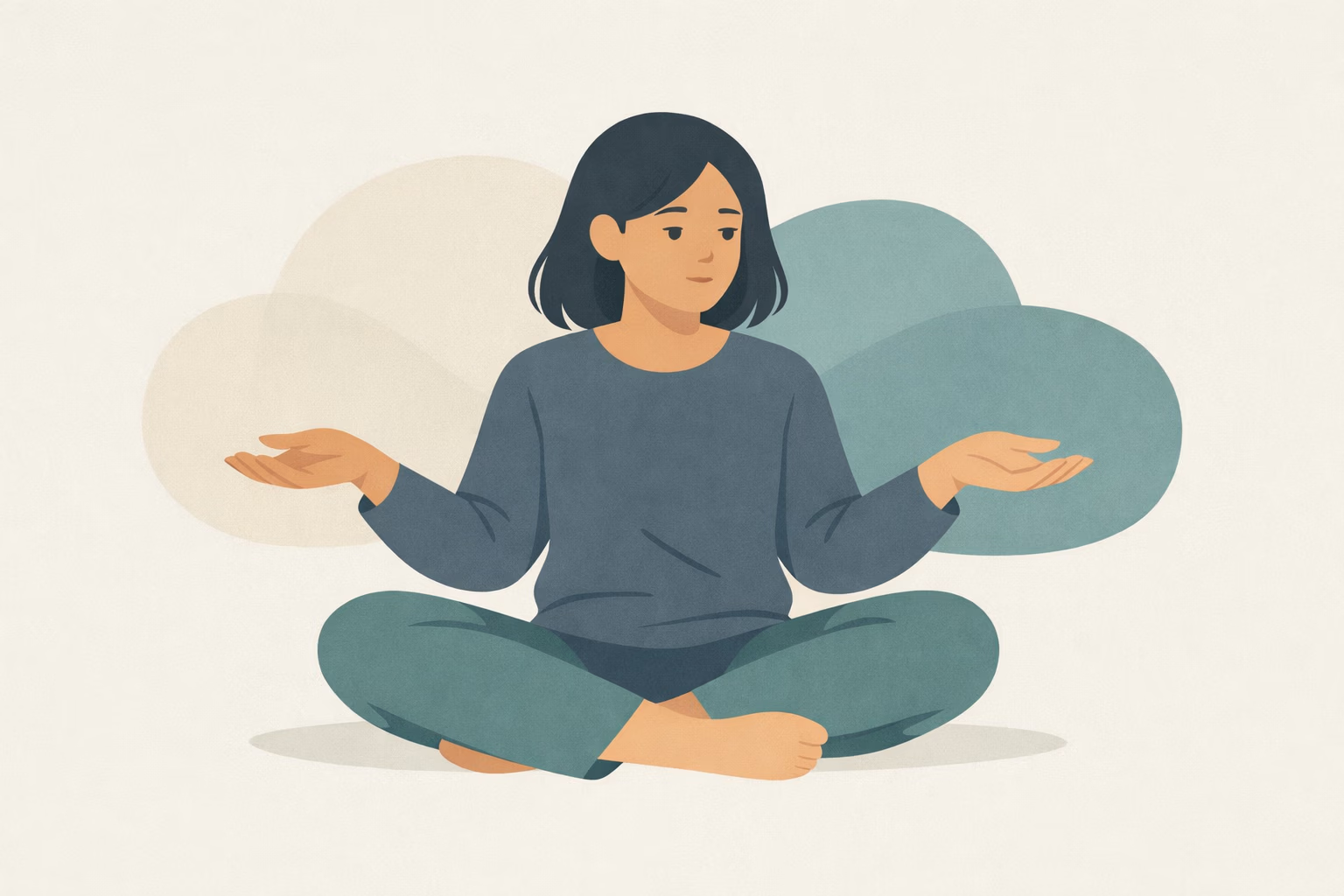
In short: It can be disorienting to feel relieved and guilty, excited and sad, calm and anxious—sometimes within the same minute. People often assume this means they’re being inconsistent, dramatic, or “not sure what they want.” But mixed emotions are usually a sign of a nervous system doing exactly what it evolved to do: hold multiple signals until a situation is truly complete.
It can be disorienting to feel relieved and guilty, excited and sad, calm and anxious—sometimes within the same minute. People often assume this means they’re being inconsistent, dramatic, or “not sure what they want.” But mixed emotions are usually a sign of a nervous system doing exactly what it evolved to do: hold multiple signals until a situation is truly complete.
What if two opposite emotions are not a contradiction, but two different kinds of information arriving at once?
In modern life—fast, evaluated, and rarely “done”—those signals can stack up. When closure is delayed, the brain keeps running parallel tracks. The result can feel like inner conflict, but it’s often an unfinished loop looking for completion, not a character flaw.
Mixed emotions can trigger a particular kind of confusion: not just “What do I feel?” but “Can I trust myself?” You might notice yourself mentally auditing your reactions—trying to figure out which emotion is the “real” one.
But ambivalence simply means having positive and negative responses to the same person, event, or choice at the same time. It’s common in transitions: endings with benefits, beginnings with costs, wins that require loss. [Ref-1]
When the environment demands a clean story—happy or sad, yes or no—your system can start treating complexity as danger. That’s often when the second layer shows up: pressure, shame, and a tightening sense that you must resolve it quickly.
It helps to know that “one feeling at a time” isn’t actually how human processing works. Different neural networks can evaluate different aspects of the same situation simultaneously—one tracking potential gains, another tracking potential costs, another tracking social impact. [Ref-2]
So you can feel genuine joy about a new opportunity while also feeling genuine grief about what it displaces. Neither cancels the other. They’re responding to different cues inside the same event.
This is why mixed emotions often feel like mental noise: it isn’t one signal getting louder; it’s multiple signals arriving without a clear completion point to let the system stand down.
From an evolutionary perspective, it would be risky to process complex situations with a single emotional channel. Many real-life moments contain both safety and risk, both reward and consequence.
Mixed emotions are one way the nervous system avoids premature commitment. They keep attention flexible enough to scan for what matters on both sides—what you want, what you might lose, what could change socially, what could change internally. Research on mixed emotions supports that they are common and not inherently pathological. [Ref-3]
In other words, the “two feelings at once” experience can be a sign of a system trying to be accurate, not a system failing.
When emotions arrive together, they can function like a temporary suspension system. Not a freeze born of weakness—more like a built-in pause that prevents you from making an irreversible move before the picture is complete.
This matters because many choices are not purely good or purely bad. Your biology often waits for additional cues—time, context, feedback, consequences—before it settles. Neuroscience discussions of mixed emotions frequently highlight this capacity to experience “opposites” as a normal brain function. [Ref-4]
What if the discomfort is not the mixed emotions themselves, but the demand to resolve them before anything is actually finished?
A common cultural story says that emotional clarity means having one clean feeling. But human reality is more layered. You can love someone and feel burdened. You can be proud and disappointed. You can feel grateful and still wish it were different.
In social-cognitive research, ambivalence shows up as a meaningful state with identifiable patterns in how the brain processes evaluation and conflict—not as an error message. [Ref-5]
When you stop treating ambivalence as proof that something is wrong with you, the inner environment often becomes less adversarial. The complexity doesn’t vanish, but it becomes easier to hold without immediately turning it into self-criticism.
There’s a difference between having mixed emotions and getting stuck in them. Stuckness often happens when the mind starts using analysis as a substitute for completion—running the same evaluation repeatedly, hoping that more thought will produce the “done” signal.
In that loop, overthinking can become a form of detour: it keeps you busy without letting the underlying situation resolve. The system stays activated because the cues for closure—clear consequence, lived outcome, relational repair, time to metabolize change—haven’t arrived yet.
Neurocognitive models of mixed emotions describe how competing appraisals can remain active together, especially when context is ambiguous. [Ref-6]
Mixed emotions often become stressful not because they exist, but because modern life pressures you to present a single, coherent stance immediately—online, at work, in relationships, even inside your own head.
Research suggests mixed emotions can relate to both better and poorer outcomes depending on context—partly because they can increase nuance, but also increase strain when forced into premature resolution. [Ref-7]
When your internal signals are complex, but your environment rewards certainty, your system may respond by tightening. That tightening often shows up as urgency: “Pick one feeling. Decide. Explain yourself.”
Resistance can also create a secondary problem: now you’re not only carrying two emotions—you’re carrying conflict about having them. That extra layer increases cognitive load, reduces flexibility, and can make the body feel revved even when nothing is happening externally.
Studies on the social utility of ambivalence point out that mixed states can serve functions in communication and adaptation—yet they can become uncomfortable when treated as illegitimate. [Ref-8]
Self-judgment tends to sharpen ambivalence into tension. Instead of “two signals,” it becomes “two sides fighting.” The mind starts building a courtroom: prosecuting one feeling, defending the other, demanding a verdict.
That internal evaluation can prolong activation because judgment rarely provides closure. It creates more tasks—more explaining, more certainty-seeking, more future-proofing—without changing the underlying reality that generated the mixed signals in the first place.
Interestingly, research suggests ambivalence can be adaptive and even socially valued in certain contexts (for example, when it signals careful consideration). When it’s framed as incompetence, the strain increases. [Ref-9]
One way to reduce internal conflict is to recognize that opposite emotions often share a root: they both indicate significance. You don’t typically feel mixed about what doesn’t matter.
Relief and guilt can both reflect care about impact. Excitement and fear can both reflect contact with the unknown. Love and anger can both reflect a bond that still has stakes. When emotions are allowed to coexist, they often stop escalating against each other, because they’re no longer forced to compete for legitimacy. [Ref-10]
Sometimes the conflict isn’t inside you. It’s the collision between a real-life situation and the simple story you think you’re supposed to have about it.
This isn’t “insight equals integration.” It’s simply a less violent frame—one that reduces the need for immediate internal prosecution and makes room for completion to occur over time.
Humans regulate in relationship. When someone can hold your complexity without forcing a conclusion, your nervous system often receives a powerful safety cue: “I don’t have to resolve this to stay connected.”
That kind of witnessing is not about extracting a perfect explanation or turning feelings into a neat narrative on demand. It’s about reducing the load of performing certainty.
Many clinical and educational discussions of ambivalence note that mixed feelings are common in change and decision points, and that non-pressured acknowledgment can reduce internal struggle. [Ref-11]
When closure begins to arrive—through time, lived consequence, relational repair, or clearer context—mixed emotions often don’t “disappear.” Instead, they stop competing for the microphone.
You might notice more spaciousness in attention, less urgency to figure it out, and a steadier ability to let signals come and go without turning them into a crisis. This is not about intensifying emotional focus; it’s about increased capacity for signal return once overall load decreases.
In everyday language, people describe this as “I can hold both truths,” or “It feels less tense.” Mixed emotions are often framed as a normal part of meaningful transitions, especially around new chapters and endings. [Ref-12]
When the system isn’t forced to pick a single “acceptable” feeling, more information stays available. That information can support choices that fit your values and your identity—choices that don’t require you to amputate part of your experience to move forward.
In that state, decisions can become less about escaping discomfort and more about honoring what matters: protection and openness, loyalty and honesty, ambition and sustainability. Mixed emotions can function like a built-in integrity check, keeping your actions connected to the full reality of your life. [Ref-13]
Coherence here isn’t a mood. It’s a settling that tends to show up behaviorally: less looping, fewer internal negotiations, and more stable follow-through because the choice feels inhabitable.
It makes sense to feel disoriented by mixed emotions in a culture that rewards quick certainty. But ambivalence often appears when something matters, when stakes are real, and when your system is tracking more than one consequence at once.
Rather than treating it as a defect, it can be understood as meaningful data: evidence that your life is complex, your bonds are real, and your nervous system is trying to stay accurate under load. In many contexts—including serious decisions—ambivalence is part of how humans engage responsibly with uncertainty. [Ref-14]
Agency doesn’t always look like immediate clarity. Sometimes it looks like staying in contact with what’s true long enough for completion to arrive, so the body can finally receive the “done” signal.
Feeling two opposite emotions at once doesn’t mean you’re broken. It often means you’re intact—sensitive to both gain and loss, both attachment and change, both hope and consequence.
Over time, when experiences complete and your system gets enough closure to stand down, those “opposites” can stop feeling like a split and start feeling like depth. Not a performance of certainty—an integrated orientation that can carry you forward with dignity. [Ref-15]
From theory to practice — meaning forms when insight meets action.
One feeling at a time isn't actually how human processing works. Different neural networks evaluate different aspects of the same situation simultaneously — one tracking potential gains, another tracking potential costs, another tracking social impact. So you can feel genuine joy about a new opportunity while feeling genuine grief about what it displaces. Neither cancels the other; they're responding to different cues inside the same event. Mixed emotions often feel like mental noise because multiple signals arrive without a clear completion point to let the system stand down. This isn't dysfunction — it's adaptive complexity, your nervous system trying to be accurate, not failing.
From an evolutionary perspective, processing complex situations with a single emotional channel would be risky. Many real-life moments contain both safety and risk, both reward and consequence. Mixed emotions are how the nervous system avoids premature commitment — keeping attention flexible enough to scan what matters on both sides. They function like a built-in suspension system: a pause that prevents irreversible moves before the picture is complete. In serious decisions, ambivalence is part of how humans engage responsibly with uncertainty. The discomfort isn't usually the mixed emotions themselves — it's the demand to resolve them before anything is actually finished.
There's a difference between having mixed emotions and getting stuck in them. Stuckness happens when the mind uses analysis as a substitute for completion — running the same evaluation repeatedly, hoping more thought will produce the Done Signal. Overthinking becomes a detour: it keeps you busy without letting the underlying situation resolve. The system stays activated because cues for closure (clear consequence, lived outcome, relational repair, time to metabolize) haven't arrived yet. Self-judgment makes it worse — turning two signals into two sides fighting. The mind builds a courtroom: prosecuting one feeling, defending the other, demanding a verdict that judgment alone can't deliver.
Recognize that opposite emotions often share a root: they both indicate significance. You don't typically feel mixed about what doesn't matter. Relief and guilt both reflect care about impact. Excitement and fear both reflect contact with the unknown. Love and anger both reflect a bond that still has stakes. When emotions are allowed to coexist, they stop competing for legitimacy. Co-regulation helps too — when someone holds your complexity without forcing a conclusion, the nervous system receives a powerful safety cue: I don't have to resolve this to stay connected. Over time, opposites stop feeling like a split and start feeling like depth — Meaning Density inside the Meaning Loop.
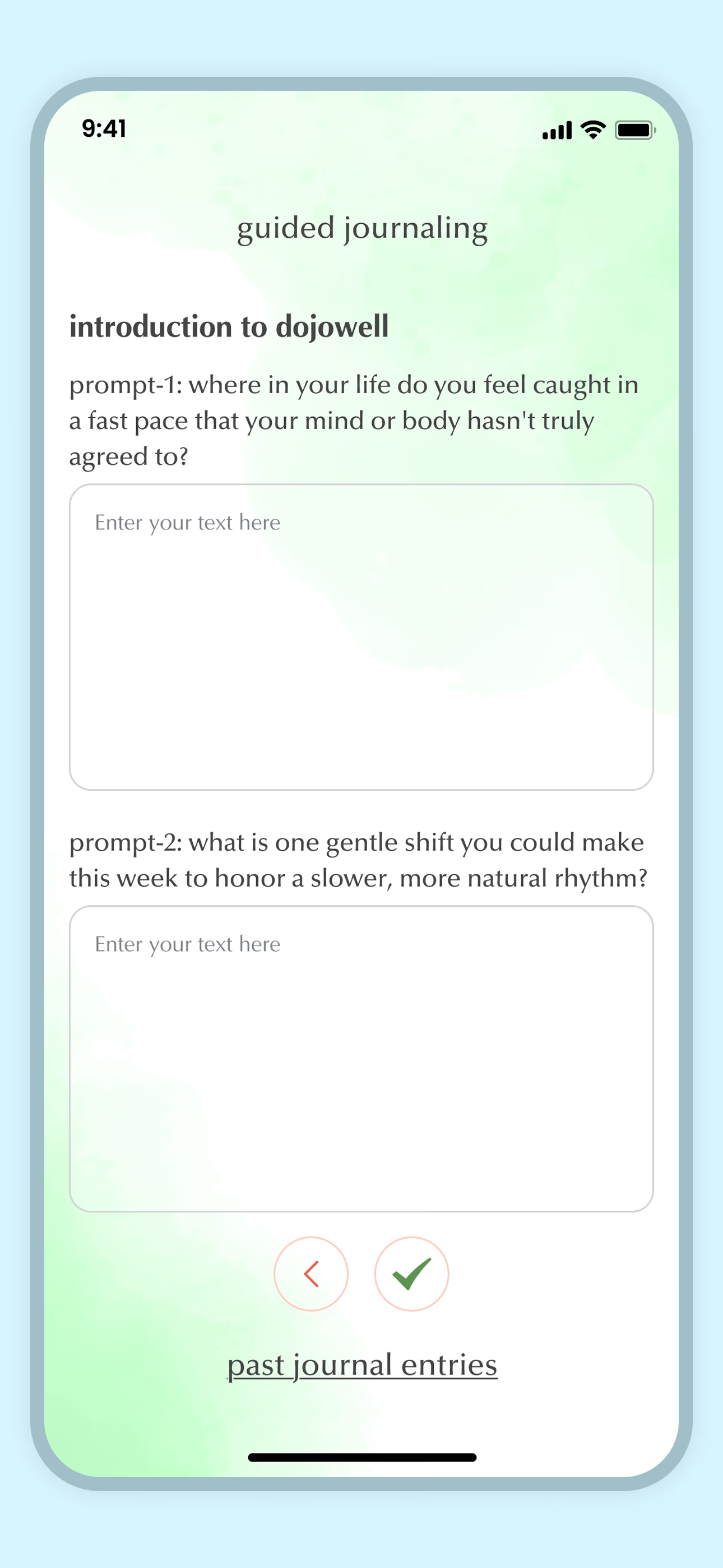
From Science to Art.
Understanding explains what is happening. Art allows you to feel it—without fixing, judging, or naming. Pause here. Let the images work quietly. Sometimes meaning settles before words do.
One Quiet Window, one insight, one reflection — every Sunday