Fight, Flight, Freeze: Understanding Shutdown Mode
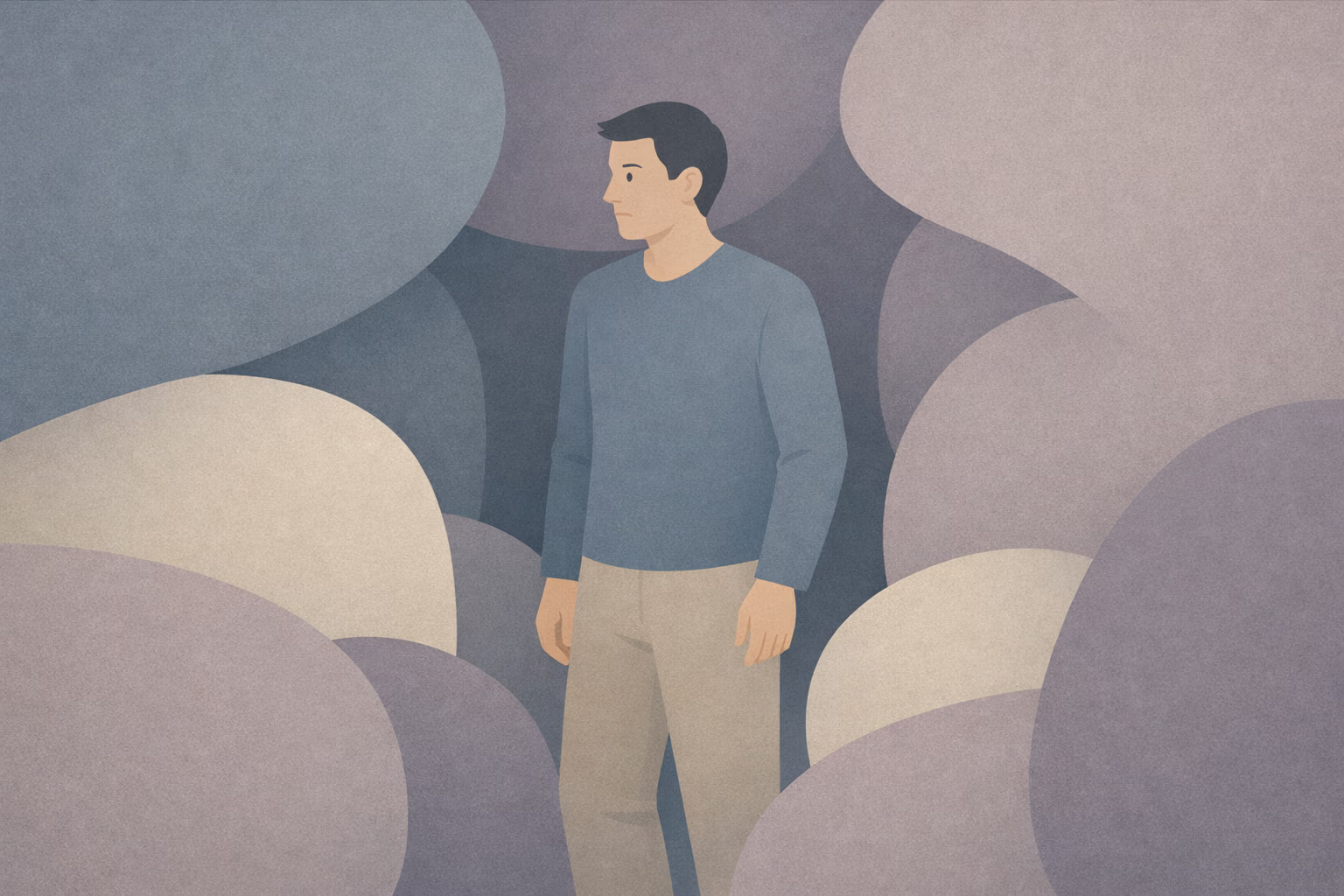
In short: Fear-based decisions are choices shaped primarily by threat-avoidance rather than by values, goals, or a felt sense of direction. They often look sensible on the surface—delay the conversation, keep the job you’ve outgrown, don’t send the message, don’t apply, don’t rock the boat—but underneath, the deciding factor is not what matters most.
Fear-based decisions are choices shaped primarily by threat-avoidance rather than by values, goals, or a felt sense of direction. They often look sensible on the surface—delay the conversation, keep the job you’ve outgrown, don’t send the message, don’t apply, don’t rock the boat—but underneath, the deciding factor is not what matters most. It’s what reduces risk fastest.
What if your anxiety isn’t your personality—what if it’s your nervous system trying to close a loop?
In a high-load system, the brain tends to privilege immediate safety cues over long-range meaning. That’s not a character flaw; it’s a predictable shift in how attention, memory, and planning work when threat circuits are running hot. This article explains how that shift happens, why it’s so reinforcing, and how agency often returns when the system gets enough closure to stand down.
One common sign of fear-based decision making is a particular kind of hesitation: not simple uncertainty, but a repeated pull toward the smallest possible move. You may notice a pattern of choosing what preserves stability today, even when it quietly costs you options tomorrow. Over time, that can create a confusing mix of relief and regret.
The inner experience is often less like “I’m scared” and more like: I can’t quite land on a choice, I keep needing more information, or nothing feels safe enough to commit to. This is the nervous system’s way of keeping decisions reversible when it doesn’t trust the environment to stay steady.
Chronic “playing it safe” can also create a subtle loss of self-trust. Not because you’re incapable, but because the system learns: decisions are dangerous, and the best decision is the one that keeps exit routes open. [Ref-1]
Anxiety changes what the brain prioritizes. Under threat activation, attention tends to narrow around potential problems, ambiguous cues, and social risk. The body mobilizes: heart rate, muscle tension, scanning, readiness. In that state, the mind often becomes less interested in what is meaningful and more interested in what prevents immediate negative outcomes. [Ref-2]
Practically, this can make choices feel like they have only two categories: safe or unsafe. The middle ground—tradeoffs, nuance, timing, experimentation—can be harder to access. Not because you lack insight, but because the system is allocating resources toward protection.
When threat circuitry is driving, the future can also feel less “real.” The brain becomes biased toward near-term certainty, because near-term certainty reduces physiological load fastest.
From an evolutionary perspective, a nervous system that over-weights danger is not irrational—it’s protective. Avoiding a possible threat has historically been cheaper than missing a real one. So under stress, the brain can default to strategies that reduce exposure, reduce unpredictability, and reduce consequences. [Ref-3]
This matters because many people interpret fear-based decisions as evidence of something wrong with them: “I’m avoidant,” “I’m weak,” “I can’t handle life.” A more accurate frame is that a protective system is operating with limited bandwidth, trying to keep you within tolerable load.
Sometimes “I don’t know what I want” is really “my system can’t afford the risk of wanting it.”
Safety choices often come with an immediate shift in the body: tension drops, urgency reduces, mental noise quiets. That change is not imagined; it’s a real nervous-system signal that the perceived threat has decreased. Avoidance can function like a fast off-switch for stress, because it reduces uncertainty and exposure right away. [Ref-4]
Importantly, this isn’t about a person “wanting comfort” or “not trying hard enough.” It’s about how quickly the body can register a drop in demand. When you choose the option that keeps stakes low, the system receives a message: we are less at risk now. That message can feel like clarity.
The difficulty is that the body’s relief signal is not the same as completion. Relief changes state; completion provides closure that lasts.
When a decision is made primarily to reduce immediate distress, the outcome may be relief—without resolution. The external issue remains unfinished, the internal sense of direction remains unformed, and the nervous system learns that backing away is the most reliable way to feel better quickly. Over time, life can shrink to match what your system believes it can manage. [Ref-5]
This can show up as “missed meaning” rather than obvious crisis. You might still be functioning, still responsible, still caring—yet carrying a quiet sense that your days are organized around avoiding wrongness instead of moving toward what feels like yours.
Relief can be real and still be incomplete.
Fear-based decisions often sit inside an avoidance loop: the system perceives threat, chooses a protective option, experiences relief, and then becomes more likely to choose protection again next time. The loop is self-reinforcing because it reliably reduces activation in the short term—even if it increases sensitivity in the long term. [Ref-6]
Over time, the threshold for “too much” can drop. Situations that were previously manageable may start to feel costly: initiating, committing, being seen, risking a no, tolerating ambiguity. The environment doesn’t have to become more dangerous for the loop to tighten; the system simply becomes less willing to spend energy without a guaranteed payoff.
The result is not just avoidance of events. It’s avoidance of open loops—anything that could create prolonged uncertainty without a clear “done” signal.
Fear-based choices don’t always look like avoidance in the obvious sense. They can look like high responsibility, politeness, over-preparation, or constant checking—strategies that reduce the chance of negative outcomes, especially in social contexts where evaluation matters. [Ref-7]
Some common patterns include:
These are not “types of people.” They are regulatory responses that often emerge when the system expects that mistakes will be expensive and support will be limited.
When many decisions are made under threat pressure, agency can start to feel less available. Not because you lose capability, but because the deciding process gets organized around minimizing error rather than expressing identity. Over time, the question becomes less “what fits me?” and more “what won’t backfire?” [Ref-8]
This shift can dull personal direction. Goals may feel less compelling, preferences less clear, and identity less coherent. If your system is constantly managing risk, it has fewer resources for the slower work of building a life that feels integrated—where choices add up to a stable sense of self.
Confidence also takes a structural hit: not because you “failed,” but because you have fewer experiences of completion. Completion is where the nervous system learns, we can do hard things and come out the other side.
The brain learns from what changes state. When a “safe” choice produces immediate relief, the relief itself becomes a kind of reinforcement: it strengthens the pathway that says, this is the way out. Over time, threat prediction becomes more dominant, and flexibility becomes harder to access under pressure. [Ref-9]
This is one reason fear-based decisions can persist even when you logically understand the cost. Logic can be intact, but the body is tracking something else: a fast reduction in load. The system is not trying to sabotage you; it’s trying to stabilize.
When that’s the learning history, “safe” doesn’t merely feel preferable—it can feel necessary, even when it contradicts what you value.
There is a meaningful difference between making decisions while threat is high and making decisions when threat is lower. When the body is less mobilized, the mind can hold more than one truth at a time: risk and possibility, caution and desire, the present and the longer arc. This is less about “thinking positively” and more about having enough regulatory capacity to think at all. [Ref-10]
In a steadier state, choices can start to include wider information: values, context, timing, support, and consequence. Not because you’ve forced courage, but because the system is no longer spending most of its energy on vigilance.
When the nervous system isn’t in emergency mode, your future can re-enter the room.
Fear-based decisions tend to increase in environments that amplify evaluation: harsh feedback, public scrutiny, unstable relationships, or workplaces where mistakes are punished and support is scarce. In these contexts, the nervous system looks for safety cues—and when it can’t find them, it relies more heavily on control and avoidance.
Even subtle signals can matter: tone of voice, unpredictability, lack of repair after conflict, or a feeling that you must perform to belong. When safety cues are weak, the body may treat ordinary decisions as higher stakes. [Ref-11]
This is why “just be confident” often fails as a narrative. Confidence is not merely a mindset; it’s frequently an outcome of conditions that allow learning, repair, and completion.
As stress load decreases and more experiences reach closure, many people notice a change that’s quiet but profound: less urgency. The same choices may still be complex, but they stop feeling like emergencies. The mind has more room to consider tradeoffs without immediately needing escape.
This is often accompanied by a broader tolerance for uncertainty. Not as a heroic stance, but as a physiological reality: the body can hold “not yet resolved” without escalating into immediate threat response. Chronic stress and allostatic load make this harder; reduced load tends to make it easier. [Ref-12]
Expanded capacity can look like:
When decisions are no longer dominated by threat avoidance, a different organizing principle can return: values. Values don’t eliminate risk; they provide orientation. They help choices cohere into an identity—so that decisions aren’t just about what you escaped, but about what you are building. [Ref-13]
This shift is often gradual and cumulative. It can feel like decisions start to “add up” again: actions align with what matters, consequences become more tolerable because they fit a larger narrative, and the system begins to register a sense of completion rather than constant management.
Protection keeps you intact. Meaning helps you become coherent.
Importantly, meaning-led direction isn’t the same as pushing through. It’s what becomes available when the body has enough stability to include both safety and significance in the same decision.
Fear often arrives with urgency, as if it deserves the final vote. But fear is information: it signals perceived cost, predicted rejection, uncertainty, or overload. Treating it as a signal (instead of a commander) changes the relationship—you can respect what the system is detecting without automatically organizing your whole life around preventing the worst-case scenario.
When shame drops out of the picture, more becomes possible. Self-kindness doesn’t erase risk; it reduces the extra layer of threat that comes from self-judgment, which can restore bandwidth for clearer decisions. [Ref-14]
Agency tends to return when choices are allowed to be imperfect, human, and context-bound—when your nervous system isn’t required to prove safety before you’re permitted to have direction.
You are not “made of fear.” You are made of a nervous system that learns from what happens next. When life provides more closure—more repair, more completion, more experiences that reach a real end—the protective grip can loosen.
And when fear is no longer steering by default, decisions can start to feel like they belong to you: not as a performance, not as a defense, but as part of an integrating life story—one where your choices reflect what you value and recognize yourself in the outcome. [Ref-15]
From theory to practice — meaning forms when insight meets action.
Fear-based choices often look sensible on the surface — delay the conversation, keep the job you've outgrown, don't send the message — but underneath, the deciding factor isn't what matters most; it's what reduces risk fastest. The inner experience often feels less like I'm scared and more like I can't quite land on a choice or nothing feels safe enough to commit to. The pull is toward the smallest possible move, keeping exit routes open. Choices feel binary: safe or unsafe, with the middle ground (tradeoffs, timing, experimentation) harder to access because the system is allocating resources toward protection.
Because safety choices come with an immediate body shift: tension drops, urgency reduces, mental noise quiets. That change is real — it's a nervous-system signal that perceived threat has decreased. Avoidance functions like a fast off-switch for stress because it reduces uncertainty and exposure right away. The body's relief signal feels like clarity, but it's not the same as completion. Relief changes state; completion provides closure that lasts. Logic can be intact while the body tracks something else entirely: a fast reduction in load. The system isn't trying to sabotage you; it's trying to stabilize.
Because the Avoidance Loop reinforces itself: threat is perceived, protection is chosen, relief arrives, protection becomes more likely next time. Over time, the threshold for too much can drop — situations that were previously manageable start feeling costly. Life shrinks to match what your system believes it can manage. Fear-based choices don't always look like avoidance; they can look like high responsibility, politeness, over-preparation, people-pleasing, overcontrol. These are regulatory responses when the system expects mistakes to be expensive and support to be limited. Missed meaning often shows up as quiet, not crisis: organizing around avoiding wrongness instead of moving toward what feels yours.
Not by forcing courage — by reducing load. There's a meaningful difference between deciding while threat is high and deciding when threat is lower. In a steadier state, the mind can hold more than one truth at a time: risk and possibility, caution and desire, present and longer arc. Values don't eliminate risk; they provide orientation, helping choices cohere into an identity. Just be confident often fails because confidence isn't merely a mindset — it's frequently an outcome of conditions that allow learning, repair, and completion. Fear is a signal, not a commander. When the wheel isn't held by threat, decisions can start to feel like they belong to you.

From Science to Art.
Understanding explains what is happening. Art allows you to feel it—without fixing, judging, or naming. Pause here. Let the images work quietly. Sometimes meaning settles before words do.
One Quiet Window, one insight, one reflection — every Sunday