Emotional Reflexes: Why You React Before You Think
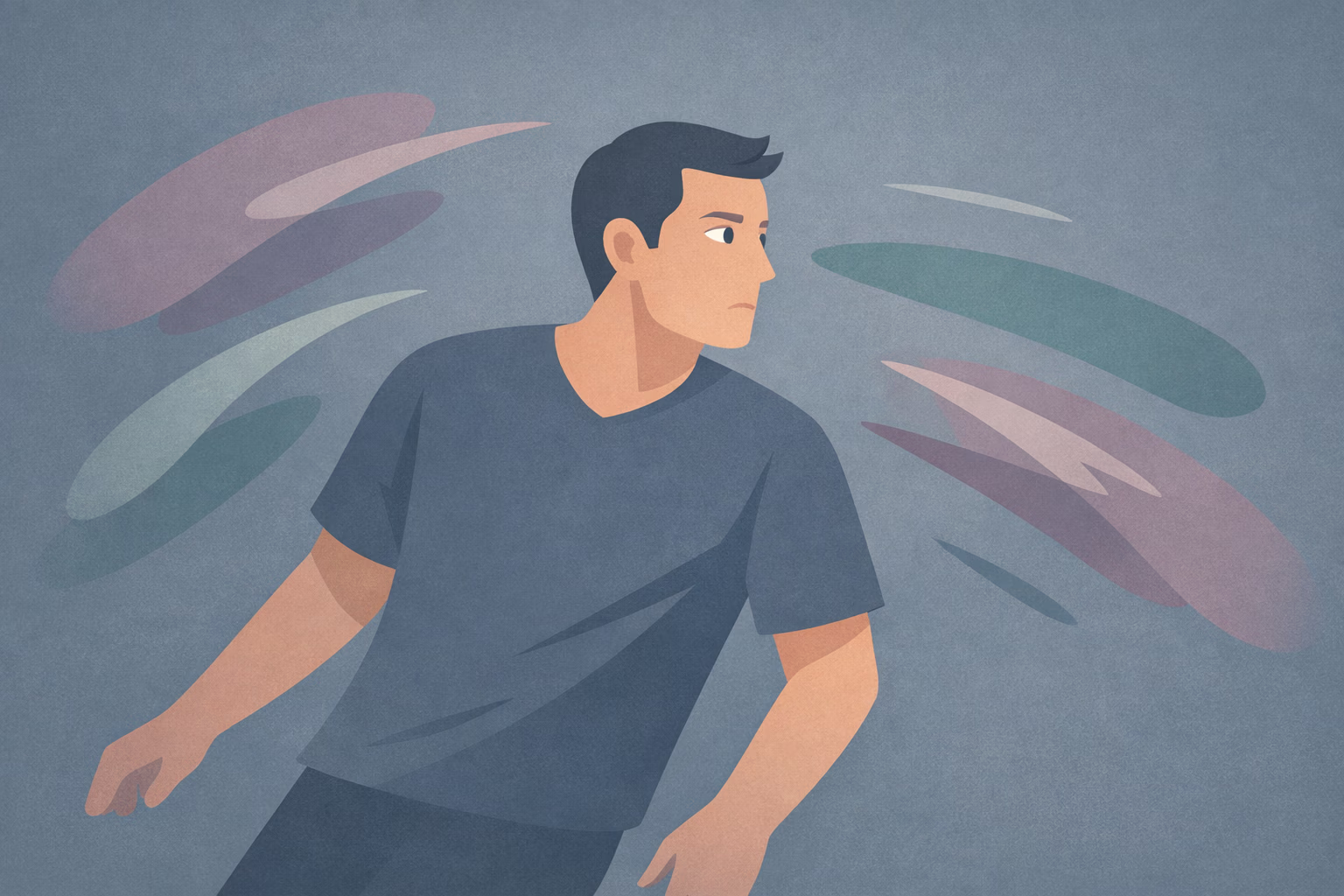
In short: Most people know the feeling: you hear a tone, read a message, get a look—and something in you moves before you’ve even decided to move. Words come out sharp. Your chest tightens.
Most people know the feeling: you hear a tone, read a message, get a look—and something in you moves before you’ve even decided to move. Words come out sharp. You go quiet. Your chest tightens. Later, you might replay it and think, “That wasn’t even what I meant.”
In a Meaning Density lens, these moments aren’t proof that you’re broken or “too sensitive.” They’re evidence of a nervous system that has been trained by life to prioritize speed over nuance when certain cues show up. The reaction is a regulatory response to load and unfinished threat-learning—not an identity.
What if the part of you that reacts first is trying to complete a safety loop, not ruin your day?
Trigger reactions often arrive with a specific texture: sudden, automatic, and oddly absolute. You might snap, defend, freeze, explain too much, withdraw, over-apologize, or feel your mind go blank—before you’ve had time to orient to what’s actually happening.
Then comes the second wave: confusion, embarrassment, regret, or a sense of distance from yourself. The mismatch can feel personal, like you “should have had control.” But speed-based reactions are not chosen in the same way reflective responses are; they’re the nervous system executing a learned protection routine under pressure. [Ref-1]
“I didn’t decide to react. I watched myself react.”
Your brain has layered processing systems. One layer scans for potential threat and meaning in milliseconds; another layer evaluates context, considers consequences, and chooses language more deliberately. In high load, the fast layer can run the show while the slower layer is still assembling the full picture. [Ref-2]
This is why triggers can feel “irrational” afterward. It’s not that your mind is defective—it’s that the sequence is reversed: body and reflex first, interpretation second. When the nervous system is mobilized, the brain prioritizes action-readiness (fight, flight, freeze, appease) over accuracy and social finesse.
A trigger is less like a thoughtful conclusion and more like a shortcut the brain saved. When something once signaled danger, humiliation, abandonment, or loss of control, the nervous system may store that pattern as a “fast cue.” Later, a similar cue can reactivate the same preparedness, even when the current situation is different. [Ref-3]
Importantly, this learning is often procedural—encoded as sensations, impulses, and micro-movements—rather than a clear, verbal memory. That’s why you can “know” you’re safe and still feel your body rush into defense. The knowledge lives in one layer; the cue-response loop lives in another.
From an evolutionary standpoint, quick reactions kept humans alive. When the cost of missing danger was high, nervous systems that mobilized early had an advantage—even if they sometimes mobilized unnecessarily. In that design, a few false alarms were cheaper than one missed alarm. [Ref-4]
So triggers aren’t a modern quirk. They are an ancient bias toward survival. The trouble is that modern life contains many “social threats” (status, belonging, judgment, ambiguity) that feel urgent to the body but rarely require immediate survival action. The system still revs as if it does.
One reason triggers are disorienting is that they often come from older learning—sometimes from childhood, sometimes from a previous relationship, workplace, or period of chronic stress. The present moment can be objectively safer than the alarm suggests, yet the nervous system responds to resemblance, not logic. [Ref-5]
This is also why triggers can be highly specific: a certain facial expression, a familiar silence, the timing of a text reply, the sound of footsteps, a door closing, a particular type of joking. These cues can act like “implicit memory tags” that bring the body into readiness without a full narrative explanation.
When your reaction feels bigger than the moment, it can be a sign of borrowed urgency—carried forward from earlier contexts.
In an avoidance loop, the system moves to reduce discomfort fast—often by discharging it through reaction. The aim isn’t to understand; the aim is to get the internal pressure down. That pressure might be conflict tension, uncertainty, perceived evaluation, or loss of control.
Because the loop is organized around immediate relief, it can bypass reflection. The sequence becomes: cue → mobilization → behavior → temporary settling. In the short term, the nervous system gets a “done” signal. In the long term, the underlying pattern doesn’t fully complete; it stays available to fire again. [Ref-6]
Triggers are often less about the content of what’s happening and more about the signal the system thinks it detects: “I’m about to be cornered,” “I’m about to be shamed,” “I’m about to be left,” “I’m about to lose status,” “I’m not safe to be imperfect.” Under strain, these signals can attach to everyday moments. [Ref-7]
Some common forms:
These aren’t “overreactions” in a moral sense. They are the nervous system matching patterns and trying to keep you inside what once equaled safety.
When triggers run the interaction, relationships can start to feel like walking through a room full of tripwires—for both people. You may find yourself explaining after the fact, repairing repeatedly, or feeling like you can’t predict your own responses.
Agency shrinks because the reaction arrives as a completed decision: the body has already chosen a direction (attack, escape, shut down, over-please). And when these cycles repeat, shame often fills the gap where orientation should be. But shame rarely creates closure; it usually adds more load to a system that is already overtaxed. [Ref-8]
“I’m not trying to be difficult. I just lose my footing so quickly.”
After a trigger response—snapping, withdrawing, over-explaining, scrolling, numbing, quitting, appeasing—there’s often a small drop in internal pressure. That relief is real. And the brain learns from it: “This worked. Do it again next time.” [Ref-9]
This is how speed becomes self-reinforcing. Not because you like conflict or drama, but because the nervous system tracks what reduces activation quickly. If the fastest path to relief is reaction, the system will keep choosing it—until enough safety and completion are present for a different outcome to settle in.
People often imagine that change happens when you “think better thoughts.” But the pause between cue and action is partly a physiological window. When the nervous system is flooded with urgency, the window narrows. When urgency lowers, the window naturally widens—and more of you becomes available. [Ref-10]
This is not about forcing calm in the moment. It’s about how systems respond when they detect safety cues: muscles soften, breathing shifts, attention can broaden, and the brain re-engages with context rather than scanning for threat. Over time, this can allow reactions to move from automatic discharge toward responses that actually fit the present.
The pause isn’t a moral achievement. It’s a capacity signal.
Triggers don’t happen in a vacuum. Humans regulate in relationship: tone, pace, facial expression, and predictability act as safety or threat signals. When someone else is tense, inconsistent, contemptuous, or fast-moving, your system may escalate—not out of “neediness,” but because the environment is broadcasting uncertainty. [Ref-11]
On the other hand, when interactions contain steadiness—clear intent, respectful pacing, repair after rupture—your nervous system gets information that allows it to stand down. This doesn’t mean you require perfect people. It means your biology is responsive to the relational field you’re in.
When load reduces and loops begin to complete, people often describe a quieter internal tempo. Not constant calm—just more room. The body returns to baseline more easily after friction. Attention can track the present rather than only the potential consequence. [Ref-12]
This restored space tends to show up as practical shifts: fewer “autopilot” messages, less compulsion to defend, more ability to wait for information, and a clearer sense of what matters in the moment. It’s not an emotional performance. It’s a nervous system with enough capacity to let signals arrive and pass without immediately converting them into emergency action.
As the pause returns, something else returns with it: values. When you’re not in emergency mode, you can sense what you actually want to stand for—how you want to speak, what kind of partner or colleague you want to be, what kind of life you’re building.
This is where meaning becomes stabilizing. Not meaning as a motivational slogan, but meaning as coherence: your actions match your identity, and your identity feels anchored in what matters. In that state, triggers can still arise, but they stop being commands. They become information—signals that something is asking for completion and safety, not immediate discharge. Social support and attunement can strengthen this shift by helping the body register safety more reliably. [Ref-13]
A trigger is the nervous system saying, “This resembles something that once cost me.” In modern life, many of those costs are social: evaluation, exclusion, humiliation, being misunderstood. When the system predicts those outcomes, it mobilizes fast. That doesn’t make you dramatic; it makes you human in a world that keeps scoring, comparing, and accelerating. [Ref-14]
When you start to see triggers as signals rather than proof of defect, shame loosens its grip. And with less shame, there is often more orientation: “This is my system seeking closure.” That orientation can be a quieter kind of agency—not the agency of forcing yourself, but the agency of recognizing what’s happening without letting the reflex write the whole story.
You don’t need to erase your trigger responses to be a coherent person. You only need them to stop being the final authority on what happens next.
As completion replaces constant mobilization, behavior tends to become less about managing threat and more about expressing what you value. That’s not willpower. That’s a system returning to choice—where your life is shaped more by meaning than by reflex. [Ref-15]
From theory to practice — meaning forms when insight meets action.
Because triggers are speed-optimized learning. A trigger isn't a thoughtful conclusion; it's a shortcut the brain saved. When something once signaled danger, humiliation, abandonment, or loss of control, the nervous system stored that pattern as a 'fast cue.' Later, a similar cue reactivates the same preparedness, even when the current situation is different. The learning is procedural — encoded as sensations, impulses, micro-movements rather than verbal memory. So you can 'know' you're safe and still feel your body rush into defense. The knowledge lives in one layer; the cue-response loop in another.
Signals — and that distinction is everything. A trigger says, 'this resembles something that once cost me.' In modern life, those costs are often social: evaluation, exclusion, humiliation, being misunderstood. When the system predicts those outcomes, it mobilizes fast. That doesn't make you dramatic; it makes you human in a world that keeps scoring and accelerating. When you start to see triggers as signals rather than proof of defect, shame loosens its grip — and with less shame, more orientation: 'this is my system seeking closure.' Triggers stop being orders; they become information.
Because triggers don't happen in a vacuum. Humans regulate in relationship: tone, pace, facial expression, and predictability act as safety or threat signals. When someone else is tense, inconsistent, or fast-moving, your system may escalate — not from neediness, but because the environment is broadcasting uncertainty. When interactions contain steadiness — clear intent, respectful pacing, repair after rupture — your nervous system gets information that allows it to stand down. The same person can seem 'fine' with one friend and reflexive with another. That's context-dependent learning, not hypocrisy.
Quieter than people expect. Not constant calm — just more room. The body returns to baseline more easily after friction. Attention can track the present rather than only the potential consequence. Fewer 'autopilot' messages, less compulsion to defend, more ability to wait for information. It's not an emotional performance; it's a nervous system with enough capacity to let signals arrive and pass without immediately converting them into emergency action. Triggers can still arise, but they stop steering — meaning starts leading.
From Science to Art.
Understanding explains what is happening. Art allows you to feel it—without fixing, judging, or naming. Pause here. Let the images work quietly. Sometimes meaning settles before words do.
One Quiet Window, one insight, one reflection — every Sunday