“Learning but Never Applying” Syndrome
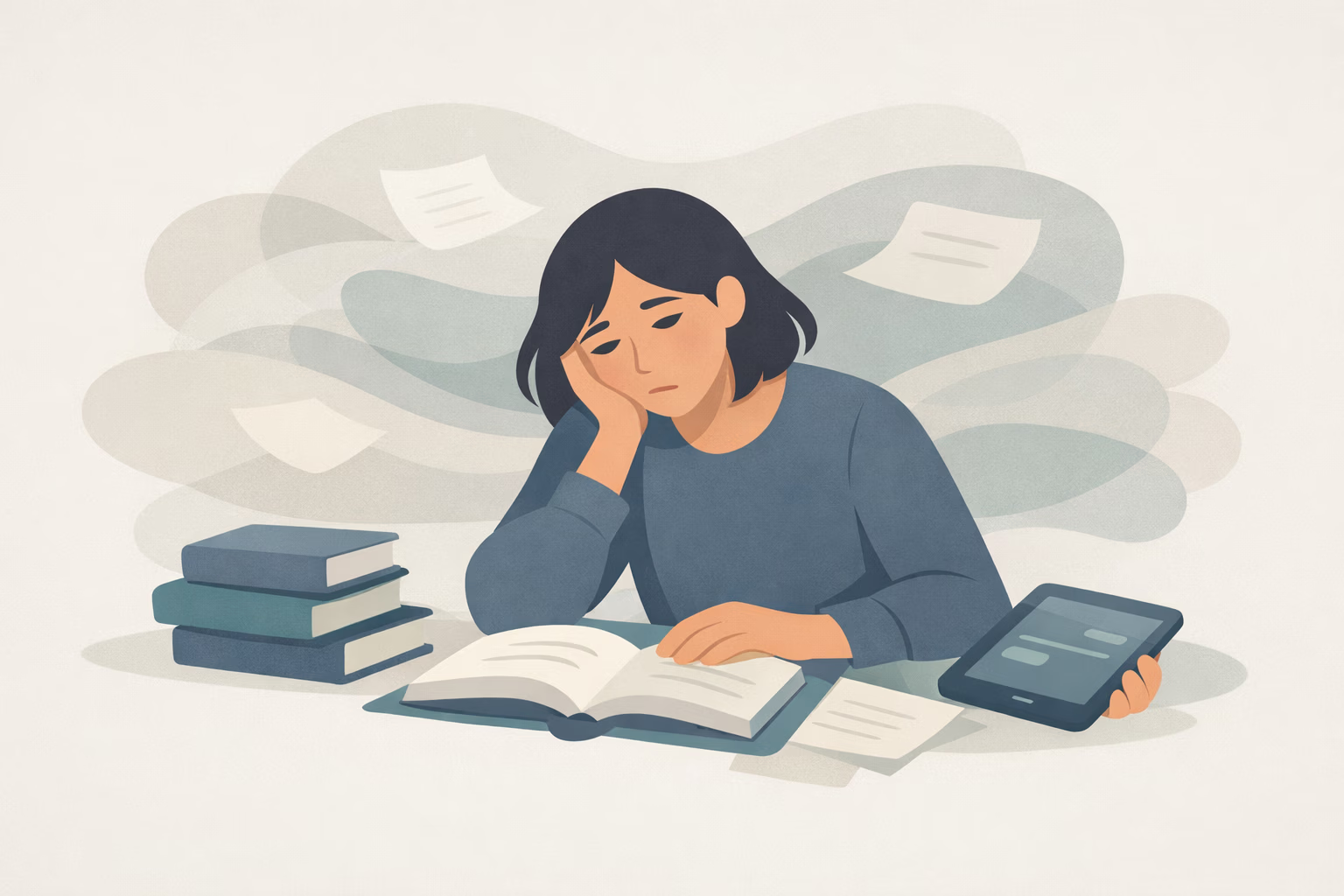
In short: There’s a particular kind of exhaustion that comes from doing “everything right” intellectually: reading the books, saving the podcasts, collecting the frameworks, taking the courses—and still feeling strangely stuck. In the Meaning Density Model™ view, this isn’t a character flaw.
There’s a particular kind of exhaustion that comes from doing “everything right” intellectually: reading the books, saving the podcasts, collecting the frameworks, taking the courses—and still feeling strangely stuck.
In the Meaning Density Model™ view, this isn’t a character flaw. It’s what happens when a system designed for completion gets trapped in continuous intake. Knowledge keeps arriving, but the inner “done” signal never lands, so the nervous system stays in a state of readiness rather than settling.
What if the issue isn’t that you haven’t learned enough—but that nothing has had room to complete?
Self-help overload often shows up as a mismatch: your mind can explain your patterns clearly, but your days don’t reflect the understanding. You can name the terms, identify the loops, even predict your reactions—yet your life still feels like it’s waiting for a switch to flip.
That gap is frustrating because it looks like “lack of follow-through.” But structurally, it can be something else: a high volume of partial starts. Each new idea creates a new open loop—another possibility to evaluate, another angle to consider—without the physiological closure that comes from completion in real time. Over time, learning can start to feel like movement while your lived system remains unchanged. [Ref-1]
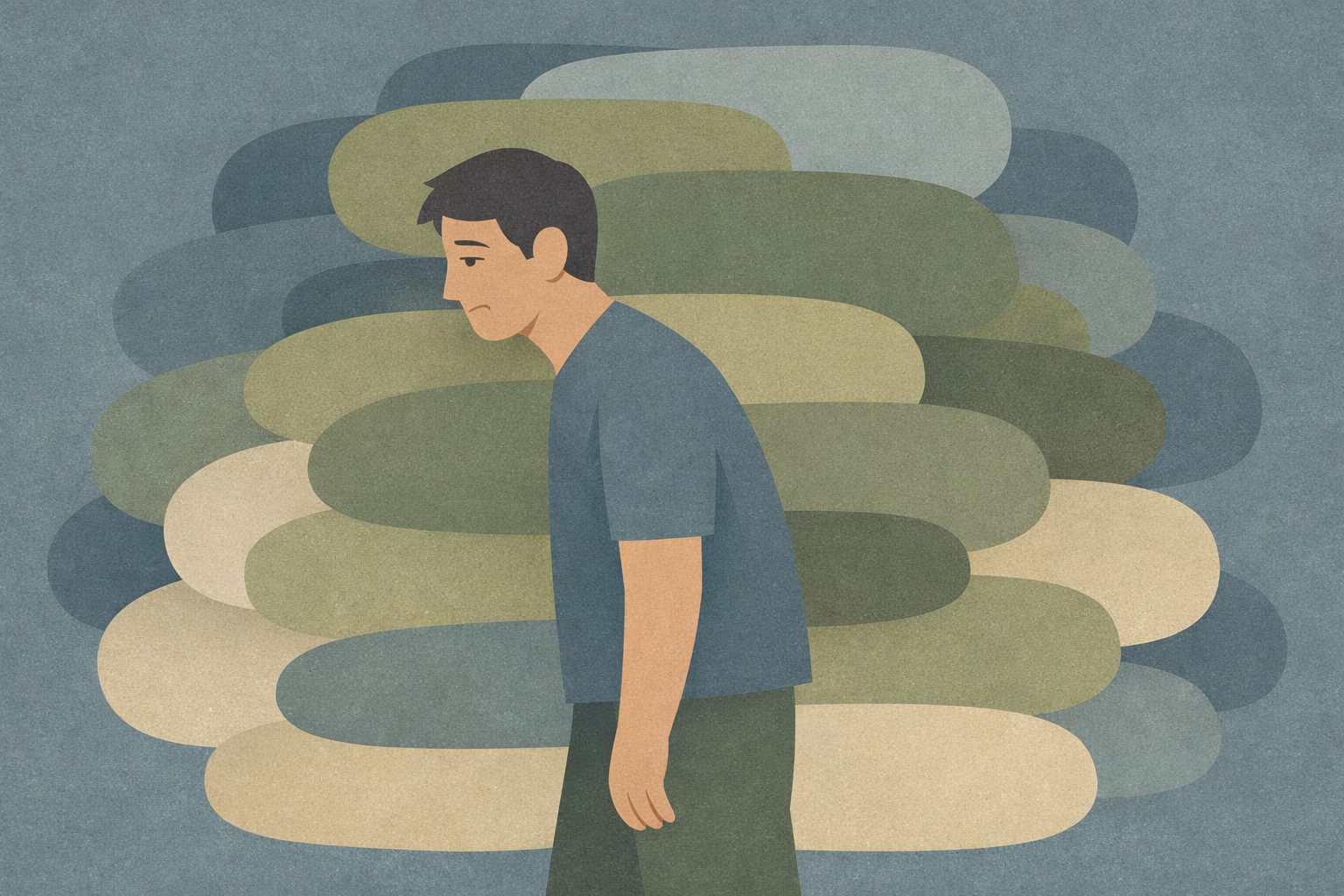
“I’m not confused. I’m saturated.”
Human cognition isn’t built to process unlimited input without rest. When messages keep arriving—new concepts, new methods, new warnings—attention gets pulled into scanning and sorting. That state is useful for immediate demands, but it’s not the same state that supports consolidation.
Consolidation is the quiet, biological “settling” where information becomes usable, selective, and embodied in choices. Under overload, the brain tends to conserve resources: it skims, defers, bookmarks, and postpones deeper processing. The result can be message fatigue, reduced comprehension, and a sense that everything matters but nothing lands. [Ref-2]
In other words, too much learning can block the conditions that allow learning to become lived.
When life feels uncertain, the mind often does something very understandable: it gathers. Information becomes a form of preparedness. If you can name the variables, anticipate outcomes, and map the terrain, your system receives a cue of safety—at least temporarily.
This is one reason information-hoarding can intensify during stressful seasons: health concerns, relationship instability, career ambiguity, identity transitions. The nervous system doesn’t interpret “more knowledge” as abstract self-improvement; it can interpret it as protection—an attempt to reduce exposure to unknown consequences.
Sometimes this leans into intellectualization: living in concepts because concepts feel controllable. Not as deception, but as regulation—staying in the realm where risk is muted and the body doesn’t have to find out what happens next. [Ref-3]
Self-help content is often designed to offer quick coherence: a clear label, a compelling explanation, a hope-filled path. That can soothe the system. For a moment, things make sense again. The tension drops. You feel like you’re “back on track.”
And importantly, that relief can arrive without the kinds of costs that real-world completion sometimes requires—exposure to uncertainty, the friction of practice, the limits of your energy, the awkwardness of change. Learning is low-risk; application is not.
This doesn’t mean learning is “avoidance” in a blameful way. It means learning can function as a safe substitute for the vulnerability of unfinished life. It can calm the system while keeping the underlying loops open. [Ref-4]
Modern culture often treats knowledge like a direct pipeline to transformation: if you can understand it, you can do it. But in practice, excessive input can delay the very conditions that make growth real.
When too many options are present, the executive system is forced into constant comparison: Which approach is best? Which expert is right? What if I choose wrong? This creates decision strain, and decision strain tends to produce postponement—not because you “won’t commit,” but because the system is protecting itself from costly mistakes. [Ref-5]
Growth typically requires fewer concepts than we think, and more completion than we’re taught to value.
An avoidance loop doesn’t have to be driven by conscious fear. It can be driven by structure: when uncertainty is high and closure is low, the system searches for a pathway that reduces activation quickly. Learning does that well.
In this loop, intake replaces engagement. Not because you don’t care, but because engagement carries consequences—feedback, limits, social exposure, imperfect attempts, time passing. Learning keeps the story active while postponing consequence. It’s a way to stay near the edge of change without crossing into the part where the nervous system has to update through lived proof.
Seen this way, self-help overload isn’t “overthinking.” It’s a regulatory strategy that becomes self-reinforcing when life doesn’t provide clean endpoints. [Ref-6]
Preparation mode can look productive from the outside. Internally, it often feels like urgency mixed with incompletion—like you’re always almost ready.
Many people also notice a cycle of hope and crash: an exciting insight, a burst of clarity, then a heavier sense of “Why can’t I make this real?” That swing is a signal of load, not a verdict on your character. [Ref-7]
Over time, too much input can quietly weaken self-trust. Not because you’re “dependent,” but because your system keeps receiving a repeated message: the next answer is elsewhere. When every problem seems to require more research, your own signals get treated as insufficient data.
Paralysis is often what happens when the mind holds too many competing maps at once. Each map implies a different identity: the disciplined one, the healed one, the optimized one, the spiritually aligned one. Without closure, identity becomes a set of drafts—none of which gets to become stable.
Information overload is also associated with stress, irritability, mental fatigue, and reduced clarity. Under those conditions, it becomes harder to choose, harder to prioritize, and easier to default back to scanning. [Ref-8]
When learning doesn’t translate into lived change, the system often responds by doubling down: “I must be missing something.” That belief is painful, but it offers a direction—keep searching. Searching feels better than helplessness.
This is how dependency on information can form. Not dependency in a moral sense, but in a regulatory sense: knowledge becomes the primary way you manage uncertainty. And because new information reliably changes your state (relief, excitement, reassurance), it can become the default tool even as it increases overall cognitive load. [Ref-9]
In this loop, the problem isn’t the person. It’s the environment plus an open-ended internal ledger: too many unresolved “shoulds,” not enough completed chapters.
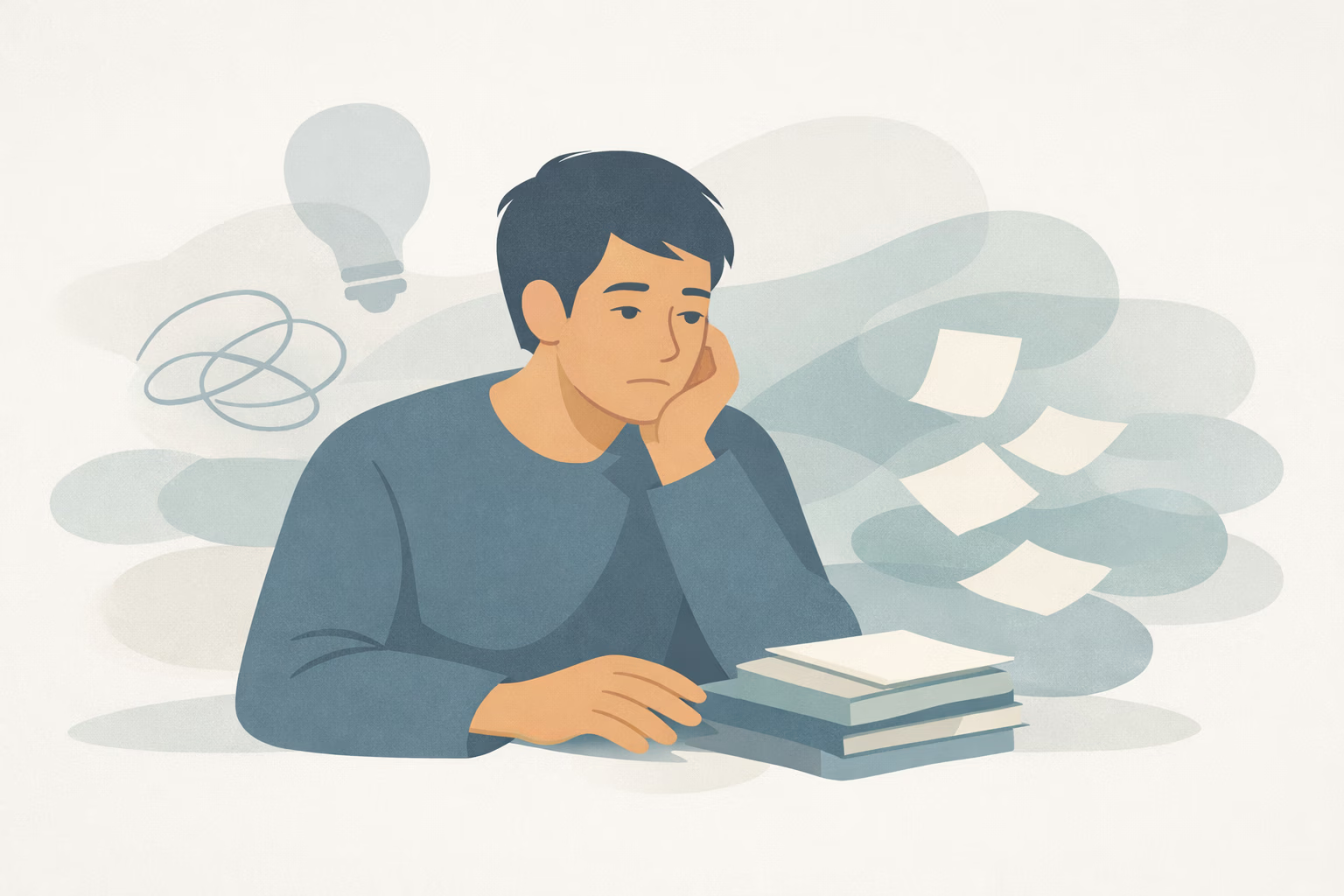
There’s a different way to frame the stuckness: not as a motivation problem, but as a digestion problem. When input outpaces integration, the nervous system stays oriented toward intake—like a browser with too many tabs open, constantly refreshing.
Slowing input isn’t a virtue signal. It’s a physiological condition for clearer selection. When the stream reduces, the executive system has less to compare and defend against. Decision fatigue eases when there are fewer active options competing for attention. [Ref-10]
What would your mind choose if it didn’t have to keep proving it was “keeping up”?
This is the bridge from information to meaning: meaning tends to emerge when experiences complete and settle into identity—when “I know this” becomes “this is how I live.” Not through intensity, but through room for closure.
One reason self-help content can stay abstract is that it’s consumed alone, in private, without relational grounding. But humans are social regulators. Our nervous systems track reality through interaction: being witnessed, receiving feedback, negotiating differences, repairing misunderstandings.
Dialogue does something that solitary learning often can’t: it creates consequences that are gentle but real. You have to articulate, simplify, and stand behind what you claim matters. Shared practice also creates a natural “end point”—a beginning, middle, and finish—where completion becomes possible.
This isn’t about external pressure or forcing yourself. It’s about the way social context converts concepts into lived specificity. The idea stops being an option among many and becomes a chosen thread in an actual life. [Ref-11]
When overload reduces and completion increases, people often describe a quieter kind of confidence. Not hype, not constant inspiration—more like steadiness. The mind becomes less busy proving it’s learning, and more available to notice what fits.
Clarity here isn’t a new insight. It’s a capacity return: attention comes back online, choices feel less fragile, and the internal narrative stops rewriting itself every time new information appears. You may still enjoy learning, but it no longer carries the job of rescuing you.
In this phase, fewer ideas feel “urgent,” and more ideas feel “optional.” That’s often a sign that the nervous system is receiving enough closure to stand down. [Ref-12]
“I didn’t find the perfect answer. I stopped needing one.”
Direction tends to appear after reduction—when there are fewer competing narratives and more completed moments. Practice (in the broad sense: living something repeatedly) provides the data that theory can’t. It teaches your system what is sustainable, what is coherent, what actually resolves strain.
This is where meaning density increases: values stop being slogans and start becoming recognizable patterns in your days. Identity stops being a project and starts being a lived orientation. The “right” method matters less than the sense of completion that follows real engagement.
Self-help can still have a place—but more as a support for lived chapters, not a replacement for them. [Ref-13]
Learning is not the enemy. For many people, it has been a lifeline: a way to find language, context, and dignity. The trouble starts when learning is asked to do the job of closure—when information becomes the main way the nervous system searches for safety and certainty.
From a meaning-centered lens, education becomes stabilizing when it supports lived alignment: when it helps you recognize what matters, relate differently, and complete real-world loops that restore trust in your own signal. When knowledge serves meaning, it tends to simplify rather than multiply.
And if you notice you’ve been using information as a shield, that doesn’t make you broken. It suggests your system has been carrying a lot—and found a clever way to keep going. [Ref-14]
In a culture that rewards endless upgrading, it can feel counterintuitive to let “more” go. But growth frequently begins when the chase relaxes—when you’re no longer trying to earn your worth through improvement, and your system finally has space to complete what it already knows. [Ref-15]
Not more insight. More closure. Not a bigger plan. A life that can settle into itself.
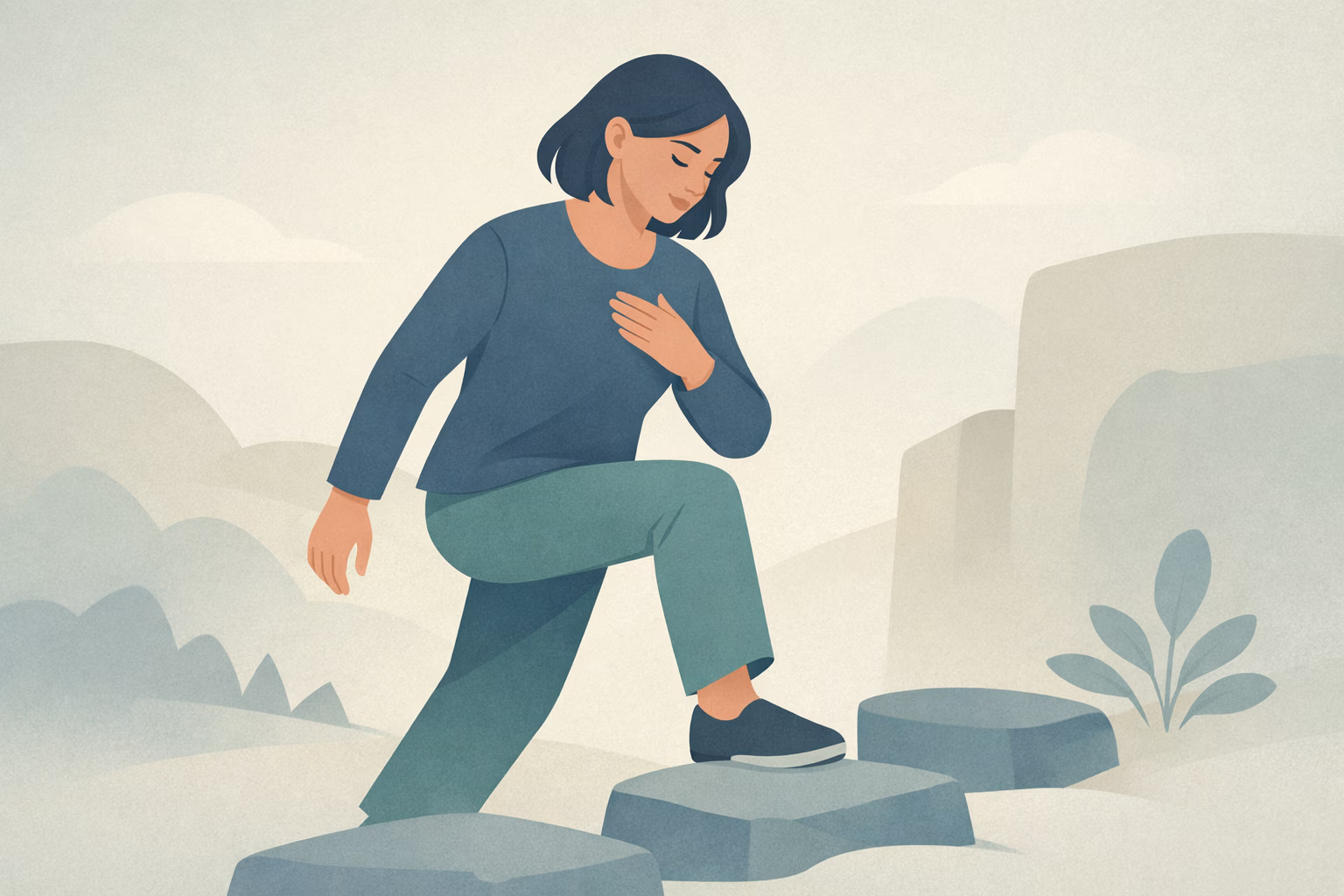
From theory to practice — meaning forms when insight meets action.
Because each new framework opens another loop without closing the previous one. You can name the patterns, identify the loops, even predict your reactions — yet your days don't reflect the understanding because the system designed for completion is trapped in continuous intake. Knowledge keeps arriving, but the inner Done Signal never lands. Over time, learning starts to feel like movement while your lived system stays unchanged. That's not lack of follow-through. It's a high volume of partial starts. The Meaning Density Model frames it bluntly: insight isn't integration. Integration shows up when the body stops bracing around the question and life moves.
It can be, but not in a blameful sense. Learning is low-risk; application is not. Self-help content is designed to offer quick coherence — a clear label, a compelling explanation, a hopeful path — so the nervous system gets relief without the costs that real-world completion requires: exposure to uncertainty, the friction of practice, the awkwardness of change. That makes learning a safe substitute for the vulnerability of unfinished life. The Avoidance Loop here isn't driven by conscious fear. It's driven by structure: when uncertainty is high and closure is low, intake becomes the lowest-friction way to keep the story active without crossing into consequence.
Because every new answer carries an implicit message: the next answer is elsewhere. When every problem seems to require more research, your own signals get treated as insufficient data. Paralysis then becomes structural — the mind holds too many competing maps at once, each implying a different identity (the disciplined one, the healed one, the optimized one), and none gets to become stable. Information overload also produces stress, mental fatigue, and reduced clarity, which makes choosing harder. So the doubling-down on more content isn't a moral failure. It's a nervous system trying to manage uncertainty with the only tool that reliably changes its state.
Less, but real. When overload reduces and completion increases, people describe a quieter confidence — not constant inspiration, more like steadiness. The mind becomes less busy proving it's learning, and more available to notice what fits. Fewer ideas feel urgent; more ideas feel optional. Direction tends to appear after reduction, when there are fewer competing narratives and more completed moments. Practice provides the data theory can't — what is sustainable, what is coherent, what actually resolves strain. Self-help can still have a place, but as a support for lived chapters, not a replacement for them. Growth often begins when the chase relaxes.
From Science to Art.
Understanding explains what is happening. Art allows you to feel it—without fixing, judging, or naming. Pause here. Let the images work quietly. Sometimes meaning settles before words do.
One Quiet Window, one insight, one reflection — every Sunday