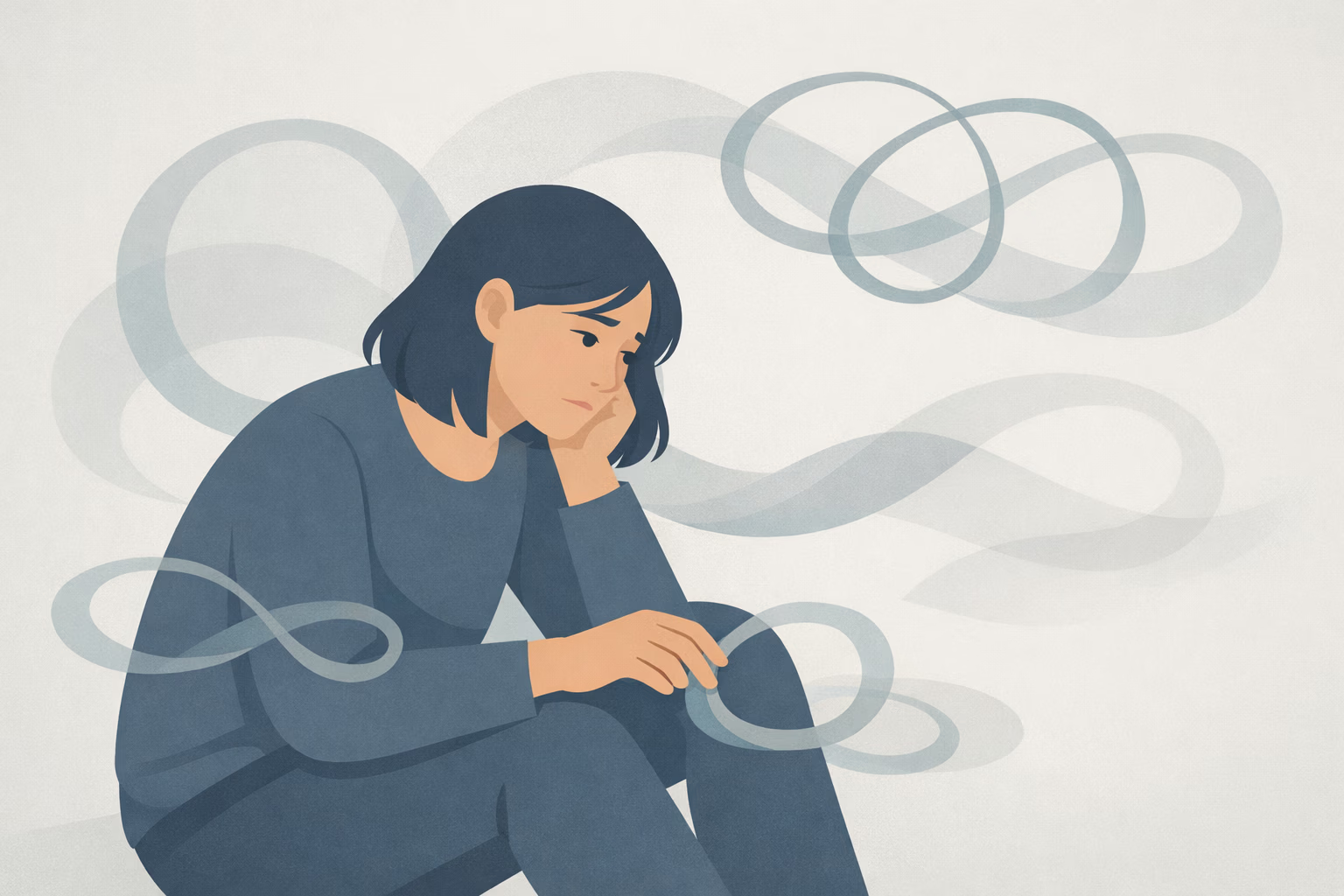
Fear-Based Decisions: How Anxiety Shapes Your Choices
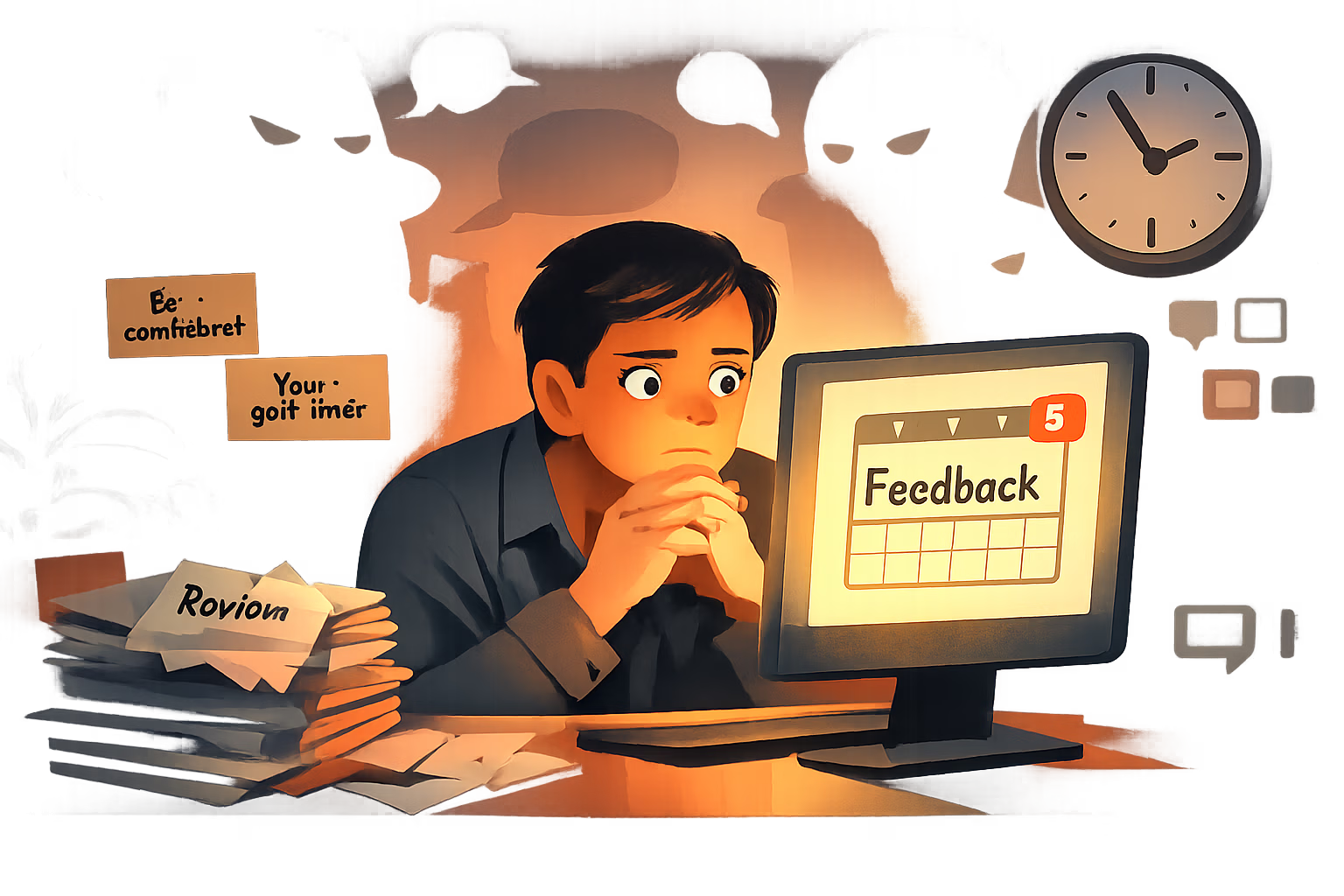
In short: Performance review anxiety isn’t a sign that you’re fragile or “bad at feedback.” It’s often what happens when workplace evaluation is processed as a threat to status, belonging, or future security—rather than as neutral information. Why can a calendar invite and a rating scale feel like your whole life is on the line?
Performance review anxiety isn’t a sign that you’re fragile or “bad at feedback.” It’s often what happens when workplace evaluation is processed as a threat to status, belonging, or future security—rather than as neutral information.
Why can a calendar invite and a rating scale feel like your whole life is on the line?
In modern work, reviews can carry real consequences (income, opportunity, reputation). When the stakes are unclear and the relationship context is thin, the nervous system tends to treat judgment as high-risk. The result can look like over-preparing, shutting down, or becoming unusually reactive—less because of personality, more because the system is trying to prevent loss.
The lead-up to a performance review often comes with a specific kind of vigilance: scanning past emails, replaying meetings, mentally rehearsing explanations, trying to predict what will be said. During the conversation, attention can narrow—tracking tone, word choice, facial expressions, pauses—like your system is monitoring for danger signals. [Ref-1]
Afterward, many people experience a crash: exhaustion, irritability, numbness, or a looping need to “figure out what it means.” This isn’t drama. It’s what happens when the body has been mobilized for threat for hours or days and then has no clear “done” signal to stand down.
Sometimes the hard part isn’t the feedback. It’s what your body has to do to stay braced for it.
When the brain senses evaluation as a risk, it shifts into protection mode. That mode prioritizes scanning and response over reflection. You may notice defensiveness, over-explaining, compliance, blankness, or a sudden inability to recall details—common results of a nervous system trying to manage uncertainty and potential loss. [Ref-2]
This is one reason reviews can feel paradoxical: the very conditions designed to support development can temporarily reduce access to the capacities that make development possible—context-holding, nuance, memory integration, and flexible problem-solving.
What if “I can’t take feedback” is actually “my system can’t learn under threat”?
Humans evolved in social groups where rank and inclusion shaped access to safety and resources. In that context, negative evaluation didn’t just sting—it could mean reduced protection, reduced opportunity, or even exclusion. Modern reviews happen in offices and video calls, but the underlying circuitry still reads “status drop” as consequential. [Ref-3]
So the reaction is not irrational. It’s an inherited survival logic meeting a modern system that can feel opaque: unclear expectations, shifting priorities, and feedback that arrives in concentrated bursts rather than as steady, relational guidance.
Performance review anxiety often organizes behavior in ways that look functional on the outside: meticulous preparation, perfectionistic polishing, over-responsiveness, extra hours, careful self-presentation. In the moment, these responses can reduce perceived risk by creating a sense of control and predictability. [Ref-4]
But it’s a short-term regulatory strategy. It quiets uncertainty by increasing effort and monitoring, which can bring temporary relief—without necessarily bringing closure. When the review is over, the system may still be left asking: “Am I safe now? Did I secure my standing?”
Many workplaces implicitly reward the fear response: urgency creates quick deliverables; pressure can look like commitment; self-critique can look like humility. This can create the illusion that anxiety is the ingredient of excellence.
But threat-based performance tends to trade away the very qualities that make improvement sustainable—clear thinking, relational trust, accurate self-assessment, and willingness to experiment. Under threat, the system aims for “don’t lose status” more than “learn.” [Ref-5]
In a Power Loop, evaluation becomes more than feedback—it becomes the place the nervous system goes to find its footing. A rating, a manager’s tone, or a single sentence can feel like it determines whether you are competent, valued, or secure.
This is not vanity. It’s what happens when status signals are treated as the primary source of stability. The system learns to look outward for “permission” to relax, and inward experience becomes secondary to the next external verdict. Workplace research and commentary increasingly note how performance reviews can amplify this fear-based dynamic. [Ref-6]
When your body treats the review as the truth, how could it not feel urgent?
When evaluation feels like threat, people often develop predictable regulatory patterns. These are not identities; they are ways the system tries to keep consequences manageable and maintain standing.
These patterns make structural sense in environments where expectations are shifting, measurement is simplified, and consequences feel disproportionate. [Ref-7]
Over time, repeated threat activation can narrow a person’s learning bandwidth. When the nervous system expects evaluation to hurt, it may reduce flexibility in advance—less experimentation, less honest conversation, more image-management. [Ref-8]
This isn’t because someone “can’t handle accountability.” It’s because chronic threat load makes the system conserve. Confidence can erode not from a lack of skill, but from a repeated lack of closure: no stable signal that effort leads to safety, and no settled sense of “I know where I stand.”
When feedback feels like danger, the safest move is often to become less visible—not more capable.
When reviews are periodic, high-stakes, and loosely connected to daily reality, the nervous system can treat them like recurring threat events. Each cycle reactivates the same motivational state: monitor, brace, manage impression, prevent loss. [Ref-9]
In that state, feedback isn’t processed as a bounded data point. It becomes “evidence” about rank. Even positive notes can feel unstable—because the system is tracking volatility, not truth. The result is a loop that doesn’t complete: the review ends, but the body doesn’t receive a reliable stand-down signal.
There is a different internal experience possible—not as a mindset trick, but as a deeper stabilization where identity is not on trial each time someone evaluates you. In that steadier state, feedback can be faced with less defensive processing because it’s no longer carrying the entire job of defining you. [Ref-10]
This kind of grounding isn’t the same as insight or positive self-talk. It’s more like an internal “weight distribution” shifting: your sense of self becomes less dependent on moment-to-moment appraisal, and more connected to lived values, accumulated competence, and coherent personal direction.
What changes when a review becomes information again—rather than a referendum?
People regulate better when expectations are clear, feedback is continuous, and leadership is humanized. Psychological safety isn’t indulgence; it’s a set of conditions that helps the nervous system interpret feedback as workable rather than dangerous. [Ref-11]
When feedback is specific, consistent, and connected to shared goals, it provides closure cues: “This is what matters, this is how it’s measured, this is how we’ll revisit it.” In contrast, vague criticism, shifting standards, or surprise evaluations keep the loop open and the system guarded.
Curiosity and openness tend to appear when threat load drops—when the body isn’t busy preventing harm. In safer conditions, feedback becomes something the mind can work with: it can be sorted, prioritized, and contextualized instead of absorbed as global condemnation.
This shift is often less about “trying to be receptive” and more about having enough internal capacity to hold complexity: strengths and gaps, impact and intent, growth edges and stable identity. Cultures that support psychological safety make that capacity easier to access. [Ref-12]
Feedback becomes integrating when it can land as a bounded message—connected to behavior, context, and direction—rather than spreading into identity. In that case, it can support completion: “I understand what’s being asked, what it affects, and what I’m choosing to do with it.”
Notice what’s different here: not more intensity, not more self-surveillance, not more emotional excavation—just a cleaner loop with clearer endpoints. When the loop completes, the nervous system can stand down, and the information can settle into a coherent narrative of growth. Psychological safety helps make that completion possible. [Ref-13]
Feedback is easiest to carry when it has edges—when it doesn’t have to become your whole story.
A performance review is a moment of measurement inside a system. It can be useful. It can be unfair. It can be both. But it is never the full map of a person.
When feedback feels like threat, it often means the nervous system is tracking survival-relevant signals: uncertainty, rank, and belonging. That reaction deserves respect, not shame. And it also helps to remember that identity stabilizes through coherence over time—through lived direction, completed loops, and relationships that provide clear safety cues. [Ref-14]
Your worth can’t be accurately captured by a rating period, a manager’s mood, or a single conversation. Reviews can shape opportunities, but they don’t define the totality of who you are.
When meaning is steadier than judgment, feedback becomes easier to place where it belongs: as one signal among many, inside a larger, ongoing life. That steadiness is not a performance—it’s a kind of internal settling that grows when life offers clearer closure and less chronic threat. [Ref-15]
From theory to practice — meaning forms when insight meets action.
Because evaluation activates threat circuitry, not just learning circuitry. Reviews carry real consequences — income, opportunity, reputation — and when the relationship context is thin and stakes are unclear, the nervous system treats judgment as high-risk. The lead-up brings a specific vigilance: scanning past emails, replaying meetings, rehearsing explanations. During the conversation, attention narrows to tone, word choice, pauses, like the system is monitoring for danger signals. Afterward comes the crash: exhaustion, irritability, or a looping need to figure out what it meant. That's not overreacting. It's what happens when the body has been mobilized for hours without a clear Done Signal to stand down.
Because humans evolved in groups where rank and inclusion shaped access to safety and resources. Negative evaluation didn't just sting — it could mean reduced protection or exclusion. Modern reviews happen on calendar invites, but the underlying circuitry still reads 'status drop' as consequential. So the reaction isn't irrational. It's inherited survival logic meeting a system that often feels opaque: unclear expectations, shifting priorities, and feedback delivered in concentrated bursts rather than as steady, relational guidance. Under that mismatch, the body aims for 'don't lose status' more than 'learn,' and the very capacities that make development possible — nuance, memory integration, flexible problem-solving — temporarily go offline.
When worth becomes externally regulated by outcomes. In a Power Loop, a rating, a manager's tone, or a single sentence can feel like it determines whether you're competent, valued, or secure. That's not vanity — it's what happens when status signals become the primary source of stability. The system learns to look outward for permission to relax, and inward experience becomes secondary to the next external verdict. Common patterns follow: rumination, people-pleasing, defensiveness, emotional shutdown, and over-identification with ratings. These aren't traits. They're regulatory strategies for keeping consequences manageable when the loop never delivers a stable 'I know where I stand.'
Feedback becomes information again instead of a referendum. The shift isn't insight or positive self-talk — it's a weight redistribution where identity stops being on trial each time someone evaluates you. Sense of self becomes less dependent on moment-to-moment appraisal and more connected to lived values, accumulated competence, and personal direction. In safer conditions, feedback can be sorted, prioritized, and contextualized instead of absorbed as global condemnation. Curiosity returns when threat load drops — not because you tried to be receptive, but because the system has enough capacity to hold strengths and gaps together. Feedback is easiest to carry when it has edges and doesn't have to become your whole story.
From Science to Art.
Understanding explains what is happening. Art allows you to feel it—without fixing, judging, or naming. Pause here. Let the images work quietly. Sometimes meaning settles before words do.
One Quiet Window, one insight, one reflection — every Sunday