Curating an Online Self vs Living a Real Self

In short: There is a particular kind of tired that shows up when life starts to feel like a set. The room is styled, the outfit is intentional, the meal is plated, the photo is edited—and yet the system inside you doesn’t land.
There is a particular kind of tired that shows up when life starts to feel like a set. The room is styled, the outfit is intentional, the meal is plated, the photo is edited—and yet the system inside you doesn’t land. Instead of “done,” there’s a faint hum of “not quite.”
Overdecorating isn’t about liking beauty. It’s what happens when beauty gets recruited for regulation: a way to create safety cues, status cues, and certainty cues in a world that feels fast and evaluative. In that state, aesthetics can shift from pleasure to pressure—not because something is wrong with you, but because the environment keeps pulling your nervous system into performance.
What if the urge to curate isn’t vanity, but a nervous system trying to secure closure and belonging?
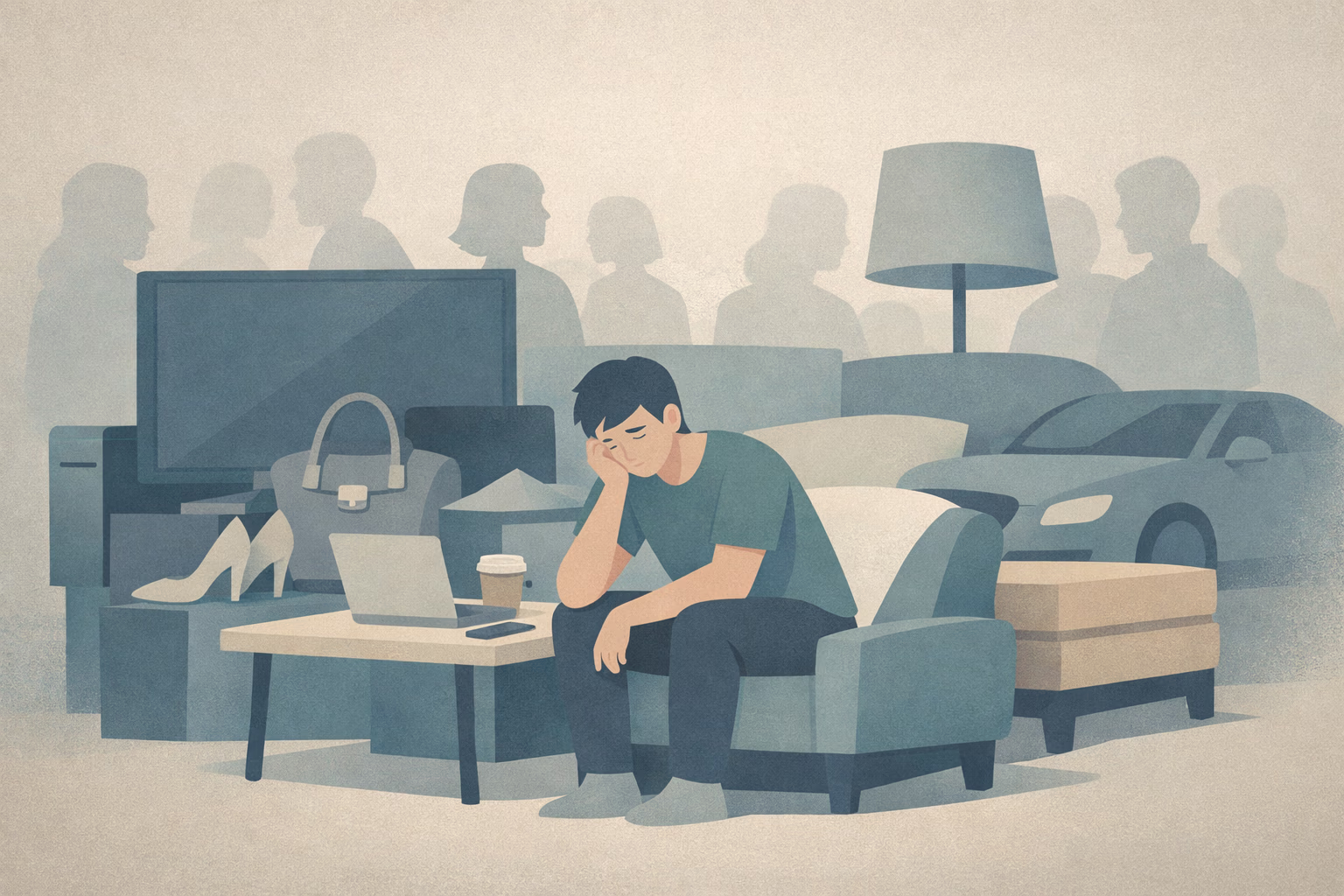
A common early sign is that ordinary moments stop giving a clear satisfaction signal. The apartment looks good, but you don’t feel settled. The new purchase arrives, and the relief is brief. The day is documented, but the day doesn’t feel lived.
This can look like boredom, restlessness, or a strange emotional flatness around things that “should” feel rewarding. Underneath, it’s often a capacity issue: the system is carrying too much evaluation load to fully register moderate pleasures. Social comparison and perfectionistic appearance standards can amplify that load, keeping attention scanning for what needs adjusting. [Ref-1]
The brain’s reward and attention systems are designed to respond to changes that matter—novelty, social signals, and potential gains. When those cues arrive in high frequency and high intensity, the baseline can start to feel muted. Not because you “lost gratitude,” but because the signal-to-noise ratio changed.
Advertising and platform design often leverage neuroscience-informed triggers—novelty, urgency, social proof—to keep attention engaged. Over time, repeated exposure to strong cues can make subtle rewards harder to detect, nudging the system to seek stronger inputs for the same sense of “hit” or satisfaction. [Ref-2]
This is not a character problem. It’s a calibration problem: the threshold for “enough” rises when “more” is constantly presented as available.
Humans evolved to track reputation and belonging because, historically, those were survival variables. Your nervous system doesn’t treat approval as a luxury; it treats it as information about safety and access. In modern life, that ancient circuitry meets constant visibility.
Social media intensifies self-presentation demands: you can see what others “have,” how they “live,” and how they are received. When the environment keeps offering comparison targets, the system can default to refining the signal you’re sending—your space, your body, your taste, your lifestyle narrative. [Ref-3]
In that loop, decorating becomes more than decorating. It becomes an interface with the social world.
High-control, high-polish actions can create an immediate sense of order. Clean lines, coordinated palettes, curated routines—these are powerful safety cues. They can temporarily reduce internal noise by giving the brain a simple story: “I am put together. I am acceptable. I am in control.”
When appearance ideals and self-objectification pressures are strong, the body and the home can start to function like ongoing projects rather than places to inhabit. That ongoing project-state can feel protective in the moment, but it also keeps attention externally oriented—toward how things read, not how they settle. [Ref-4]
Sometimes the aesthetic isn’t the problem. The problem is that it has to carry your whole sense of “I’m okay.”
Modern messaging often implies that the right look will deliver the right feeling: buy the item, achieve the vibe, become the person. Emotional branding works because it pairs products and aesthetics with identity promises—belonging, confidence, ease. [Ref-5]
But satisfaction isn’t produced by intensity alone. The nervous system needs completion signals: moments that resolve, land, and become part of lived identity. When the standard keeps moving (new trends, new comparisons, new micro-upgrades), the “done” signal gets postponed. The result can be a strange gap: you keep improving the surface while the inside keeps waiting.
There’s a difference between pleasure and coherence. Pleasure can change state quickly—brighten, soothe, distract. Coherence is slower: it’s what happens when experiences complete and integrate into who you are, leaving less residue behind.
Neuromarketing and attention engineering can bias the system toward quick pleasure loops: browse, select, purchase, display, receive feedback. The cycle is clean and repeatable—and it offers immediate signals without requiring true completion. [Ref-6]
In a high-pressure environment, that repeatability can become the nervous system’s safest option: predictable input, predictable payoff, minimal uncertainty. The cost is that the deeper “I am living my life” feeling can thin out.
Overdecorating-for-validation is often a regulatory response to a world that feels surveilled, competitive, or unstable. It can look different across people, but the structure is similar: external refinement stands in for internal closure.
Common expressions include:
Social media comparison can intensify body monitoring and self-objectifying attention, making the self feel like a project to manage rather than a place to return to. [Ref-7]
When attention is repeatedly pulled toward optimization of presentation, it becomes harder to register low-intensity rewards—warmth, ease, quiet connection. This isn’t because those rewards disappeared, but because the system is trained to prioritize louder signals.
Over time, the costs can stack:
Marketing ecosystems are built to keep the loop open—new needs, new micro-dissatisfactions, new “solutions.” Neuromarketing techniques can amplify salience and urgency, increasing the sense that something is missing. [Ref-8]
Once the nervous system learns that aesthetic upgrades and external feedback deliver quick regulation, it makes sense that it reaches for them again. The issue is that the relief is short-lived. The baseline return—the ability to feel okay without a new input—can get weaker with repetition.
Then the system adapts in the only way it knows: it raises the dose. More polished. More frequent updates. More comparison checking. More tightly controlled environments. Curated perfection online can intensify this escalation by constantly presenting “better” as normal, keeping the system in a mild state of inadequacy scanning. [Ref-9]
What looks like “high standards” is often a nervous system trying to recover a feeling of enough.
There is a subtle but important shift that can happen in how the brain relates to reward: from intensity to completion. Intensity is the spike—newness, praise, the perfect look. Completion is the settling—when something ends cleanly and becomes part of lived identity rather than an open tab.
Consumer decision-making is strongly influenced by cues that predict reward and reduce uncertainty. When life feels uncertain, choices that offer immediate clarity and social legibility become especially compelling. [Ref-10]
In this frame, recalibration isn’t about “understanding why you do it” or forcing yourself to stop. It’s about the system being allowed to experience moderate experiences that actually close—so the self doesn’t need constant updating to feel real.
One of the most regulating inputs for humans is low-demand connection: shared presence that doesn’t require performance. When that kind of connection is available, the nervous system receives safety cues that don’t depend on looking perfect or being impressive.
Markets often use scarcity and urgency to increase perceived value and accelerate decisions, which can keep the system keyed up and future-oriented. In contrast, genuine connection slows the timeline: it brings attention back to what is already here and already happening. [Ref-11]
In that slower social field, pleasure often becomes simpler—less about display, more about mutual reality.
When the system has less evaluation load and more opportunities for clean closure, small signals start to return. Not as a dramatic breakthrough, but as a quiet re-sensitizing: ordinary comforts register again. Neutral moments feel less empty. The day doesn’t need a highlight-reel structure to feel legitimate.
People often describe this as increased curiosity about regular life—food tasting like food, conversations feeling more dimensional, spaces feeling usable instead of merely photogenic. As comparison pressure loosens, self-acceptance narratives become more plausible because the nervous system isn’t constantly being asked to compete. [Ref-12]
Not everything has to be stunning to be satisfying.
Over time, the center of gravity can shift from “How does this look?” to “Does this complete something real in me?” That’s not a moral upgrade. It’s a structural change: rewards become linked to values, continuity, and identity—not just external response.
Much of consumer behavior happens through fast, cue-driven processes that bypass deliberation. When the environment is saturated with cues, it’s easy to slide into automatic purchasing and presentation cycles. [Ref-13]
Coherence feels different than validation. Validation is a brief signal from outside. Coherence is an internal stand-down: less chasing, less correcting, more capacity to inhabit what you’ve already chosen.
If you’ve been overdecorating your life, it may not mean you’re shallow or broken. It may mean your system has been living under chronic social evaluation, where visibility and comparison are constant and “enough” is hard to prove. Social comparison pressures can turn the self into an object to appraise, which naturally increases monitoring and urgency. [Ref-14]
In that context, aesthetics become a way to stabilize identity: to say “this is who I am” when everything else feels fragmented. The goal isn’t to abandon beauty. It’s to recognize when beauty has been asked to carry the full weight of safety, belonging, and self-worth.
Agency often returns when life contains more moments that resolve—moments that don’t require an audience to count as real.
Vividness isn’t something you can force by adding more stimulation. It tends to return when the nervous system is no longer being kept on alert by scarcity, urgency, and constant evaluation—when there is room for completion and the body can stand down. [Ref-15]
And when that happens, beauty changes role. It stops being proof. It becomes a companion to living—something you can enjoy without it having to hold you together.
From theory to practice — meaning forms when insight meets action.
Because reward sensitivity recalibrates under repeated high-intensity cues. The brain's attention systems are designed to respond to changes that matter — novelty, social signals, gains. When those cues arrive constantly through advertising, platforms, and curated feeds, the baseline gets muted. It's not lost gratitude; it's that the signal-to-noise ratio shifted. The threshold for 'enough' rises when 'more' is constantly presented as available. Layer in evaluation load — appearance ideals, comparison, perfectionistic standards — and the system has too much attention deployed on scanning to fully register moderate pleasures. That's a calibration problem, not a character one.
Because it offers immediate safety cues. Clean lines, coordinated palettes, polished routines give the brain a simple story: 'I am put together. I am acceptable. I am in control.' That temporarily reduces internal noise. The catch is that ongoing curation keeps attention externally oriented — toward how things read, not how they settle. The body and the home become projects rather than places to inhabit. Aesthetic upgrades and external feedback deliver quick regulation, but the relief is short-lived, and the baseline ability to feel okay without a new input gets weaker with repetition. Then the system raises the dose: more polished, more frequent, more comparison.
Pleasure changes state quickly — brighten, soothe, distract. Coherence is slower: experiences complete and integrate into who you are, leaving less residue. Neuromarketing and attention engineering bias the system toward quick Pleasure Loops — browse, select, purchase, display, receive feedback. The cycle is clean and repeatable, with immediate signals but no true completion. In a high-pressure environment that repeatability becomes the safest option: predictable input, predictable payoff, minimal uncertainty. The cost is that the deeper 'I am living my life' feeling thins out. The Meaning Loop needs continuity that quick rewards can't provide.
Quietly, as the evaluation load drops. When the system has fewer comparisons running and more opportunities for clean closure, small signals start to register again. People describe ordinary comforts coming back online — food tasting like food, conversations feeling more dimensional, spaces feeling usable instead of merely photogenic. Low-demand connection helps especially: shared presence that doesn't require performance gives the nervous system safety cues that don't depend on looking impressive. The shift isn't a moral upgrade. It's structural: rewards become linked to values, continuity, and identity rather than external response. Beauty stops being proof and becomes a companion to living.
From Science to Art.
Understanding explains what is happening. Art allows you to feel it—without fixing, judging, or naming. Pause here. Let the images work quietly. Sometimes meaning settles before words do.
One Quiet Window, one insight, one reflection — every Sunday