

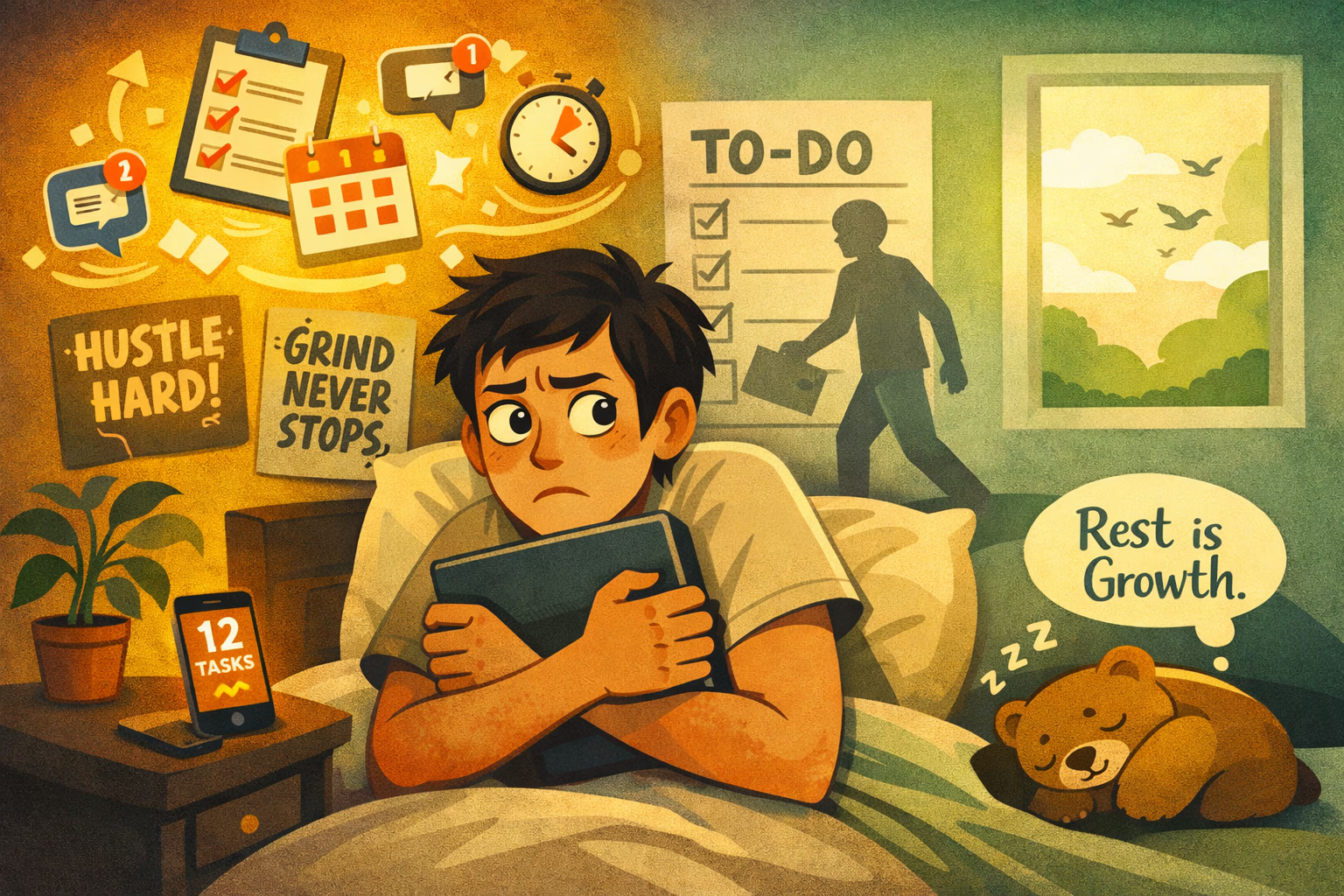
Toxic Productivity: When Rest Feels Like Failure

In short: Quiet quitting is often described as “doing the minimum.” But inside the body, it can feel less like a choice and more like a protective downshift: you keep showing up, yet something essential withdraws. The work gets done, but the person doing it feels distant—less invested, less present, less reachable.
Quiet quitting is often described as “doing the minimum.” But inside the body, it can feel less like a choice and more like a protective downshift: you keep showing up, yet something essential withdraws. The work gets done, but the person doing it feels distant—less invested, less present, less reachable.
This isn’t a character issue. It’s what can happen when effort stops producing stability—when your nervous system learns that care, initiative, or visibility leads to more demand, more scrutiny, or more disappointment. Under that kind of load, disengagement becomes a way to preserve capacity and reduce exposure.
What if “checking out” isn’t laziness—what if it’s your system trying to find an exit from a loop that never resolves?
One of the most confusing parts of quiet quitting is that performance may look “fine” on the outside. Tasks are completed. Meetings are attended. Messages get answered. Yet internally, there can be numbness, low energy, and a sense of mechanical motion—like you’re operating from a distance.
This “self-absent” quality is an important clue. It suggests the issue isn’t skill or competence. It’s the cost of involvement. When involvement has repeatedly led to strain without closure—no real completion, no lasting recognition, no stable safety cue—the system starts conserving.
In burnout language, this can resemble exhaustion and mental distance from work: not dramatic collapse, but gradual thinning of presence. [Ref-1]
Under prolonged stress, bodies don’t only rev into fight-or-flight. They also conserve. When demands feel continuous and recovery feels unreliable, the nervous system often reduces emotional investment as a way to spend less energy per hour.
In that frame, quiet quitting isn’t “not caring.” It’s a recalibration: fewer internal resources allocated to work, fewer expectations attached to outcomes, fewer parts of the self placed on the line. That can look like doing only what is required, avoiding extra projects, or refusing to take on responsibilities that used to feel meaningful. [Ref-2]
This is what regulation can look like in a high-pressure environment: not motivation building, but exposure reducing.
From an evolutionary perspective, when a situation feels inescapable—financially, socially, or structurally—organisms don’t always fight or flee. Another option is to narrow engagement: reduce movement, reduce signaling, reduce visibility. It’s a survival logic that minimizes risk when the environment doesn’t respond to effort with safety.
At work, “inescapable” doesn’t have to mean extreme. It can mean: you can’t leave yet, you can’t change the workload, and voicing concerns has not led to change. In that context, withdrawing becomes a way to protect the parts of you that would otherwise keep reaching—and getting no completion in return. [Ref-3]
Sometimes the body doesn’t choose enthusiasm or collapse. It chooses distance.
Disengagement often brings immediate relief. When you expect less, you’re less likely to be surprised by broken promises, shifting goalposts, or invisible labor. Lowering investment can reduce disappointment, reduce conflict, and reduce the sense that your identity is being evaluated every day.
This matters because many workplaces don’t just measure output—they measure “attitude,” availability, and emotional labor. When the standards are ambiguous or constantly changing, the safest move can be to stop offering more than what’s written down.
In that way, quiet quitting functions like a psychological and physiological boundary: a reduction of exposure to stressors that feel endless or unclear. [Ref-4]
Withdrawal can feel stabilizing at first: fewer spikes of urgency, less pressure to prove yourself, fewer emotional hits. But over time, prolonged disengagement can have a different cost. Not because you “should” care more—because humans need some form of completion to feel alive inside their own days.
When weeks turn into months of “just getting through,” vitality often drops. Work becomes a place where you spend hours without receiving the internal “done” signal that comes from meaningful contribution, fair exchange, or recognized progress. The system stays braced, even if it looks calm.
The result can be a quiet flattening: less interest, less creativity, and less sense that your time is building toward anything. [Ref-5]
Quiet quitting often sits inside an Avoidance Loop. The loop isn’t about fear or weakness. It’s about a structural trade-off: disengagement prevents further harm (overload, disappointment, identity injury), but it also blocks the conditions that would allow the situation to resolve.
When you withdraw, you may avoid extra work and extra scrutiny. But you also lose access to the feedback that could restore coherence—clear wins, repaired trust, shared purpose, or a realistic renegotiation of expectations. The system stays in “protective mode” because nothing arrives that signals completion.
From the outside, it can be mislabeled as “bare minimum.” From the inside, it can feel like the only sustainable way to remain employed. [Ref-6]
Because it’s subtle, quiet quitting is often recognized by patterns rather than a single moment. The common thread is reduced self-exposure: fewer bids for visibility, fewer voluntary stakes, fewer parts of the self invested in outcomes.
These patterns have existed under many names (disengagement, burnout distance), and “quiet quitting” is one newer label for something older: the human system protecting capacity when the exchange no longer feels workable. [Ref-7]
Humans don’t just need rest; we need coherent effort—effort that leads somewhere, that concludes, that becomes part of lived identity. When work becomes a place where nothing truly completes, the system adapts by narrowing what it offers. Over time, that narrowing can reduce the ability to experience meaning even when opportunities appear.
This is one of the hidden losses of long disengagement: not only reduced output, but reduced inner responsiveness. Self-worth can quietly erode—not because performance is low, but because the person’s contribution no longer feels connected to who they are.
Signs of disengagement like low initiative, reduced participation, and cynicism are often discussed organizationally, but they also reflect an internal economy: the system is spending less because it doesn’t trust the return. [Ref-8]
Once meaning drops out, the workplace can begin to feel like a place where effort is simply extracted. In that context, re-engagement doesn’t feel like hope—it can feel like vulnerability. Offering more attention, care, or creativity can register as reopening a channel that previously led to overload or disappointment.
That’s how withdrawal becomes self-reinforcing. The less meaning you receive, the more sense it makes to invest less. The more you invest less, the fewer experiences you have that could restore trust, closure, or a sense of agency. Disengagement becomes a stable equilibrium.
Many models describe stages of disengagement that deepen over time, moving from emotional distance into reduced effort and reduced identification with the work. [Ref-9]
Re-engagement isn’t usually forced into existence. It tends to arrive when there are enough safety cues and enough meaning cues for the system to stop guarding. That shift can feel subtle: a bit more spontaneous attention, a small return of care, a willingness to be seen in the work again.
This is not the same as “understanding what’s going on” or having a new mindset. It’s more like an internal stand-down: the body no longer expects the same cost for showing up. When the context changes—when expectations become clearer, exchange becomes fairer, or purpose becomes tangible—energy can return without being wrestled into place. [Ref-10]
What if the goal isn’t to push harder—what if it’s to make involvement safe enough that effort becomes natural again?
Quiet quitting is often addressed as an individual motivation problem. But the conditions that create withdrawal are frequently relational and structural: unclear priorities, inconsistent feedback, chronic understaffing, or leadership that rewards overextension while calling it “culture.”
In contrast, environments that reduce disengagement tend to provide steadier signals: validation that is specific (not performative), boundaries that are respected (not punished), and leadership that aligns words with workload realities. When people can predict what “enough” looks like, the nervous system spends less energy bracing.
Workplace discussions often note that quiet quitting and burnout overlap with factors like poor leadership, lack of purpose, and lack of support—conditions that make sustained engagement expensive. [Ref-11]
As load decreases and closure becomes possible, certain capacities tend to return on their own timeline. Curiosity can reappear—not as excitement, but as a small willingness to look again. Presence can become easier—not constant, but less effortful. Availability returns as a signal that the system expects fewer penalties for being engaged.
This is the opposite of a motivational hack. It’s a return of signal: the ability to register interest, satisfaction, or pride when something completes. When work begins to offer coherent endings—clear deliverables, recognized contributions, realistic scopes—the internal world can start to match the outer one.
In learned-helplessness frameworks, persistent lack of control can narrow initiative; as controllability returns, engagement can re-emerge gradually rather than dramatically. [Ref-12]
When quiet quitting loosens, it’s often because engagement reconnects to values: fairness, craftsmanship, service, learning, stability, contribution, dignity. Values are not motivational slogans; they’re orientation. They help the system know what is worth energy because it coheres with identity.
This is also where pressure-based approaches tend to fail. If the system has learned that extra effort leads to more demand and no resolution, “doing more” can feel like walking back into a trap. A values-based return is different: it restores agency by linking effort to meaning and to realistic limits, not to endless proving.
When people experience repeated non-resolution, they can begin to expect that their actions won’t change outcomes; that expectation can reduce initiative over time. Reconnecting effort to meaningful, controllable domains is one way this expectation can soften. [Ref-13]
Quiet quitting doesn’t have to be read as failure. It can be read as information: your system found a way to reduce harm when the exchange between effort and meaning broke down. The disengagement itself is often a form of self-protection under sustained mismatch.
In that light, the central question isn’t “How do I force myself to care?” It’s “What conditions would make caring sustainable again?” Not as a demand, but as a reality—where contributions can complete, expectations are stable, and identity isn’t constantly on trial.
When work begins to restore agency and predictability, withdrawal can stop being necessary. And when withdrawal stops being necessary, meaning has room to return. [Ref-14]
Quiet quitting is often discussed like a trend, but for many people it’s a nervous-system outcome: what happens when a role keeps taking more than it gives back in stability, recognition, or purpose. [Ref-15]
When work can once again support dignity—when it fits a life instead of swallowing it—engagement doesn’t need to be demanded. It tends to re-form as the natural byproduct of coherence: effort that lands, identity that stays intact, and days that finally feel like they add up.
From theory to practice — meaning forms when insight meets action.
It's usually a protective downshift, not laziness. Tasks get completed and meetings get attended, but inside there's numbness, low energy, and a sense of operating from a distance. That self-absent quality is the clue: the issue isn't skill or competence, it's the cost of involvement. When involvement has repeatedly led to strain without closure — no real completion, no lasting recognition, no stable safety cue — the nervous system starts conserving. Fewer internal resources allocated to work, fewer expectations attached to outcomes, fewer parts of the self placed on the line. It's regulation in a high-pressure environment: not motivation building, but exposure reducing.
Because when escape isn't possible, organisms don't always fight or flee — they go small. Reduce movement, reduce signaling, reduce visibility. It's a survival logic that minimizes risk when the environment doesn't respond to effort with safety. At work, inescapable can mean you can't leave yet, you can't change the workload, and voicing concerns hasn't led to change. In that context, withdrawing protects the parts of you that would otherwise keep reaching — and getting no completion in return. Sometimes the body doesn't choose enthusiasm or collapse. It chooses distance. Lower expectations reduce injury quickly, even when the long-term cost is vitality.
Structurally, it's a trade-off: disengagement prevents further harm — overload, disappointment, identity injury — but it also blocks the conditions that would let the situation resolve. When you withdraw, you may avoid extra work and scrutiny, but you also lose access to the feedback that could restore coherence: clear wins, repaired trust, shared purpose, realistic renegotiation. The Avoidance Loop stays in protective mode because nothing arrives that signals completion. Safer now, stuck later. From outside it looks like bare minimum; from inside it can feel like the only sustainable way to remain employed. The label is harsh, but the function is regulatory.
Re-engagement isn't usually forced into existence. It tends to arrive when there are enough safety cues and enough meaning cues for the system to stop guarding. Steadier signals matter: validation that's specific (not performative), boundaries that are respected (not punished), leadership that aligns words with workload realities. When people can predict what enough looks like, the nervous system spends less energy bracing. Curiosity and presence return as a signal that the system expects fewer penalties for being engaged. Reconnection to values — fairness, craftsmanship, contribution — restores agency by linking effort to meaning rather than to endless proving. Caring becomes sustainable again.

From Science to Art.
Understanding explains what is happening. Art allows you to feel it—without fixing, judging, or naming. Pause here. Let the images work quietly. Sometimes meaning settles before words do.
One Quiet Window, one insight, one reflection — every Sunday