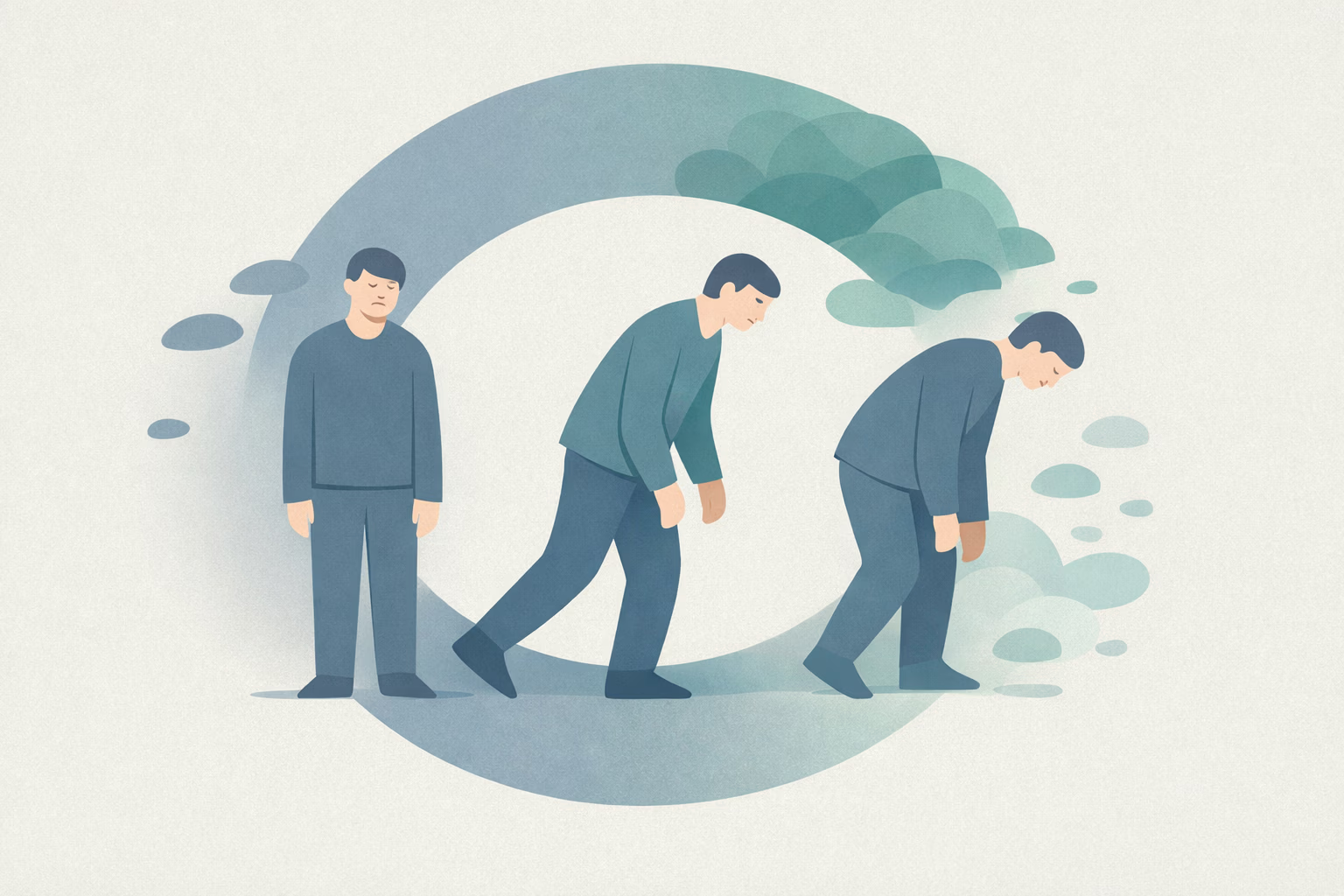
The Numb–Crave–Crash Cycle: Modern Life’s Emotional Loop
In short: Many people recognize a familiar sequence: a small wave of discomfort, a quick reach for the phone, a blur of time, and then a heavy drop—regret, irritation, self-criticism, or a tired kind of numbness. It can feel confusing because the scrolling seemed like a break.
Many people recognize a familiar sequence: a small wave of discomfort, a quick reach for the phone, a blur of time, and then a heavy drop—regret, irritation, self-criticism, or a tired kind of numbness. It can feel confusing because the scrolling seemed like a break. Yet the system often ends up more strained afterward.
What if this isn’t a motivation problem, but a closure problem?
In a nervous system sense, “scroll–escape–regret” is a modern regulation loop: a fast way to reduce load in the moment, paired with an environment that makes completion difficult. When the “done” signal never arrives, the mind doesn’t settle—and the cycle keeps offering itself as the quickest exit.
The loop often starts quietly. Not with drama, but with a small internal signal: strain, restlessness, mental clutter, or a sense of being behind. The phone appears as an immediate doorway out of that state—portable, socially acceptable, endlessly available.
Then time changes shape. Minutes turn into an hour. When attention returns to the room, there can be a sharper contrast: the original pressure is still present, plus the added friction of “Where did the time go?” and “Why did I do that again?” This pattern is common in problematic internet use, where regulation and attention become tightly linked to digital engagement. [Ref-1]
The key detail is structural: scrolling isn’t only entertainment. It functions like a rapid state-shift—an easy way to leave an unfinished moment without having to complete it.
Scrolling can deliver quick relief because it changes the nervous system state fast: novelty, micro-rewards, and constant updates narrow attention and temporarily soften internal noise. The system gets a short-lived sense of “better” without needing resolution.
But when the stimulation stops—or even pauses—the nervous system can rebound into a lower, harsher state. That’s when self-judgment often activates. Shame tends to show up here not as truth about who you are, but as a high-intensity signal meant to prevent repetition: “Don’t do that again.” Unfortunately, shame rarely creates stability; it increases threat and load, making the next escape more likely. Research links shame and problematic internet patterns in ways that reinforce this cycle. [Ref-2]
So the loop isn’t simply pleasure-seeking. It’s relief-seeking followed by a threat response directed inward.
Humans have always needed ways to reduce overload quickly. When conditions feel too intense, too uncertain, or too complex, the nervous system favors short-term stabilization over long-term coherence. In evolutionary terms, immediate downshifting can be protective—an attempt to conserve resources and prevent escalation.
In modern life, the “threat” is often not a predator but an accumulation: unresolved tasks, social ambiguity, financial pressure, constant comparison, and fragmented attention. Avoidance in this context doesn’t require a story about fear or suppression. It can simply be the system choosing the lowest-resistance path to reduce activation.
Reviews of internet addiction and emotional regulation patterns describe how digital behaviors can become linked to managing distress states, especially when other closure pathways are limited. [Ref-3]
Soothing and rest are not identical. Soothing is a state change; rest is a settling. Scrolling often provides the first: it lowers friction by replacing messy, ambiguous input with clean, predictable streams—swipe, refresh, next.
It can also reduce the felt complexity of the present moment. Real life contains mixed signals and incomplete loops: a conversation that didn’t land, a decision that isn’t made, a feeling that hasn’t found its endpoint. The feed offers a simpler contract: consume and move on.
When mobile social media use becomes problematic, it often correlates with experiential avoidance and reduced grounding in immediate experience—not as a moral issue, but as a regulatory outcome under load. [Ref-4]
The painful twist of the scroll–escape–regret loop is that it can create a net increase in load. The original discomfort gets postponed, not completed. Then additional pressures stack on top: lost time, disrupted focus, sleep erosion, and a growing sense that your attention is not fully yours.
This is why the aftermath can feel heavier than the beginning. The system returns to the same unresolved point, but now with fewer resources. That resource drop changes how everything feels: small tasks feel larger, relationships feel more effortful, and the future feels closer and more urgent.
Work on stress-coping and problematic social media use highlights how coping-by-distraction can be associated with higher distress over time, even when it works briefly in the moment. [Ref-5]
This cycle is often misunderstood as “lack of discipline.” A more accurate view is that it’s an avoidance loop fueled by stimulation: the nervous system learns that a quick hit of novelty reliably shifts state.
Over time, the brain begins to treat the phone as a primary regulator—especially during transition moments (before bed, after work, between tasks, after a socially dense interaction). The loop becomes efficient: discomfort → reach → relief → drop → self-attack → more discomfort.
Literature reviews on problematic internet use frequently describe a bidirectional relationship with emotional dysregulation: when regulation is strained, use increases; and when use becomes excessive, regulation and mood can worsen. [Ref-6]
The scroll–escape–regret loop rarely announces itself as a “problem.” It shows up as small, repeatable patterns that keep slipping past intention because they reduce friction quickly.
Systematic reviews describe these kinds of repetitive, hard-to-stop cycles as characteristic of problematic internet patterns, especially when distress and avoidance become paired with use. [Ref-7]
“It’s not that I want to be on my phone. It’s that being anywhere else feels harder for a moment.”
Self-trust isn’t a belief. It’s a bodily expectation built from repeated completion: “When I say I’m going to stop, I stop,” or “When I’m uncomfortable, I can stay present long enough for the moment to pass.” In the scroll loop, those completions get interrupted.
As interruptions accumulate, the nervous system starts to anticipate failure before it happens. That anticipation itself adds load. The result can look like fatigue, fog, and a growing reliance on the fastest regulator available.
Research reviews on internet addiction describe associations with reduced well-being and increased functional impairment over time, which can further narrow the options a person has for recovery of steadier regulation. [Ref-8]
Regret can be informative. Shame is different: it often acts like an internal alarm that says you are the problem. That message increases threat, and threat narrows behavior.
When shame rises, the nervous system looks for immediate downshift. The phone is already tagged as a reliable downshift. So shame, ironically, can become a trigger for the very behavior it condemns. This is one reason cycles of problematic use can persist even when someone strongly wants change.
Studies connecting shame with internet addiction patterns suggest shame can be part of the reinforcing mechanism, shaping how people cope and how they interpret their own behavior afterward. [Ref-9]
What if the “I did it again” moment is not proof of broken will, but proof of overload?
Urges often escalate when the nervous system senses rising load and predicts no clean endpoint. The body moves toward the quickest exit before the discomfort becomes unmanageable. In that sense, the urge is not irrational; it’s an early-warning signal that capacity is being exceeded.
This is also why “understanding the pattern” doesn’t automatically change it. Insight can name the loop, but integration requires a different thing: a physiological stand-down that comes after completion, not after analysis. When the system experiences more moments that actually end—moments that resolve rather than spin—urges tend to lose some urgency.
Reviews on problematic internet use emphasize the role of emotional dysregulation and stress reactivity in escalating use, especially when internal states intensify quickly. [Ref-10]
Digital stimulation isn’t the only way humans regulate. Nervous systems also settle through safe connection: being seen without being evaluated, sharing space without performing, receiving cues that you don’t have to manage everything alone.
What matters here isn’t forced vulnerability or “talking about feelings” as a project. It’s the presence of cues that reduce threat load: a steady voice, familiar rhythms, mutual attention, a sense of belonging that doesn’t demand constant output.
Research on internet addiction often points to interpersonal factors and social support as relevant to how and why people use the internet to cope, including patterns where weaker offline connection can increase reliance on online regulation. [Ref-11]
When the scroll–escape–regret loop starts to loosen, the change is often subtle before it is dramatic. It can look less like a sudden “new you” and more like small returns of capacity.
Importantly, this isn’t merely feeling more emotion. It’s the nervous system regaining a steadier baseline—more ability to come back online after stress, more ability to hold an unfinished moment without immediately escaping it.
Popular mental health education often notes that reducing doomscrolling is associated with improved mood and time awareness, though the deeper shift tends to be about decreased load and restored closure. [Ref-12]
A meaningful turning point is not “never wanting to scroll.” It’s when discomfort becomes more tolerable in small doses because life contains more completion—more moments that actually end, more signals of “enough,” more internal quiet after the day closes.
In that condition, the phone is less of an escape hatch and more of a tool. The body no longer needs to flee the moment as urgently, because the moment is no longer experienced as a trap.
Doomscrolling is often described as a response to uncertainty and threat-heavy information environments; the loop makes sense in a world that keeps delivering unfinished alarms. [Ref-13]
Coherence doesn’t arrive as a pep talk. It arrives when your system finally gets a real “done.”
It can help to hold this cycle with dignity: scrolling is not a moral failure, and regret is not a verdict. They are signals from a system trying to regulate in an environment that rarely offers clean stopping points.
The path out is less about forcing yourself into constant control and more about restoring conditions where completion can happen—where attention can land, where the day has edges, where your mind can receive “safe enough” cues instead of constant evaluation.
When presence becomes less punishing and more inhabitable, dependence softens. Not because you “tried harder,” but because your nervous system no longer needs the same escape route to get through the moment. [Ref-14]
Scrolling often promises rest, but it usually delivers stimulation with a brief anesthetic. Rest is different: it’s what happens when the system believes it has finished something and can power down.
If shame has been part of your loop, it may help to remember what shame is trying to do—protect you through intensity—while also recognizing its cost. When the inner environment becomes less threatening, regulation becomes easier to sustain. [Ref-15]
And when regulation is steadier, meaning has room to return: not as a concept, but as a lived sense that your time, your attention, and your life can belong to you again.
From theory to practice — meaning forms when insight meets action.
Because the loop runs without ever closing. A small wave of discomfort triggers a quick reach for the phone. Time blurs. Then comes the drop — regret, irritation, self-criticism, or tired numbness. Scrolling delivered fast relief by changing nervous-system state quickly: novelty, micro-rewards, narrowed attention. But relief is a state change, not closure. The original discomfort was postponed, not completed. Now there's the original strain plus added friction of lost time and 'why did I do that again?' Soothing isn't the same as rest. The phone is functioning as a rapid state-shift — an easy way to leave an unfinished moment without having to complete it.
Almost never. Shame acts like an internal alarm announcing that you are the problem, which increases threat and narrows behavior. When threat rises, the nervous system looks for an immediate downshift — and the phone is already tagged as a reliable downshift. So shame ironically becomes a trigger for the very behavior it condemns. This is one reason cycles of problematic use persist even when someone strongly wants change. Regret can be informative; shame compounds. The 'I did it again' moment is rarely proof of broken will. It's usually proof of overload meeting an environment that offers no clean stopping points. Compassion lowers internal hostility; hostility just adds load.
Because the brain learns that a quick hit of novelty reliably shifts state, and starts treating the phone as a primary regulator — especially during transition moments (before bed, after work, between tasks, after socially dense interactions). The cycle becomes efficient: discomfort, reach, relief, drop, self-attack, more discomfort. Each loop reinforces the wiring. Doomscrolling during uncertainty, 'just one more' checks, closing an app and reopening it seconds later, private scrolling for a pocket of relief — these aren't lack of discipline. They're an Avoidance Loop fueled by stimulation. Self-trust thins because completions get interrupted, and the system starts anticipating failure before it happens.
Subtle before dramatic. Time feels more trackable — less like a disappearance. The inner critic shows up with less intensity or leaves faster. Transitions like bedtime, waking, and waiting feel less precarious. The phone becomes one option among options, not the default regulator. Underneath, what's shifting is that life contains more completion — more moments that actually end, more signals of 'enough,' more internal quiet after the day closes. Discomfort becomes more tolerable in small doses because the moment is no longer experienced as a trap. The body no longer needs to flee as urgently. Coherence doesn't arrive as a pep talk. It arrives when the system finally gets a real Done Signal.
From Science to Art.
Understanding explains what is happening. Art allows you to feel it—without fixing, judging, or naming. Pause here. Let the images work quietly. Sometimes meaning settles before words do.
One Quiet Window, one insight, one reflection — every Sunday