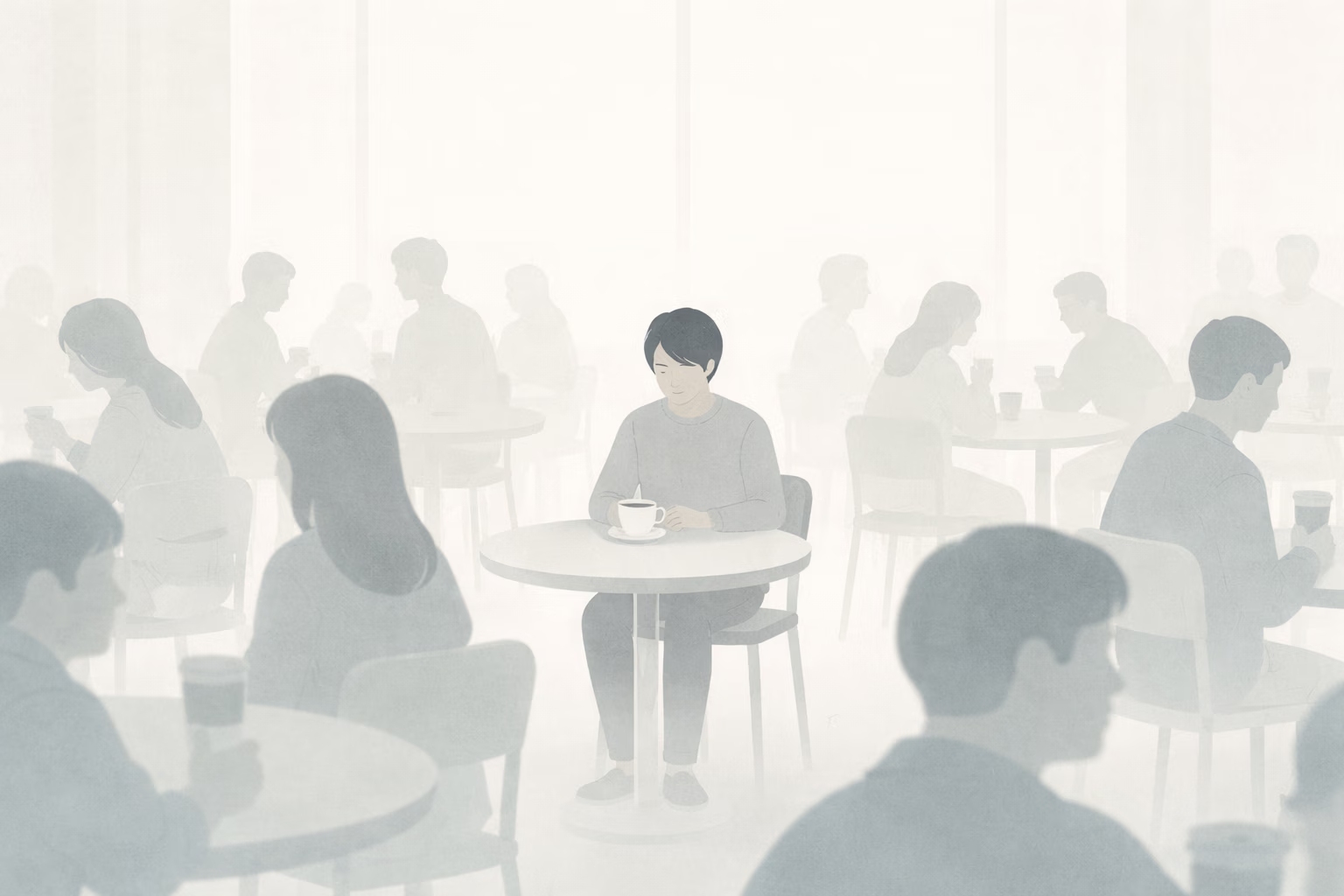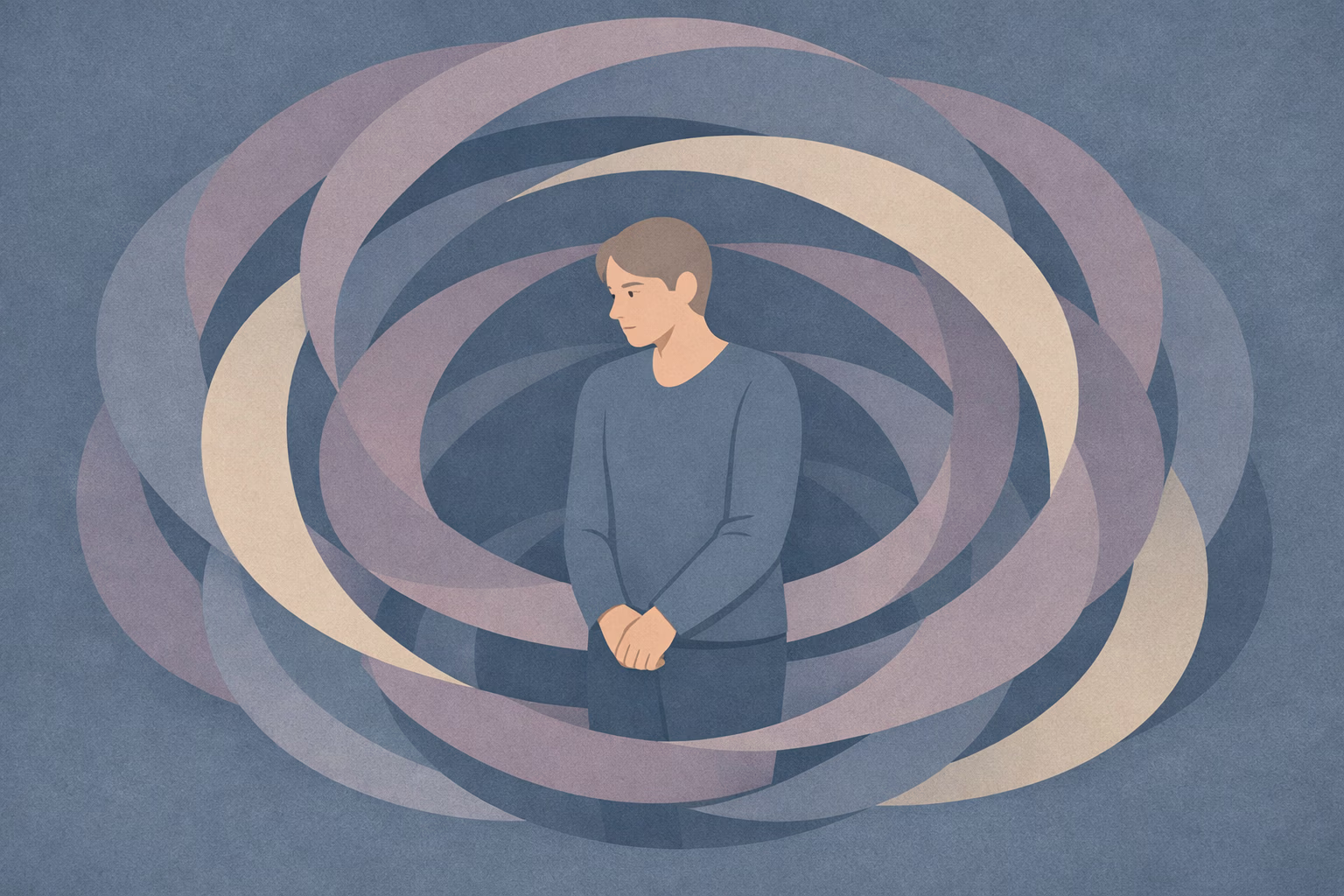
The Inner Critic Spiral: How Judgment Becomes Habit
In short: Clear opinions, sharp boundaries, strong certainty. But inside, it often functions less like “high character” and more like a stabilizer—something the nervous system reaches for when ambiguity, criticism, or social friction starts to feel unsafe.
Self-righteousness can look like confidence: clear opinions, sharp boundaries, strong certainty. But inside, it often functions less like “high character” and more like a stabilizer—something the nervous system reaches for when ambiguity, criticism, or social friction starts to feel unsafe.
In the Meaning Density Model™, this isn’t a personal defect. It’s a regulatory stance that helps create immediate structure: right/wrong, us/them, clean lines where life feels messy. Certainty becomes a way to reduce internal noise, restore control, and protect identity when things feel exposed.
What if “needing to be right” is sometimes a body-level attempt to feel safe?
Self-righteousness often arrives with a particular internal pressure: a sense that the stakes are high, that a point must be made, that something needs to be corrected. It can carry irritability, contempt, or a fast move to judgment—not because a person is cold, but because the system is loaded and seeking a quick resolution.
Underneath, there is often an uncomfortable split: part of the mind wants connection and respect, while another part insists on certainty to prevent a drop in status, safety, or self-worth. The body reads disagreement as a destabilizing signal, and “rightness” becomes the fastest way to re-stabilize. [Ref-1]
When the inside feels shaky, the outside can harden—because hard edges feel easier to hold.
Humans regulate through safety cues: tone of voice, belonging, predictable roles, and the sense that we’re still “okay” in the group. When those cues weaken—through criticism, uncertainty, rejection, or comparison—the nervous system tends to recruit control-based defenses.
Moral certainty is one of the cleanest forms of control. It reduces ambiguity, shortens decision-making, and creates immediate orientation. In that state, nuance can feel like danger—not emotionally in a story-based way, but structurally: nuance keeps the loop open, and open loops keep the system activated.
In a threat state, does “certainty” become the quickest route back to steadiness?
From this angle, self-righteousness isn’t a personality label. It’s a temporary architecture the system builds to hold itself together. [Ref-2]
Across human history, social standing has mattered for survival: access to resources, protection, and belonging. When safety depends on the group, the mind becomes highly sensitive to signals of rank, respect, and legitimacy.
Self-righteousness can be understood as a status-and-safety response. Moral language can function like armor: it asserts legitimacy (“I’m correct”), elevates position (“I see clearly”), and pushes threat away (“you are wrong, therefore you are the problem”). That isn’t “evil”; it’s a protective maneuver in a social species.
Many common features of self-righteousness map onto this: quick blame, rigid rules, intolerance for ambiguity, and an urge to correct others. These are not random habits; they are organized behaviors that create immediate hierarchy and certainty when the system is on alert. [Ref-3]
When the body is bracing for threat, it looks for fast closure: a conclusion, a verdict, a clear story that reduces uncertainty. Moral superiority offers that closure quickly. It compresses complexity into a single outcome—“I’m right, they’re wrong”—and the nervous system often experiences that as relief.
That relief is real, but it’s typically state-based rather than integration-based. The system feels steadier because ambiguity has been removed, not because the underlying tension has completed and settled into identity. This is why the same pattern often needs repeating: new friction reactivates the same loop, and certainty gets used again to restore control. [Ref-4]
If certainty works so well in the short term, why does it so often cost us later?
Self-righteousness can create a sensation of strength: decisiveness, moral clarity, a charge of energy. But the body pays for that strength through ongoing rigidity—tight scanning, quick reactivity, and a reduced tolerance for complexity.
One reason it can escalate is that blame and indignation can intensify arousal and narrow attention, making a person feel focused and justified. The nervous system interprets that narrowed focus as “effective.” Yet the same narrowing can reduce empathy, curiosity, and repair—elements that help experiences actually complete. [Ref-5]
In the Power Loop, control becomes the primary regulator. Instead of moving toward completion—where an experience lands, updates identity, and the body stands down—the system moves toward dominance: winning, proving, exposing, shaming, or performing virtue.
This is where public certainty can become intoxicating. It can bring quick rewards: attention, agreement, a sense of importance, a momentary drop in insecurity. But it also keeps the loop alive because the system learns: “I stabilize when I assert.” Over time, the person may need stronger expressions of certainty to get the same settling effect. [Ref-6]
When the world won’t give a “done” signal, the mind tries to manufacture one through verdicts.
Self-righteousness tends to look consistent because the environment repeatedly triggers the same configuration: social evaluation, comparison, conflict, or ambiguity. The resulting behaviors can appear like personality, but they function more like a reliable setting the system returns to under load.
Common expressions include:
These patterns often overlap with status pursuit dynamics—ways humans attempt to maintain standing and avoid diminishment when the social field feels unsafe. [Ref-7]
Because self-righteousness is built for protection, it can quietly trade away what it was trying to preserve. Relationships become less safe, not more. Conversations become narrower. The person can feel increasingly alone inside their certainty, even while appearing confident.
Over time, rigidity reduces learning—not because the person “won’t look inward,” but because the system cannot afford the destabilization that real updating requires. Growth requires a temporary openness to being wrong, incomplete, or uncertain. In a threat-loaded system, that openness reads as exposure.
The result is a particular kind of stuckness: high conviction with low completion. The posture stays upright, but the inner loops don’t close. [Ref-8]
When self-righteousness is running, vulnerability is structurally blocked—not through conscious suppression, but through bypassed resistance. The system moves around the unstable material by jumping to conclusion, blame, or moral verdict. That jump creates immediate order, but it interrupts completion.
Without completion, the underlying insecurity remains “unfiled.” It doesn’t settle into a coherent narrative of self. So the nervous system keeps detecting the same threat, again and again, and returns to the same stabilizer: superiority, distance, certainty.
In relationships, this often shows up as a cycle: conflict → moral stance → disconnection → intensified certainty. What looks like strength can be a sign that the system never receives the signal that repair or resolution has actually occurred. [Ref-9]
There is a common fear underneath rigid certainty: that if the stance relaxes, the self will fall apart. But self-respect does not require omniscience. A stable identity can hold imperfection, mixed motives, and partial knowledge without turning that into humiliation.
In nervous-system terms, acknowledging uncertainty can reduce threat activation because it ends the fight against reality’s complexity. The system no longer has to hold an impossible line—always correct, always justified, always ahead. This is not a sentimental “opening.” It’s a load reduction that makes room for completion to occur.
Sometimes what looks like grand certainty is actually a protective shell around a fragile sense of self. When the shell softens, the self doesn’t have to vanish; it can become more accurate and more durable. [Ref-10]
Power loops tighten when people feel unseen. Empathy doesn’t mean agreement; it means signaling recognition: “I understand how you got there.” That kind of recognition can act as a safety cue, lowering the need for dominance and making space for shared reality.
Listening—when it’s genuine—often interrupts defensive configurations because it shifts the interaction from ranking to relating. It reduces the social threat of being “less than” and invites a more balanced stance: two humans trying to understand, not two sides trying to win.
In psychological terms, defenses are often protective maneuvers that help us function under strain. When safety cues increase, defenses can become less necessary. [Ref-11]
Sometimes the most regulating experience is not being proven right—it’s being met.
As threat load decreases, a different quality becomes possible: flexibility. Not as a moral upgrade, but as a sign that the system has more capacity. Ambiguity becomes tolerable. Feedback becomes information rather than danger. The need to control the story relaxes.
This shift often includes a quieter inner environment: less scanning for disrespect, less urgency to correct, less compulsion to make the other person wrong. The person may still hold strong values, but those values no longer need constant performance or defense to feel real.
Research on intellectual humility suggests it relates to openness and better relational and learning outcomes—not because humility is “nice,” but because it allows new data to update the self without threatening it. [Ref-12]
What changes when your identity doesn’t depend on winning?
Humility is often misunderstood as self-erasure. In practice, it can be a form of stability: a self that doesn’t need to inflate to stay intact. When identity is oriented toward learning rather than dominance, conflict becomes less about protection and more about navigation.
From a Meaning Density perspective, humility supports coherence because it permits completion. Mistakes can be metabolized into identity rather than defended against. Conversations can end with real closure rather than lingering tension. Over time, the nervous system learns a new association: safety can come from truthfulness and repair, not only from control.
Evidence suggests intellectual humility predicts mastery-oriented behavior in learning contexts—showing how a non-defensive stance supports development over time. [Ref-13]
If self-righteousness has been part of your pattern, it may help to see what it has been doing for you: creating quick structure when you felt exposed, granting temporary relief when the social world felt unsafe, offering a ready-made “done” signal when life wouldn’t provide one.
That reframe doesn’t excuse harm. It does, however, reduce shame—and shame rarely creates closure. Seeing the pattern as a safety strategy can restore agency, because it locates the behavior in conditions and nervous system load rather than character.
When people feel protected enough to be honest, meaning tends to return: relationships become less like battlegrounds, values become lived rather than performed, and identity becomes something you inhabit rather than defend. Humility, in this sense, is not weakness—it’s a sign that the system is no longer trapped in the power loop. [Ref-14]
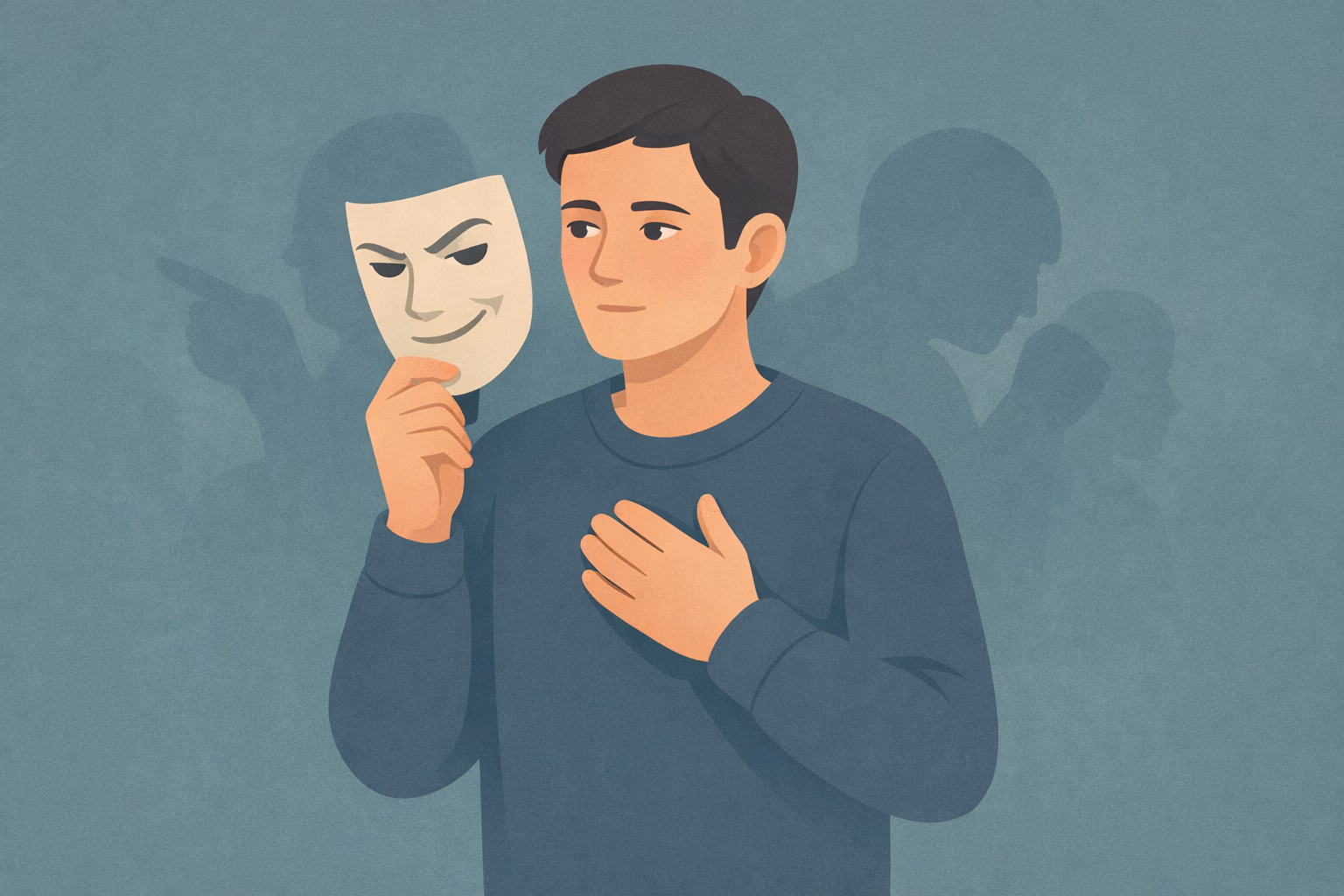
Self-righteousness often wears the mask of strength because it can create immediate steadiness. But lasting stability usually comes from a different place: a self that can stay intact without needing superiority, a nervous system that can stand down because enough loops have reached completion.
When moral certainty loosens its grip, what can emerge is not collapse, but coherence—values that feel grounded, relationships with more room to breathe, and a quieter confidence that doesn’t require proving. In many contexts, intellectual humility is linked with healthier learning and relationships, pointing to a form of strength built on reality-contact rather than defense. [Ref-15]
From theory to practice — meaning forms when insight meets action.
Often, yes — but not in a moralizing way. The article frames self-righteousness less as 'high character' and more as a stabilizer the nervous system reaches for when ambiguity, criticism, or social friction starts to feel unsafe. When the inside feels shaky, the outside hardens — because hard edges are easier to hold. The body reads disagreement as a destabilizing signal, and 'rightness' becomes the fastest way to re-stabilize. There's an uncomfortable internal split: part of the mind wants connection and respect, while another part insists on certainty to prevent a perceived drop in status, safety, or self-worth.
Because it offers fast closure. When the body is bracing for threat, it looks for a conclusion, a verdict, a clear story that reduces uncertainty. Moral superiority compresses complexity into a single outcome — 'I'm right, they're wrong' — and the nervous system experiences that as relief. The article distinguishes carefully: the relief is real but state-based rather than integration-based. The system feels steadier because ambiguity has been removed, not because the underlying tension has completed and settled into identity. That's why the same pattern keeps repeating — new friction reactivates the same loop, and certainty gets used again to restore control.
By replacing completion with dominance as the primary regulator. Instead of moving toward closure where an experience lands and the body stands down, the system moves toward winning, proving, exposing, shaming, or performing virtue. The article describes this as intoxicating short-term — attention, agreement, importance, a momentary drop in insecurity — but it keeps the loop alive because the system learns 'I stabilize when I assert.' Over time, stronger expressions of certainty are needed for the same settling effect. Vulnerability gets structurally blocked through bypassed resistance, the underlying insecurity stays unfiled, and the nervous system keeps detecting the same threat.
Not collapse — coherence. The article frames this as load reduction: when the system stops fighting reality's complexity, it no longer has to hold an impossible line of always correct, always justified, always ahead. Flexibility becomes possible — not as a moral upgrade but as a sign of more capacity. Ambiguity becomes tolerable, feedback becomes information rather than danger, the need to control the story relaxes. People may still hold strong values, but those values no longer require constant performance or defense. Sometimes the most regulating experience isn't being proven right — it's being met. Mistakes can finally metabolize into identity rather than be defended against.
From Science to Art.
Understanding explains what is happening. Art allows you to feel it—without fixing, judging, or naming. Pause here. Let the images work quietly. Sometimes meaning settles before words do.
One Quiet Window, one insight, one reflection — every Sunday