
Lack of Tribe: Why Modern Life Exaggerates Threat Loops
In short: For much of human history, living completely alone was rare—not because people lacked independence, but because survival and daily life were organized around shared proximity. Today, many people can meet material needs in private, behind a door, with minimal reliance on others.
For much of human history, living completely alone was rare—not because people lacked independence, but because survival and daily life were organized around shared proximity. Today, many people can meet material needs in private, behind a door, with minimal reliance on others. And yet a quiet kind of distress keeps showing up in the background: a sense of disconnection that doesn’t always have a clear story.
Why can you be “fine” on paper and still feel like something is missing?
The loneliness epidemic isn’t just about the number of people around you, or whether you have a phone full of contacts. It’s about what the nervous system expects as a baseline for safety and orientation—and what happens when the signals of everyday belonging don’t arrive consistently.
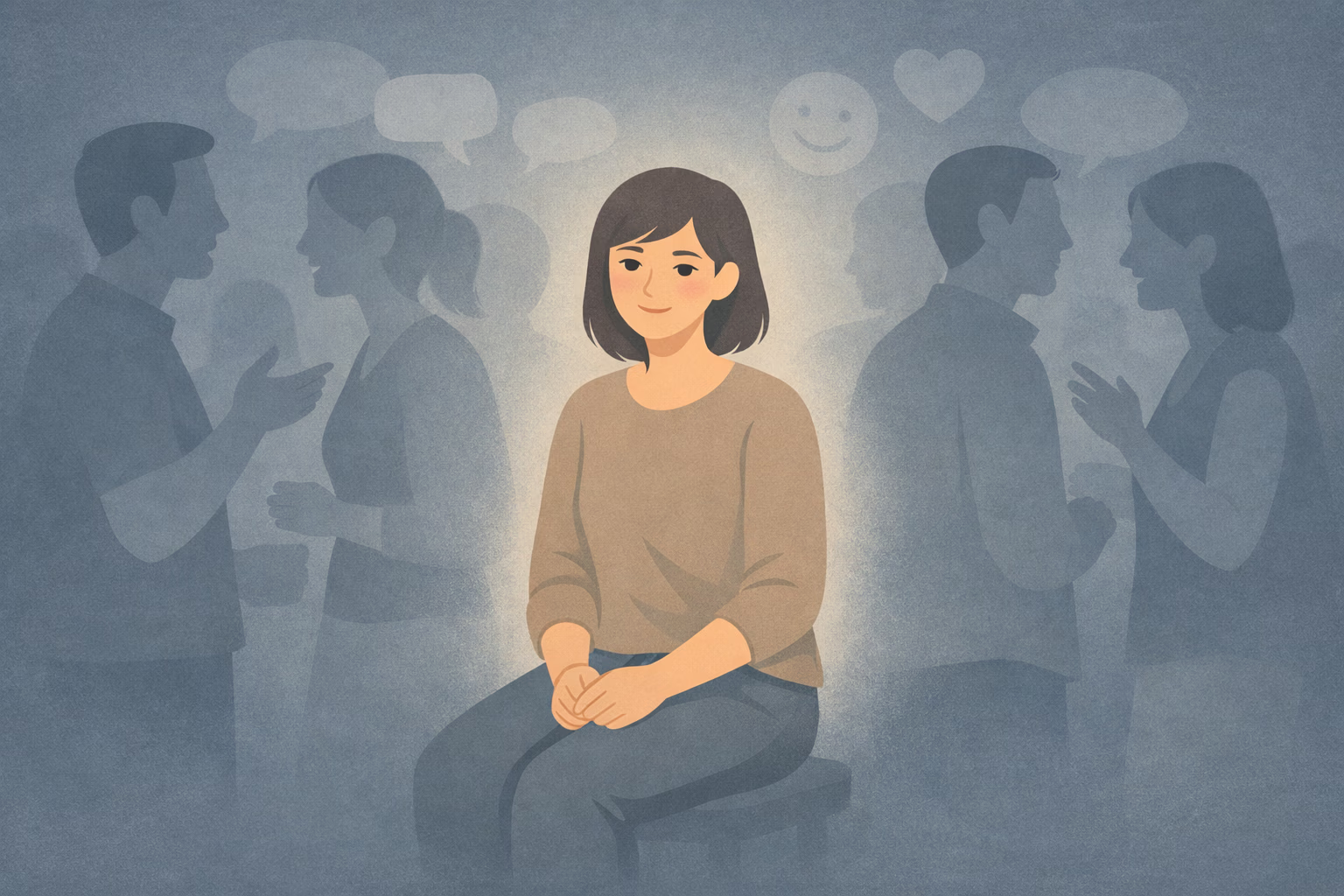
Loneliness often isn’t dramatic. It can look like a well-managed calendar, a clean apartment, and a life that functions—paired with a vague emptiness that doesn’t respond to logic. The mind may say, “Nothing is wrong,” while the body carries a different message: unfinished, unconfirmed, not quite anchored. [Ref-1]
This is why loneliness can feel like quiet despair instead of obvious sadness. It isn’t always a single emotion; it’s a lack of completion. Without regular moments of mutual recognition—small exchanges that close the loop of “I exist here with others”—the system can stay subtly open-ended, like a sentence that never quite ends.
Some kinds of pain come from what isn’t happening, not from what is.
Humans don’t only evaluate safety through physical threats. We also evaluate safety through social continuity: familiar faces, predictable contact, and the implicit sense that support would be available if needed. When those cues are missing, the nervous system can shift into a guarded mode even if your environment is objectively safe. [Ref-2]
In that guarded mode, the body may run “just in case” energy—tension, scanning, sleep disruption, irritability, or a background urgency. Not because you are broken, but because the system is built to interpret prolonged aloneness as a context where risk is harder to manage.
It can feel confusing: “Why am I on edge when nothing is happening?”
From an evolutionary perspective, humans are tribe-dependent mammals. Our brains developed in conditions where people were typically within earshot, and where the day contained repeated micro-moments of coordination—sharing tasks, tracking one another’s moods, exchanging glances, working near each other.
That proximity does something biological: it buffers stress and helps the nervous system downshift after challenge. Being near trusted others offers “safety cues” that make recovery from daily strain more efficient. [Ref-3]
So when modern life removes routine proximity, it doesn’t only remove companionship. It removes a stabilizing rhythm that the body expects as normal.
It’s important to name the genuine advantages of living alone: privacy, control over your space, fewer conflicts, and more freedom to think and move without negotiation. For many people, independence has been protective and liberating.
Autonomy can also bring a clear sense of self. You learn what you like, what you need, what you value—without constant compromise. And for those whose earlier environments were intrusive or unpredictable, solitude can feel like relief.
There is nothing inherently “wrong” with living alone. The issue is not independence; it’s the hidden biological cost when autonomy becomes long-term social absence—especially when there are few reliable ways for the system to receive belonging signals. [Ref-4]
In modern culture, self-sufficiency is often framed as a personal achievement: paying bills, keeping up with responsibilities, functioning without help. But nervous systems don’t measure wellbeing the way resumes do. They measure it by regulation, recovery, and the availability of safe contact.
Social contact is not just a “nice to have.” It influences stress physiology and helps the body return to baseline after load. When contact is sparse or inconsistent, the system may compensate with control, stimulation, or withdrawal—strategies that reduce immediate friction but don’t always create the internal “done” signal that comes from being held in a shared world. [Ref-5]
When connection feels uncertain, effortful, or inconsistent, many people drift into a self-protective pattern: fewer invitations, fewer risks, fewer bids for contact. Not as a conscious choice, and not because of a character flaw—more as a regulatory response to incomplete social loops.
In avoidance loops, the nervous system learns that reaching out doesn’t reliably resolve into closure. Messages hang. Plans dissolve. Conversations stay surface-level. Over time, the system may choose the lowest-friction option: reduce contact, reduce exposure, reduce the chance of another incomplete ending. That can lower immediate strain while widening the gap that created the strain in the first place. [Ref-6]
This is how loneliness can persist even in people who are capable, kind, and socially skilled. The pattern isn’t an identity. It’s what a system does when completion is rare.
Loneliness often shows up less as a single feeling and more as a shift in baseline. The body and mind adapt to low belonging input by conserving, dampening, and narrowing. This is not “laziness” or “being unmotivated.” It’s load management.
Some common expressions include: [Ref-7]
These patterns can make sense as short-term regulation: they reduce friction and keep the day moving. The cost is that they also reduce the chances for the system to receive the confirming feedback of shared presence.
Over time, prolonged isolation can behave like chronic stress: not always intense, but continuous. When recovery signals are limited, the body may carry more allostatic load—wear and tear from staying activated without enough completion. [Ref-8]
This can look like rising anxiety, depressed mood, increased stress sensitivity, and a harder time bouncing back from small setbacks. It can also look like identity erosion: when days contain fewer shared mirrors—fewer moments where your roles are confirmed (friend, neighbor, teammate, sibling)—the sense of “who I am in the world” can feel less solid.
Importantly, this is not because people are failing at coping. It’s because coping is being asked to replace what community used to provide: frequent, low-effort cues that life is held together with others.
Social confidence is partly a skill, but it’s also a state. When you have regular contact, your nervous system stays practiced in the micro-timing of conversation: turn-taking, facial cues, repair after awkwardness. When contact decreases, that timing can get rusty.
Then a predictable spiral can emerge: fewer interactions lead to more activation during the interactions that do happen. Afterward, the body may interpret the activation as evidence that contact is “costly,” even if the interaction went fine. This can reinforce further withdrawal—not because of conscious fear, but because the system is tracking effort and consequence. [Ref-9]
When connection becomes rare, it can start to feel like a performance instead of a place.
When steady community isn’t available, people often assume they must replace it with motivation or self-discipline. But loneliness doesn’t usually resolve through pressure. Pressure adds load. What helps the system stabilize is coherence: experiences that complete, settle, and become part of lived identity rather than remaining open loops.
“Inner safety” in this context isn’t a mood and it isn’t a thought. It’s the body’s sense that it can stand down because something has resolved: a moment of being seen, a predictable rhythm, a relationship that holds continuity, a role that is real in practice—not just in principle. Attachment systems are especially sensitive to consistency, not intensity. [Ref-10]
So the bridge here is not “think differently,” but “recognize what your system has been missing.” That recognition doesn’t integrate the lack by itself, yet it can reduce shame by placing the experience where it belongs: in biology, history, and conditions.
Belonging isn’t only formed through big friendships or perfect social lives. Mammalian nervous systems respond to repeated, low-stakes proximity: brief chats, familiar routines, small moments of mutual acknowledgment.
These interactions matter because they deliver frequent “return” signals: your presence lands, someone responds, a loop completes. Over time, that can reduce the effort cost of contact and make the body less vigilant during social moments. Social buffering research shows that supportive presence can dampen stress responses—even when no problem is being solved. [Ref-11]
When belonging signals become more consistent, people often describe changes that are surprisingly practical. Not a constant glow of happiness, but a shift in baseline: more warmth in the body, more spontaneous energy, more capacity to recover after stress. [Ref-12]
Life can start to feel “inhabited” again. Meals feel like actual meals. Weekends feel less like blank space to manage. There is often a renewed sense of being grounded in ordinary time—because the nervous system is getting more regular confirmation that the world includes you.
Coherence is often quiet.
It can show up as fewer internal negotiations, fewer compensatory cravings for stimulation, and more moments where the system naturally settles after contact rather than staying activated.
Isolation changes behavior because it changes what feels available. When the environment offers few stable connection points, the system adapts: it minimizes bids, narrows needs, and leans on substitutes. That adaptation is understandable. It is also reversible when conditions allow more completion.
Intentional connection, in this frame, isn’t a self-improvement project. It’s a movement toward values becoming lived again—toward roles that are enacted in real time: being someone’s neighbor, colleague, friend, familiar face. Values-based behavior isn’t powered by hype; it’s stabilized when actions repeatedly resolve into identity-level “this is my life.” [Ref-13]
As those loops complete, agency tends to return. Not as force, but as orientation: you know where you belong, what you’re part of, and what your presence means.
Loneliness can sound like self-criticism—“I’m behind,” “I’m unlikable,” “I should be more social.” But at its core, it is often a contact signal: the nervous system noting a shortage of belonging cues and continuity. Interpreting it as a personal failure adds a second burden on top of the first. [Ref-14]
Many people are carrying loneliness in silence precisely because they are competent. They can function. They can handle things. But functioning is not the same as being held in a relational world where experiences regularly complete.
When loneliness is seen as information—about load, about missing closure, about the human need for shared presence—shame has less to attach to. And meaning has more room to return.
Resilience is often described as something individuals possess. But for social mammals, resilience is also something environments provide: predictable contact, mutual recognition, and the steady confirmation that you don’t have to carry reality alone.
When shared presence becomes part of life again, the body receives permission to stand down. Not through willpower, and not through constant stimulation, but through completion—through the ordinary, repeated experience of being met. That is where meaning becomes dense again: not as an idea, but as a lived sense of “I am here, and I am with.” [Ref-15]
From theory to practice — meaning forms when insight meets action.
Because loneliness often isn't dramatic — it can look like a managed calendar, a clean apartment, a life that functions, paired with a vague emptiness that doesn't respond to logic. The mind says 'nothing is wrong' while the body carries a different message: unfinished, unconfirmed, not quite anchored. This isn't a single emotion; it's a lack of completion. Without regular moments of mutual recognition — small exchanges that close the loop of 'I exist here with others' — the system stays subtly open-ended. The Attachment & Belonging System tracks signals continuously. Some kinds of pain come from what isn't happening, not from what is.
Because humans don't only evaluate safety through physical threats. The nervous system also tracks social continuity: familiar faces, predictable contact, the implicit sense that support would be available. When those cues are missing, the system shifts into a guarded mode even when the environment is objectively safe. In that mode the body runs 'just in case' energy — tension, scanning, sleep disruption, irritability, background urgency. Humans evolved as tribe-dependent mammals; proximity buffers stress and helps the system downshift after challenge. When modern life removes routine proximity, it doesn't only remove companionship — it removes a stabilizing rhythm the body expects as normal.
Often yes, structurally. When connection feels uncertain or effortful, people drift into self-protective patterns: fewer invitations, fewer risks, fewer bids for contact — not as conscious choice, but as regulatory response to incomplete social loops. The system learns that reaching out doesn't reliably resolve into closure. Messages hang. Plans dissolve. Conversations stay surface-level. Over time, the system chooses the lowest-friction option: reduce contact, reduce exposure, reduce the chance of another incomplete ending. That lowers immediate strain while widening the gap that created it. The pattern persists in capable, kind, socially skilled people — it isn't an identity, it's what a system does when completion is rare.
Because mammalian nervous systems respond to repeated, low-stakes proximity: brief chats, familiar routines, small moments of mutual acknowledgment. These deliver frequent return signals — your presence lands, someone responds, a loop completes. Attachment systems are sensitive to consistency, not intensity. Familiarity creates predictability; predictability reduces activation; reduced activation makes connection feel less expensive. When belonging signals become more consistent, the change is practical: more warmth in the body, more spontaneous energy, more capacity to recover after stress. Life feels inhabited again. Coherence is often quiet — fewer compensatory cravings for stimulation, more moments where the system settles after contact rather than staying activated.
From Science to Art.
Understanding explains what is happening. Art allows you to feel it—without fixing, judging, or naming. Pause here. Let the images work quietly. Sometimes meaning settles before words do.
One Quiet Window, one insight, one reflection — every Sunday