Porn Overstimulation: When Pleasure Exceeds What the Brain Evolved For

In short: Many people describe the same confusing arc: a surge of excitement, a short window of relief, and then a fast slide into flatness—sometimes paired with restlessness, self-disgust, or a sharp need to “fix” the feeling. It can look like a moral problem from the outside, but inside it often feels more like a nervous system that can’t land.
Many people describe the same confusing arc: a surge of excitement, a short window of relief, and then a fast slide into flatness—sometimes paired with restlessness, self-disgust, or a sharp need to “fix” the feeling. It can look like a moral problem from the outside, but inside it often feels more like a nervous system that can’t land.
Why does something that promises satisfaction so reliably end in a crash?
One grounded way to understand this is structural rather than personal: high-intensity novelty can spike reward signaling, and the brain-body system then compensates to protect balance. The compensation is the “downshift” that makes ordinary life feel muted for a while. The loop isn’t an identity—it’s a regulation pattern that forms when the system keeps getting pulled into peaks without getting enough closure afterward.
A common report is not just pleasure, but a rapid fade: excitement becomes neutrality; neutrality becomes agitation. The body may feel keyed up while the mind feels blank. The result is often an urge to return—not because a person “lacks discipline,” but because the system is trying to climb back to a livable state. [Ref-1]
In this arc, satisfaction doesn’t settle into a “done” signal. Instead, the experience ends with an open loop: unfinished activation, unfinished settling. When closure is missing, the nervous system stays partially online, scanning for the next lever that will change state quickly.
It’s not that it didn’t work. It’s that it worked fast—and then left the system without a landing.
Dopamine is often described as “pleasure,” but in many contexts it functions more like a relevance and pursuit signal—helping the brain allocate attention, energize seeking, and mark what is worth repeating. When stimulation is unusually intense and novel, that signaling can surge. [Ref-2]
The nervous system, however, is built to maintain balance. After repeated spikes, compensatory mechanisms can reduce sensitivity or shift baseline responsiveness for a time—so the same everyday inputs (conversation, food, sunlight, ordinary touch, routine progress) register as less compelling. This is not punishment. It’s the system protecting itself from staying in overdrive.
That “below baseline” period is what many people call the crash: low drive, low enjoyment, irritability, and a sense that something is missing—often paired with a narrow focus on the fastest route back to intensity.
Human reward circuitry evolved in environments where novelty was intermittent and rewards usually required effort, time, and risk. In that setting, spikes in motivation and seeking were useful—they helped us pursue scarce opportunities and then return to baseline after completion.
Online pornography can behave like a “supernormal stimulus”: high novelty, high salience, and rapid variability with little delay. The system that once tracked rare opportunities is suddenly surrounded by endless ones. It’s not surprising that the brain learns quickly here; it’s doing what it was designed to do—prioritize what seems most biologically relevant. [Ref-3]
When the environment supplies intense novelty without natural endpoints, the learning is fast, but the “done” signal is harder to reach. The loop stays open.
The pull is rarely just about sex. For many people, the stronger effect is immediate state change: boredom becomes charged; stress becomes quieter; ambiguity becomes a single task with a clear outcome. That can feel like certainty in a world that otherwise feels scattered.
In nervous-system terms, the experience can temporarily organize attention and reduce diffuse load—like flipping from many open tabs to one dominating screen. The body reads that narrowing as relief, even if the relief is short-lived. Over time, the brain may begin to associate this specific intensity with “safety cues” (predictability, quick completion, controllable outcome), even when the aftermath is unpleasant. [Ref-4]
So the cycle isn’t irrational.
It’s a reliable short-term regulator inside an unreliable long-term pattern.
The mind often reaches for a simple explanation: I just need one more session to feel normal. That story makes sense during a crash because the system is under-stimulated and urgently seeking restoration. The trouble is that the same lever that lifts the state also tends to deepen the compensatory downshift afterward.
As intensity becomes the fastest route to relief, satisfaction gets redefined as “not crashing.” And because the crash returns, the brain updates the prediction: relief is possible, but only through the same channel—creating a narrowing of options.
This is where shame often appears. But shame usually misunderstands the mechanics: it treats a predictable rebound effect like a personal contradiction, rather than a load-and-closure problem.
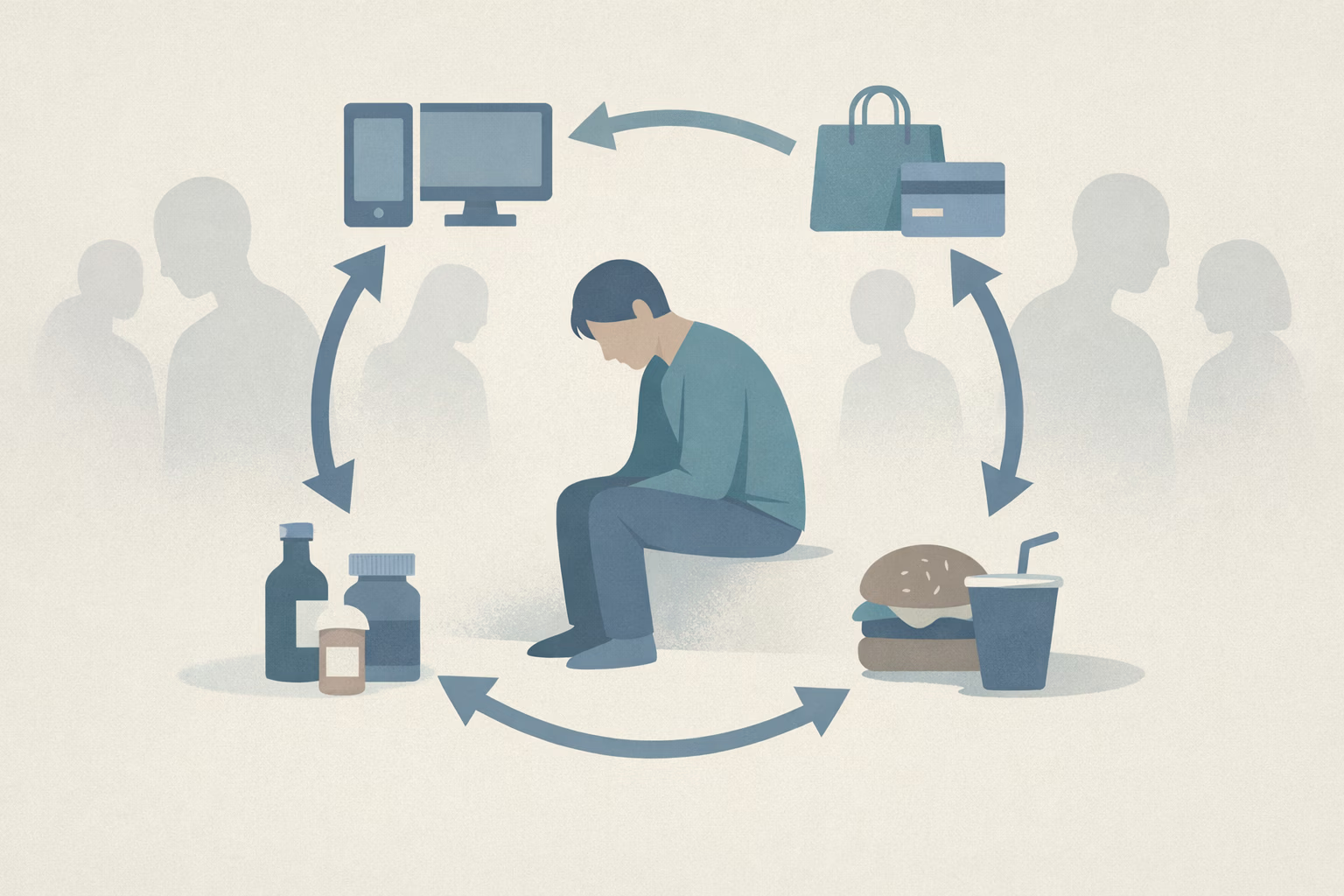
This pattern is often a classic pleasure loop: a rising urge (discomfort, flatness, restlessness), a quick stimulus that changes state, and then a rebound that returns the original discomfort—often sharper—so the next urge arrives sooner. [Ref-6]
From the inside, it can feel like “I keep choosing the thing I don’t even want.” Structurally, it’s more like: the nervous system learns that one pathway offers immediate regulation, while slower pathways (rest, connection, ordinary accomplishment) feel temporarily unavailable because the baseline is low.
What looks like “lack of motivation” is often a narrowed reward landscape. The system is not refusing life; it’s momentarily unable to register life as rewarding enough to move toward.
The porn–dopamine crash cycle doesn’t always look dramatic. It can look like subtle dependence on intensity to initiate interest or feel “online.” Over time, the signs are often more about pattern than frequency. [Ref-7]
None of these signals prove anything about who you are. They describe how a reward system adapts when quick peaks become the main route to relief.
When a nervous system repeatedly cycles through high peaks and compensatory drops, the middle range can start to feel faint. People often describe it as muted motivation, less joy, and a kind of grayness—especially around simple, low-intensity pleasures. [Ref-8]
This doesn’t mean life has become meaningless. It often means the reward system is temporarily calibrated to a level of intensity that everyday inputs can’t match. The world may be offering signals, but the receiver is turned down.
Relationships can be affected too—not because connection is “not enough,” but because connection is slower. Relational rewards are often distributed across time: warmth, trust, shared attention, subtle cues. Those signals are easiest to register when baseline sensitivity is intact.
Craving is often framed as desire. In a crash cycle, it can be closer to a homeostasis alarm: the system is below baseline and flags the fastest known route back to functional. That can make returning to stimulation feel necessary, not optional—like restoring oxygen rather than choosing dessert. [Ref-9]
This is why willpower often fails as the primary explanation. In a low-baseline state, the brain narrows toward whatever previously restored state quickly. The choice set shrinks, and the urgency grows.
Seen this way, the loop is less about “bad habits” and more about incomplete recovery time between spikes—insufficient settling, insufficient closure, insufficient return of ordinary reward.
There’s a quiet reframe that changes the emotional temperature of this topic: the goal of a reward system isn’t to produce constant intensity. It’s to support sustainable engagement with life—so effort, curiosity, and satisfaction can arise and then resolve.
When intensity is repeatedly high, the system learns to expect high. When intensity reduces, the system can gradually regain sensitivity to the middle range again—so normal life feels more “enough.” This is less like a motivational breakthrough and more like a physiological recalibration that becomes possible when load drops and completion is allowed to register. [Ref-10]
In other words: satisfaction lasts when the nervous system is permitted to land, not when stimulation keeps it airborne.
One reason digital stimulation is so compelling is its tight timing: cue → peak → outcome, with high variability and minimal friction. Variability and frequency are powerful learning drivers for reward systems. [Ref-11]
Connection works differently. Attuned presence—being seen, being responded to, sharing attention—delivers smaller signals that accumulate. It doesn’t “hit” the system so much as it buffers it, giving the body more cues of safety and less need for emergency regulation.
This isn’t a sentimental claim. It’s about pacing: relational reward is slower and more integrative, and it tends to produce fewer violent rebounds. When it goes well, it creates a kind of closure the nervous system recognizes as completion rather than extraction.
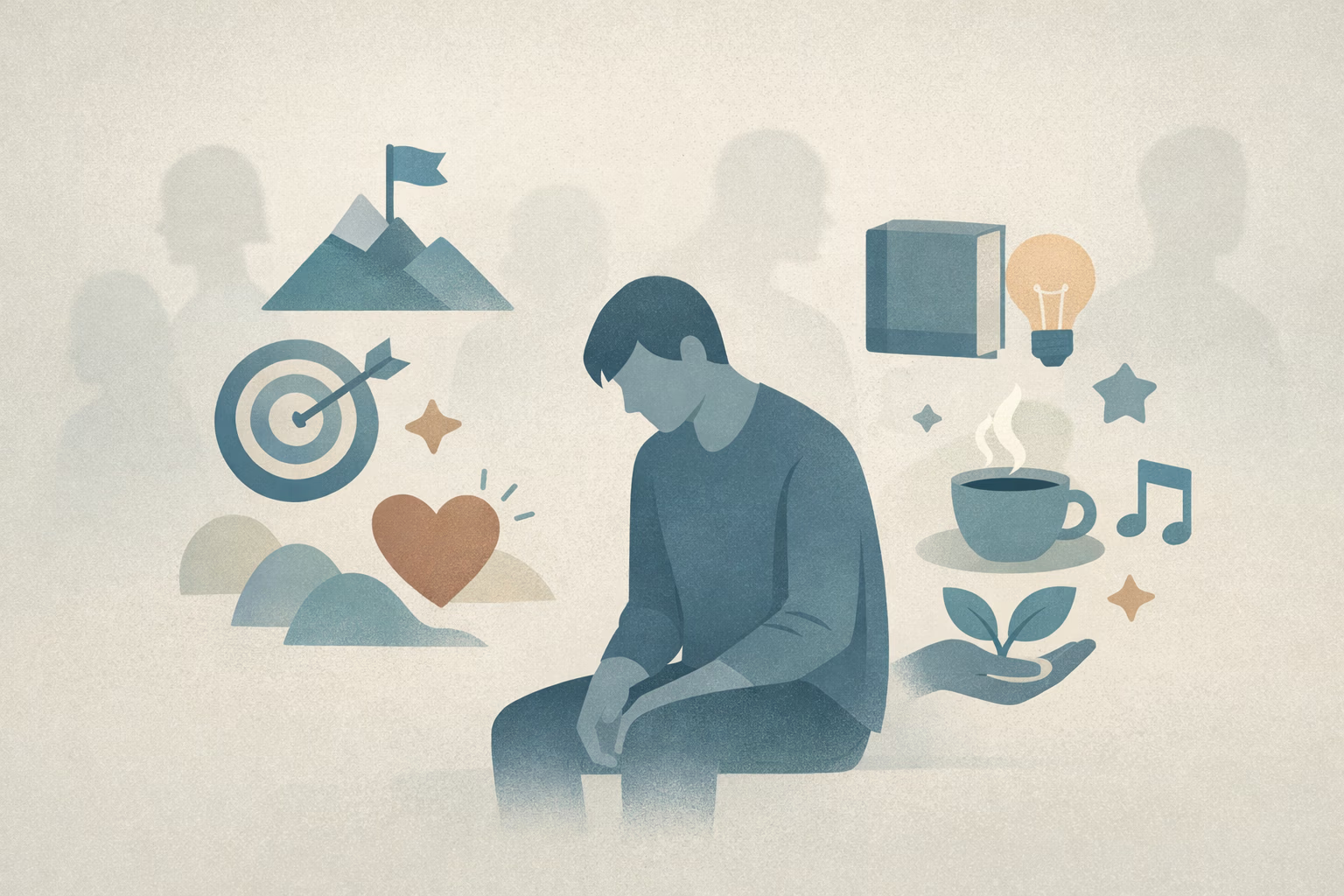
As baseline reward sensitivity returns, people often notice changes that are easy to miss at first: a steadier mood, less sharp irritability, and more responsiveness to ordinary good things. The system begins to register small rewards again—music, movement, progress on a task, a calm evening, a real conversation. [Ref-12]
Satisfaction also tends to last longer. Not because life becomes constantly pleasant, but because experiences can complete. The nervous system receives more “done” signals—moments that close rather than reopen the loop.
It’s less like needing a jolt to feel alive, and more like being able to stay with a day without chasing an exit.
When the reward system is no longer dominated by high-intensity prediction and rapid variability, desire often reorganizes. The brain becomes more willing to invest in rewards that are less certain but more sustaining—learning, intimacy, creative work, health, craftsmanship, contribution.
Dopamine is deeply involved in how we estimate what is worth pursuing under uncertainty. When the system is repeatedly trained on fast, certain outcomes, it can become biased toward the immediate and the guaranteed. When that bias softens, broader pursuits regain credibility—things that don’t pay instantly, but build a life that feels coherent. [Ref-13]
This is where meaning becomes practical: not as a belief, but as a lived orientation that reduces fragmentation. The more life contains completions that align with values, the less the nervous system needs emergency intensity to feel organized.
The porn–dopamine crash cycle can be read as a signal of mismatch: human reward systems were built for paced novelty, effortful reward, and natural endpoints. When stimulation is engineered for speed, intensity, and endless continuation, the system adapts—and then pays for adaptation with a lower baseline.
In that light, the “never lasting” feeling isn’t proof that satisfaction is impossible. It’s evidence that the system is being asked to live without enough closure. And when closure returns—when experiences can complete and settle—agency tends to reappear as a byproduct of restored capacity, not as a forced mindset. [Ref-14]
If you recognize yourself in this cycle, it can help to hold a dignified truth: your nervous system is responding to conditions, not revealing a defect. Peaks and crashes are what many reward systems do under repeated high-intensity variability.
Lasting satisfaction is less about chasing the next hit and more about respecting human limits—pace, recovery, and the kinds of reward that integrate into identity and relationship rather than evaporate on impact. Over time, when reward signaling is not constantly forced upward, it becomes more trustworthy again. [Ref-15]
From theory to practice — meaning forms when insight meets action.
Because the nervous system maintains balance. After unusually intense and novel stimulation, compensatory mechanisms reduce sensitivity or shift baseline responsiveness for a time — so the same everyday inputs register as muted afterward. This isn't punishment; it's the system protecting itself from staying in overdrive. The crash is the predictable downshift, not a personal failing. Dopamine is less about pleasure than about relevance and pursuit, marking what's worth repeating. When the spike was high, the trough is low, and ordinary reward gets temporarily under-registered. The experience ends with an open loop: unfinished activation, unfinished settling, no clean Done Signal.
Yes. Human reward circuitry evolved where novelty was intermittent and rewards required effort, time, and risk — so spikes in seeking helped pursue scarce opportunities and then return to baseline after completion. Online pornography behaves like a supernormal stimulus: high novelty, high salience, rapid variability, no delay. The system that once tracked rare opportunities is now surrounded by endless ones. The brain learns fast because that's what it was designed to do. The structural problem is environmental: intense novelty without natural endpoints. Calling the loop a character defect misses the wiring. It's a Pleasure Loop running inside a context the body wasn't built to navigate.
Because when the system repeatedly cycles through high peaks and compensatory drops, the middle range goes faint. Music, conversation, ordinary touch, a calm evening, real progress on a task — these get harder to register because the receiver is temporarily turned down. People often describe muted motivation, less joy, a kind of grayness around low-intensity pleasures. Relationships can feel slower not because connection is insufficient, but because relational rewards are distributed across time — warmth, trust, shared attention — and those signals are easiest to register when baseline sensitivity is intact. What looks like lack of motivation is often a narrowed reward landscape.
Through baseline recovery, not bigger peaks. The reward system's purpose isn't constant intensity — it's sustainable engagement so effort, curiosity, and satisfaction can arise and resolve. When intensity drops and completion is allowed to register, sensitivity to the middle range gradually returns. This is physiological recalibration, not a motivational breakthrough. Connection helps because attuned presence delivers smaller signals that accumulate, buffering the system instead of extracting from it. Satisfaction lasts when the nervous system is permitted to land, not when stimulation keeps it airborne. Loop Sovereignty here is about respecting human pacing — peaks, recovery, and reward that integrates rather than evaporates.
From Science to Art.
Understanding explains what is happening. Art allows you to feel it—without fixing, judging, or naming. Pause here. Let the images work quietly. Sometimes meaning settles before words do.
One Quiet Window, one insight, one reflection — every Sunday