Pleasure Desensitization: Why Normal Life Feels “Too Boring”
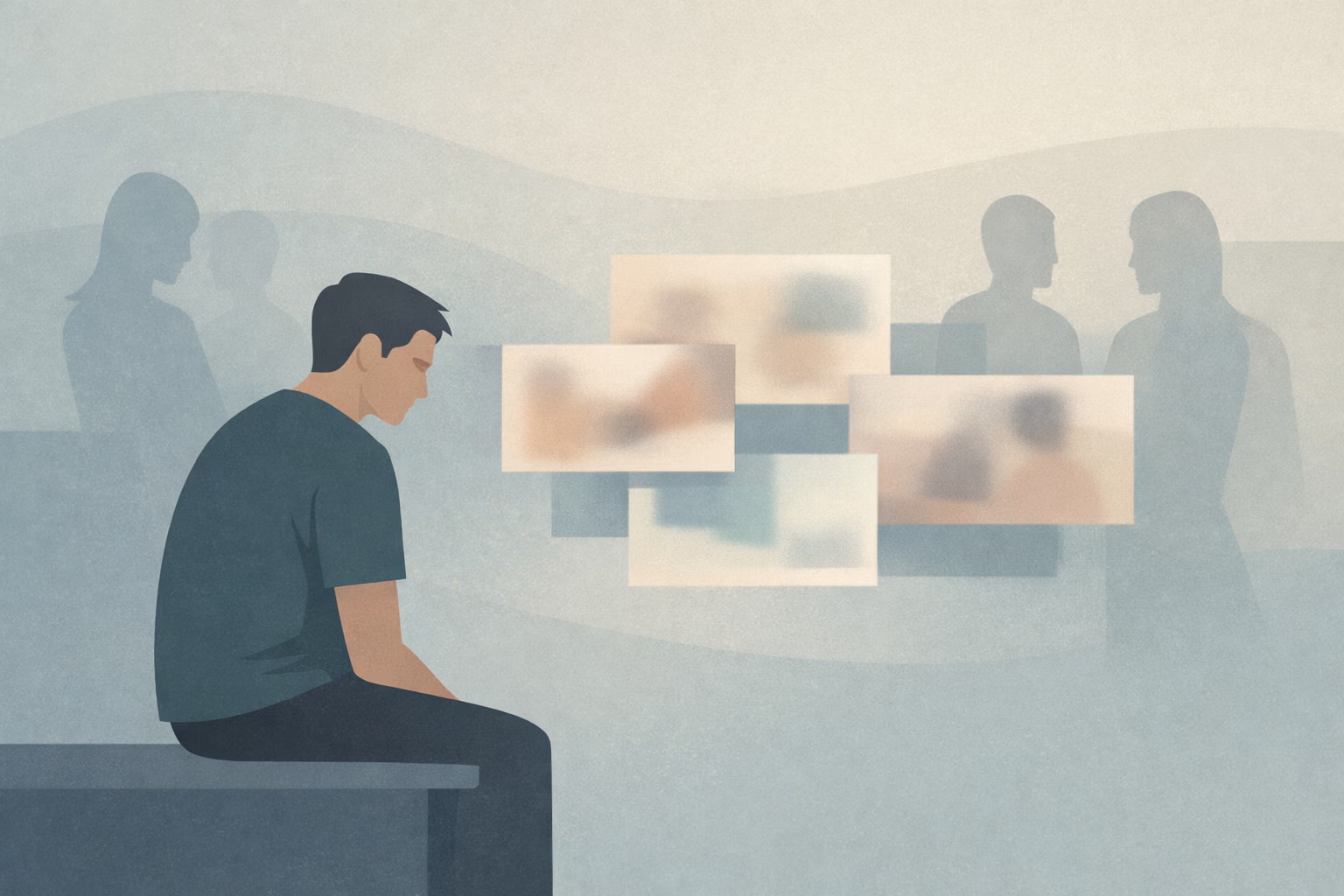
In short: Porn overstimulation isn’t a character flaw, a lack of love, or a sign that something is “wrong” with you. It’s often what happens when a human reward system—built for occasional novelty and real-world pacing—meets limitless, on-demand sexual intensity.
Porn overstimulation isn’t a character flaw, a lack of love, or a sign that something is “wrong” with you. It’s often what happens when a human reward system—built for occasional novelty and real-world pacing—meets limitless, on-demand sexual intensity.
In older environments, sexual cues were bounded by context: time, privacy, relationship dynamics, and the reality of another person. Today, high-definition novelty can arrive instantly, with no interpersonal uncertainty, no need for coordination, and no natural stopping signal. That mismatch can gradually change what your nervous system expects from arousal and relief.
What if the problem isn’t your desire—but the speed and volume of stimulation your system has been carrying?
A common experience with porn overstimulation is not “too much sex drive,” but a narrowing of what feels compelling. Some people notice they can get aroused quickly with screens, yet feel detached, flat, or effortful with a real partner. Others feel present physically but not psychologically, like their attention can’t settle.
This isn’t best explained by a lack of attraction or a lack of care. It can be a sign of a nervous system that has learned to associate arousal with rapid novelty, control, and predictable reward—conditions that real intimacy cannot (and should not) replicate. Over time, the body starts treating real-world cues as comparatively quiet. [Ref-1]
The reward system is designed to pay attention to what is salient, new, and potentially high-value. In sexual contexts, novelty can be especially activating. When the brain repeatedly receives strong, rapid spikes of stimulation—especially paired with constant variety—it adapts. What once felt exciting becomes baseline, and baseline starts to feel dull.
This is not a moral story; it’s a learning story. Habituation is what nervous systems do to stay functional. The same mechanism that helps you stop noticing a constant sound can also reduce responsiveness to repeated high-intensity sexual cues. Natural signals—scent, subtle anticipation, relational warmth—can get crowded out by stronger digital inputs. [Ref-2]
Sometimes it’s not that you want “more.” It’s that your system has learned to require “louder.”
Human mating and attachment circuits evolved under conditions where novelty was real but limited. Newness often implied opportunity, social information, and potential reproductive payoff. The system is meant to notice novelty because, historically, it mattered.
Digital pornography offers something evolution never had to regulate: effectively endless variation with near-zero cost, effort, or risk. The brain can interpret this stream as repeated high-value opportunity—again and again—without the natural brakes of time, social context, or relationship consequences. Under that kind of abundance, “enough” becomes hard for the nervous system to register. [Ref-3]
Porn doesn’t only provide pleasure. It can also provide a fast exit from stress load: a reliable shift in state, a narrowing of attention, and a sense of control. There’s no need to negotiate pace, read cues, risk rejection, or manage another person’s needs in real time.
That certainty can be soothing to a system carrying a lot—work pressure, loneliness, insomnia, conflict, or simply chronic overstimulation from modern life. In that context, porn can become a predictable “done signal”: tension rises, release happens, and the loop closes quickly. The catch is that this closure is physiological relief, not relational completion, so it often doesn’t translate into deeper settling. [Ref-4]
What if the pull is less about sex—and more about a nervous system searching for a dependable off-switch?
High-intensity stimulation can feel like satisfaction, especially in the moment. But satisfaction is not only about intensity; it’s also about resolution—an experience completing in a way that the body and identity can absorb. When the reward arrives without meaningful context, the system may discharge tension without building lasting fullness.
That’s where the paradox appears: a person can feel temporarily relieved and still feel less resourced afterward. Over time, the nervous system may protect itself from constant peaks by flattening responsiveness. The result can look like “low libido,” “boredom,” or “disinterest,” when it may actually be saturation—too many high-amplitude signals without recovery. [Ref-5]
In a pleasure loop, the brain learns a tight association: cue → stimulation → release → short-term relief. The loop is efficient. It’s also narrow. It asks the nervous system to prioritize speed and intensity over nuance, reciprocity, and time.
Because porn is highly controllable, it can train arousal to respond more to novelty and framing than to embodied connection. This isn’t “losing humanity.” It’s conditioning: the brain invests in what repeatedly works. With enough repetition, subtle rewards can start to register as too quiet to compete. [Ref-6]
People often describe these patterns as confusing because they don’t match their values. They may love their partner, want intimacy, and still feel pulled toward the easier channel. That tension is not evidence of being broken; it’s evidence of competing regulatory pathways—one built for speed and certainty, one built for mutuality and real-world pacing.
Common structural signs include:
These are not moral failures. They are the nervous system doing what it does under repeated training: choosing the channel with the clearest, fastest signal.
When a system is repeatedly saturated, the costs are often indirect. It’s not only about sex. It can affect motivation, attention, confidence, and the capacity to stay present with ordinary pleasures.
Over time, some people notice a drift in how they relate to themselves and others: less patience, less delight in subtle connection, and more dependence on high-contrast input to feel “awake.” In relationships, this can translate into less initiative, more emotional distance, or a sense that intimacy is performance rather than contact. Research discussions have also described changes in sexual responding and habituation patterns associated with repeated pornography exposure. [Ref-8]
When pleasure becomes mostly a private shortcut, intimacy can start to feel like a test instead of a home.
Once sensitivity drops, the system often tries to solve the problem the only way it knows: by turning the volume up. This is how escalation can happen even when someone doesn’t want it. The goal isn’t excess; it’s registration—trying to reach the threshold where arousal and reward feel clear again.
In brain terms, repeated high stimulation can shift dopamine signaling toward seeking and anticipation. When the baseline feels flatter, the mind looks for stronger cues to create the same level of activation. That can tighten dependence on artificial novelty and make ordinary intimacy feel comparatively underpowered, even when it’s emotionally meaningful. [Ref-9]
When your system is under-registering, it doesn’t crave “sin.” It craves signal.
It can help to separate two processes that often get mixed together: stopping a behavior versus restoring sensitivity. People often assume that if they “understand the issue” or feel motivated, their responsiveness should instantly return. But nervous systems don’t recalibrate on insight alone.
Re-sensitization is more like hearing returning after leaving a loud concert. The world didn’t become boring; your system was saturated. As load decreases and stimulation becomes less extreme, smaller signals can begin to register again—touch, warmth, anticipation, the texture of being wanted and known. This is a physiological settling process, not a mindset shift. [Ref-10]
Performance demand—whether self-imposed or relational—adds load. It turns intimacy into evaluation, which can push the nervous system toward urgency, control, or shutdown. Attuned connection does the opposite: it offers safety cues, pacing, and mutual responsiveness.
In qualitative accounts of problematic pornography use, people often describe loneliness, stress, and disconnection as part of the context—not as personal weakness, but as conditions that made the quick, private channel feel more manageable. When connection becomes safer and less pressurized, the intimacy system has more room to recalibrate. [Ref-11]
As saturation eases, many people describe a return of “small” pleasures: attraction that arises without forcing, enjoyment of gradual build, and more capacity to stay with one person and one moment. The body becomes less dependent on novelty spikes to get a clear signal.
This isn’t about becoming more intense. It’s often about becoming more reachable—where arousal can be influenced by context, affection, and trust again. Presence starts to come back online because the nervous system is no longer defending against constant peaks. [Ref-12]
It’s not that pleasure disappears. It becomes less demanding—and more real.
Over time, desire can reorganize around what actually stabilizes a life: connection, integrity, and experiences that settle into identity. Intensity is easy to confuse with satisfaction. But satisfaction often has a quieter signature—less urgency afterward, more coherence, more “that mattered.”
When sex is integrated with values and relationship reality, it can start to feel less like chasing a peak and more like participating in a bond. The nervous system learns that pleasure can be both arousing and safe, both exciting and containing. In that shift, agency tends to grow—not through force, but through restored choice. [Ref-13]
Porn overstimulation is often a predictable outcome of ancient reward circuitry placed in an environment of unlimited sexual novelty and instant access. When a pattern forms, it usually forms because it worked—at reducing load, providing certainty, or offering fast relief.
And yet, many people also sense a cost: intimacy feels thinner, pleasure feels louder but less nourishing, and self-trust gets shaky. Naming this as a mismatch can reduce shame and increase orientation. From there, the question becomes less “What’s wrong with me?” and more “What kind of intimacy creates real completion for my system and my life?” [Ref-14]
Pleasure doesn’t have to be punished or feared to become fulfilling again. It often becomes steadier when it’s linked to presence, mutuality, and chosen meaning—when the experience can land, not just spike.
When stimulation stops outrunning the nervous system’s capacity to integrate, desire can become simpler: less about chasing signal, more about inhabiting connection. That’s not a personality change. It’s a system returning to coherence. [Ref-15]
From theory to practice — meaning forms when insight meets action.
Because the nervous system has learned to associate arousal with rapid novelty, control, and predictable reward — conditions real intimacy cannot and should not replicate. The body starts treating real-world cues as comparatively quiet. This isn't a lack of attraction or care; it's habituation. The same mechanism that lets you stop noticing a constant sound can reduce responsiveness to repeated high-intensity sexual cues. Natural signals — scent, subtle anticipation, relational warmth — get crowded out by stronger digital inputs. Sometimes it's not that you want more; it's that your system has learned to require louder. The Reward & Stimulation System is doing what it does under repeated training.
Often, no — it's about a nervous system searching for a dependable off-switch. Porn provides a fast exit from stress load: a reliable shift in state, a narrowing of attention, and a sense of control. There's no need to negotiate pace, read cues, risk rejection, or manage another person's needs. That certainty soothes a system carrying work pressure, loneliness, insomnia, conflict, or chronic overstimulation. The loop becomes a predictable Done Signal: tension rises, release happens, the loop closes quickly. The catch is that closure is physiological relief, not relational completion, so it doesn't translate into deeper settling. The Pleasure Loop runs efficiently, but it stays narrow.
Because once sensitivity drops, the system tries to solve the problem the only way it knows — by turning the volume up. The goal isn't excess; it's registration, trying to reach the threshold where arousal and reward feel clear again. Repeated high stimulation shifts dopamine signaling toward seeking and anticipation. When the baseline feels flatter, the mind looks for stronger cues to create the same level of activation. Escalating novelty — different content, more tabs, more intensity — isn't a moral failure. It's the nervous system under-registering and trying to find signal. When your system is under-registering, it doesn't crave sin. It craves clarity.
Yes — but through re-sensitization, not willpower. It's like hearing returning after leaving a loud concert. The world didn't become boring; your system was saturated. As load decreases and stimulation becomes less extreme, smaller signals begin to register again — touch, warmth, anticipation, the texture of being wanted and known. This is physiological settling, not a mindset shift. Performance pressure adds load, while attuned connection offers safety cues, pacing, and mutual responsiveness that help the intimacy system recalibrate. People often describe a return of small pleasures: attraction that arises without forcing, enjoyment of gradual build, capacity to stay with one person and one moment. Pleasure becomes less demanding — and more real.
From Science to Art.
Understanding explains what is happening. Art allows you to feel it—without fixing, judging, or naming. Pause here. Let the images work quietly. Sometimes meaning settles before words do.
One Quiet Window, one insight, one reflection — every Sunday