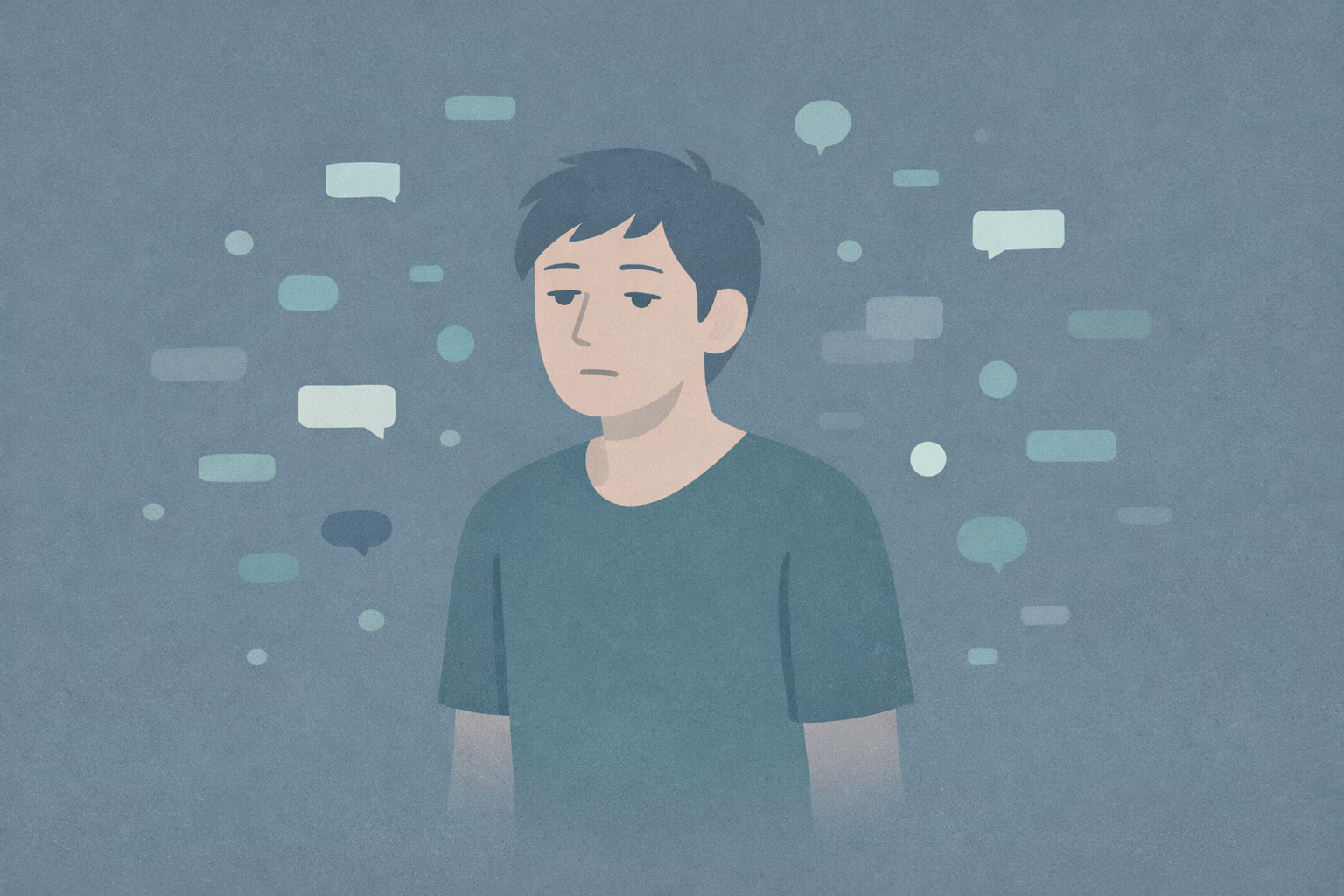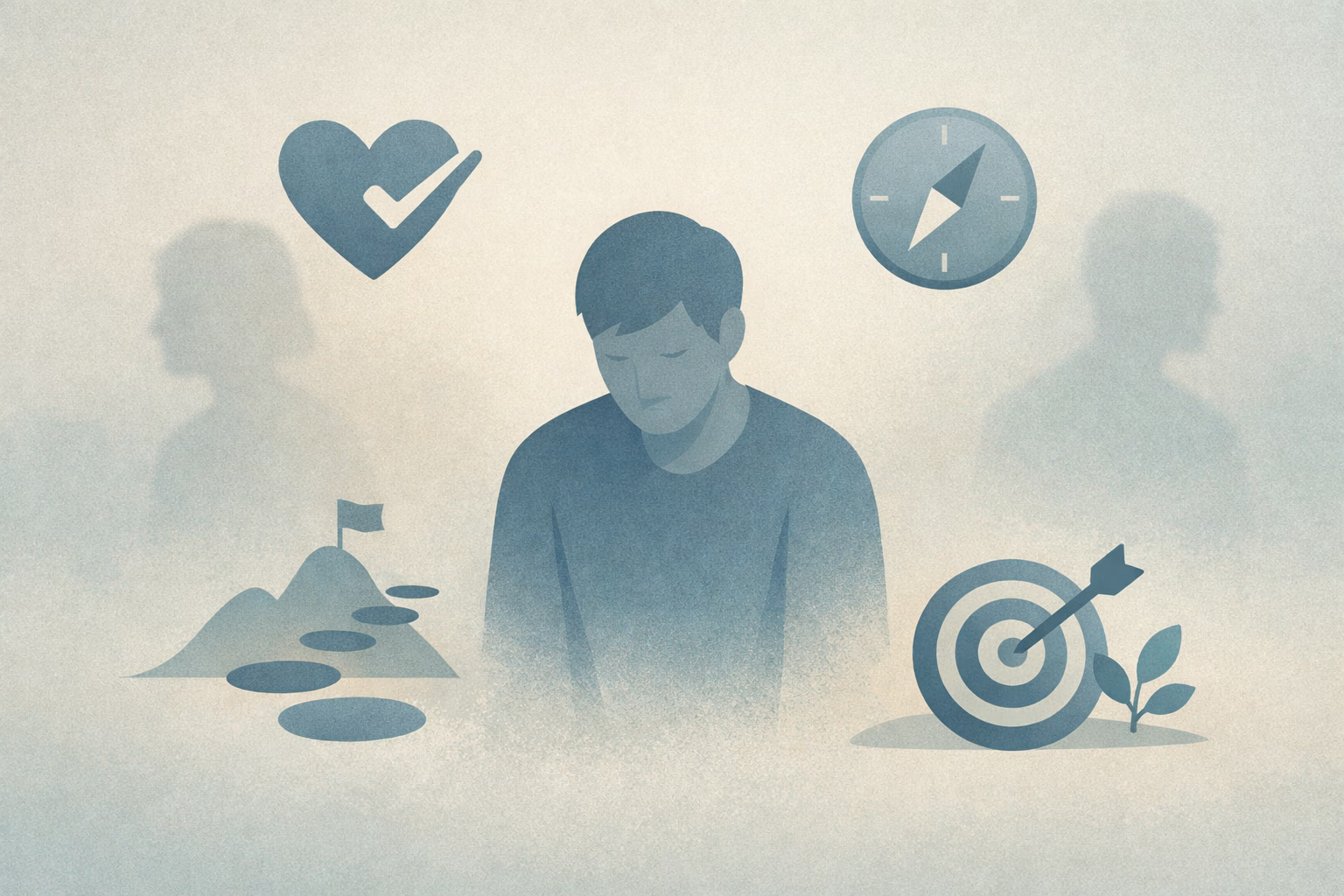
Stress Sensitivity: Why Small Things Suddenly Feel Big
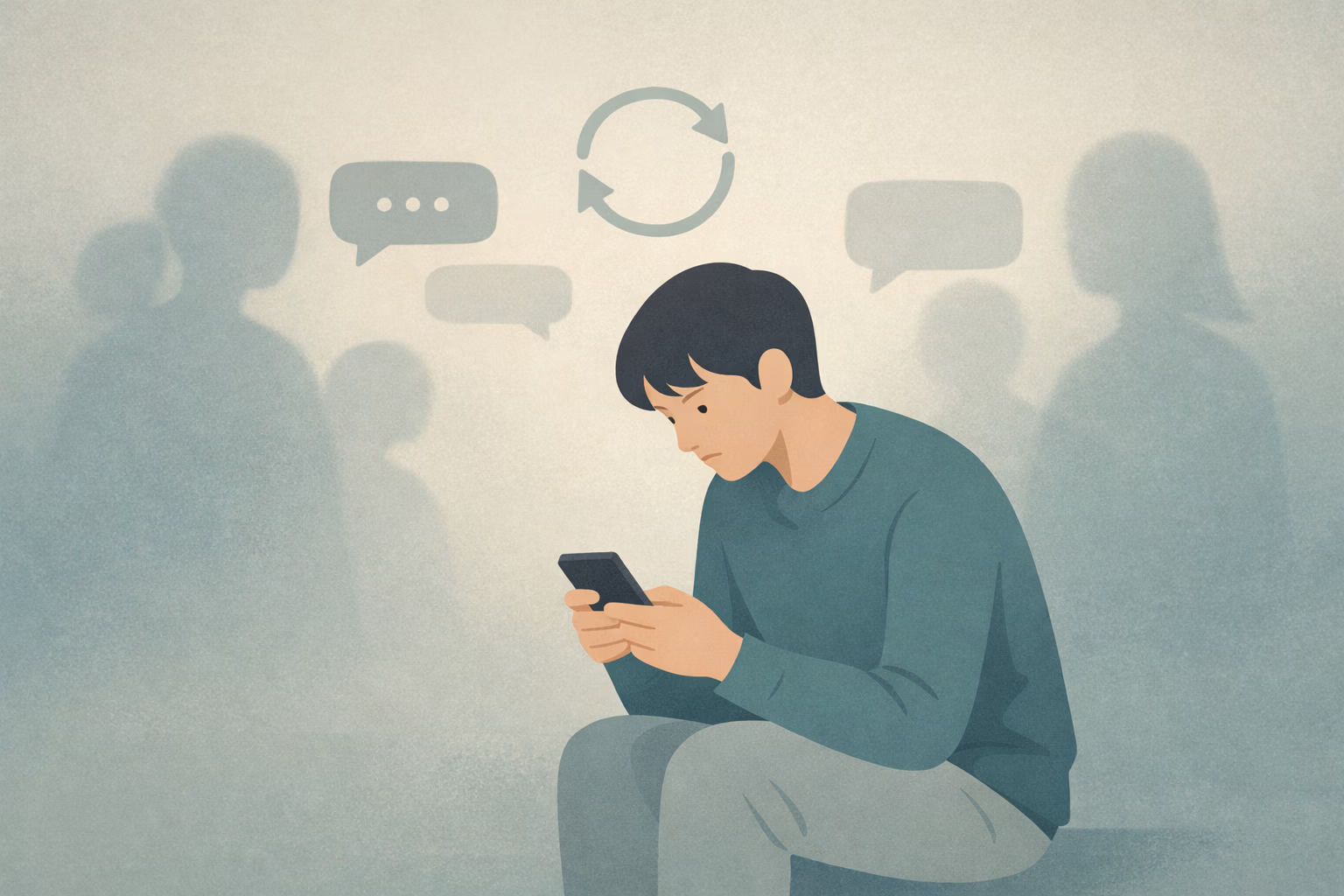
In short: There’s a particular kind of tension that can arrive with a simple screen: you send a message, the bubble disappears, and suddenly your body is on alert. Not as a thought experiment—but as a real shift in breath, focus, and urgency.
There’s a particular kind of tension that can arrive with a simple screen: you send a message, the bubble disappears, and suddenly your body is on alert. Not as a thought experiment—but as a real shift in breath, focus, and urgency. In those moments, “no reply yet” can register less like neutral time and more like a change in safety.
This pattern isn’t a character flaw, and it isn’t proof you’re “too much.” It’s often a nervous system doing what it evolved to do: monitor social connection for cues of closeness, distance, and belonging.
What if the intensity isn’t about the phone—so much as your system trying to complete an unfinished social loop?
In an anxious texting cycle, the gap between “sent” and “received” can feel physically loud. Attention narrows. You may reread what you wrote, scan for tone, and start building narratives out of tiny details: punctuation, timing, online status. The mind speeds up because the body is trying to locate certainty.
Then, when the reply finally arrives, there can be a wave of relief that’s almost disproportionate—like pressure releasing from a sealed container. The system stands down, at least briefly, because a signal returned and the loop seems “closed.” [Ref-1]
It can feel like your day is on hold until the little notification returns you to the ground.
Brains don’t treat social cues as optional. For humans, shifts in connection have historically affected access to protection, resources, and belonging. So when a message goes unanswered, the nervous system can interpret that ambiguity as “something changed”—even if nothing has actually happened.
In that state, stress physiology can rise: vigilance, scanning, and repetitive checking are common outputs of an uncertainty-loaded system. Digital silence is uniquely potent because it is both highly noticeable and information-poor—no facial expression, no tone, no context—so the brain keeps sampling for missing data. [Ref-2]
Long before phones, humans relied on rapid detection of social distance: who is close, who is withdrawing, who is safe to approach. That sensitivity isn’t pathology—it’s an evolved orientation toward relational stability.
Texting compresses this ancient system into a modern channel. A delayed response can be read as reduced proximity; a short response can be read as lowered warmth. The body responds to the perceived shift first, and the story often comes later. [Ref-3]
When your system monitors the “space between,” it isn’t trying to be dramatic—it’s trying to stay connected.
Repeated checking often functions like a fast uncertainty-reducer. Every glance at the screen is a micro-attempt to get a “done” signal: a reply, a read receipt, any evidence that the connection still exists in the expected form.
Because the relief is real (even if short-lived), the behavior makes sense. A nervous system that settles with contact will naturally reach for contact cues—especially in a medium that offers constant re-checking and intermittent reassurance. [Ref-4]
What feels like safety—checking, monitoring, sending follow-ups—can quietly train the system to require more frequent cues before it stands down. Instead of building tolerance for ambiguity, the loop becomes: uncertainty → activation → checking → brief relief → renewed uncertainty.
Over time, this can raise the baseline. The nervous system learns that calm is contingent on external confirmation arriving on a tight schedule. That’s not a moral failing; it’s conditioning under pressure, shaped by a medium that delivers partial signals and rapid rewards. [Ref-5]
Anxious texting can look like pursuit, but structurally it often functions as avoidance: not avoidance of the person, but avoidance of the open-ended gap. The gap carries unresolved information, and unresolved information keeps systems active.
When a behavior reliably reduces that activation—even for seconds—it gets reinforced. The nervous system doesn’t need a philosophy for this; it follows relief. This is how a loop forms without anyone choosing it as an identity. [Ref-6]
In other words, the pattern isn’t “you being irrational.” It’s a predictable rhythm: incomplete closure creates load; load creates urgency; urgency seeks the fastest path back to stand-down.
Once a system is organized around rapid confirmation, certain behaviors become more likely—not because someone lacks insight, but because the environment offers endless “almost-answers.” Many people recognize some version of these outputs:
These patterns are consistent with attachment-related regulation under stress load: when signals are inconsistent or incomplete, monitoring increases. [Ref-7]
When the nervous system is in ongoing “scan mode,” it becomes harder to stay present in the relationship itself. Conversation can become less about connection and more about surveillance: what does this mean, what happens next, what am I missing?
Over time, this can thin the felt sense of trust—not because the relationship is doomed, but because trust requires enough settledness to let moments complete. Constant evaluation interrupts completion. Stress and relational insecurity also tend to amplify each other, creating a climate where small gaps feel bigger than they are. [Ref-8]
It’s not just the waiting that hurts; it’s the way waiting keeps rewriting the relationship in your body.
One of the most exhausting parts of anxious texting is the oscillation: spike, dip, spike again. Relief arrives with the reply, but because it was obtained through urgent monitoring, the nervous system may not fully file the experience as “resolved.” It files it as “managed.”
That distinction matters. When relief depends on repeated checking, the brain learns to escalate checking during uncertainty. In broader anxiety research, similar dynamics appear when reassurance or accommodation reduces distress in the short term while strengthening threat-monitoring in the long term. [Ref-9]
The result is not simply “more anxiety.” It’s a narrower bandwidth for ambiguity—because ambiguity repeatedly ended in a stress cycle rather than a completed, settled outcome.
Reframing anxious texting isn’t about convincing yourself you shouldn’t care. It’s about recognizing what your system is actually asking for: a coherent signal that the relationship is intact, the moment is complete, and you can return attention to the rest of life.
This is where meaning matters. When a delayed response is experienced as “unfinished,” the body stays mobilized. When a delayed response is experienced within a stable relational narrative—one that can hold gaps without rewriting identity—load decreases. That decrease isn’t a thought; it’s a physiological stand-down that becomes possible when enough closure exists.
Research on smartphone attachment and mental health consistently points to the way persistent phone-based checking can intertwine with anxiety and regulation capacity, especially when the device becomes a primary safety cue. [Ref-10]
Human nervous systems do better with predictable signals. In close relationships, clarity functions like a safety cue: it reduces the amount of interpretation required and lowers the frequency of “gap scanning.”
When expectations around responsiveness are implicit, the brain fills in missing structure with monitoring. When expectations are mutually understood (in timing, tone, and availability), the system doesn’t have to work as hard to maintain coherence. This is less about controlling the other person and more about reducing ambiguous load in the channel.
Studies of problematic mobile phone attachment and separation-like discomfort suggest that uncertainty around access and response can amplify anxious activation, particularly when the phone has become a stand-in for closeness. [Ref-11]
When the loop loosens, waiting still feels like waiting—but it stops feeling like an emergency. Attention becomes more available again. The body can hold a gap without immediately converting it into a full relational storyline.
And when messages arrive, the experience is different: not a rescue from freefall, but a simple continuation of connection. Many people notice more patience and clearer interpretation—less “decoding,” more receiving. [Ref-12]
The reply becomes information, not a verdict.
At its best, texting is a tool: a lightweight way to coordinate, care, and share small moments. It works well when it sits inside a larger field of connection—tone, history, repair, consistency—so that a delay doesn’t carry the whole meaning of the bond.
As coherence returns, the phone stops functioning as the primary regulator of relational safety. The relationship can be felt as more continuous, not constantly reset by notifications. In that state, a message is less likely to trigger identity-level alarm and more likely to support secure closeness. [Ref-13]
Not “never anxious”—just less organized around emergency and more organized around belonging.
Anxious texting cycles often point to something tender and human: an attachment system that’s sensitive, a nervous system that’s been asked to carry too much ambiguity, and a modern channel that rarely offers real closure.
Seen through that lens, the pattern isn’t proof of neediness or inadequacy. It’s a signal that connection matters to you—and that your system is looking for steadier, more coherent cues of “we’re okay.” When those cues exist, agency tends to return naturally, because less energy is spent on scanning and more is available for living. [Ref-14]
Relational stability isn’t built by constant reassurance; it’s built when moments can complete and settle—when the nervous system can register, again and again, that a gap is not the end of connection.
Over time, the most noticeable change may not be what you think about texting, but how your body relates to it: less braced, less recruited, more able to let the relationship feel continuous even when the screen is still. That’s what it can look like when digital interaction aligns with safety and genuine connection. [Ref-15]
From theory to practice — meaning forms when insight meets action.
Because your nervous system isn't reading the gap as neutral time — it's reading it as a possible shift in social safety. The Threat & Safety System and Attachment & Belonging System were built to track proximity, and a delayed reply registers as ambiguity the body has to monitor. That's why breath, focus, and urgency change the moment the bubble disappears. The article calls this an unfinished social loop: the message went out, the system expects a return signal, and until it arrives the body stays mobilized. The intensity isn't drama or neediness — it's an evolved circuit running through a medium that rarely offers real closure.
Structurally, it functions as avoidance — but not avoidance of the person. It's avoidance of the open-ended gap. The unresolved space between sent and seen carries unfinished information, and unfinished information keeps the system active. Checking, refreshing, drafting, and deleting are all fast attempts to extract a Done Signal so the body can stand down. That's why the Avoidance Loop forms: uncertainty produces activation, checking produces brief relief, and the system learns to require contact cues on a tighter and tighter schedule. It looks like reaching, but it's really the nervous system trying to close a loop the medium keeps holding open.
Because the reply isn't just information — it's a state change. While you were waiting, your system was holding open social ambiguity, which costs energy. When the message lands, pressure releases from a sealed container, and the loop seems closed. The catch, as the article points out, is that relief obtained through urgent monitoring often gets filed as 'managed' rather than 'resolved.' That distinction matters. Your nervous system doesn't fully complete the experience; it just stands down until the next gap. Over time this trains the body to need stronger and faster reassurance to reach the same sense of closure.
Yes, and the article frames this as a co-regulation point rather than a control issue. Human nervous systems do better with predictable signals. When responsiveness expectations are implicit, the brain fills the missing structure with monitoring — which is exhausting. When timing, tone, and availability are mutually understood, ambiguous load in the channel drops, and the system doesn't have to scan as hard to maintain coherence. This isn't about scripting the relationship. It's about giving the Threat & Safety System enough predictable cues that a delay stops carrying the entire weight of the bond, and the body can let small gaps stay small.
From Science to Art.
Understanding explains what is happening. Art allows you to feel it—without fixing, judging, or naming. Pause here. Let the images work quietly. Sometimes meaning settles before words do.
One Quiet Window, one insight, one reflection — every Sunday