Lack of Tribe: Why Modern Life Exaggerates Threat Loops
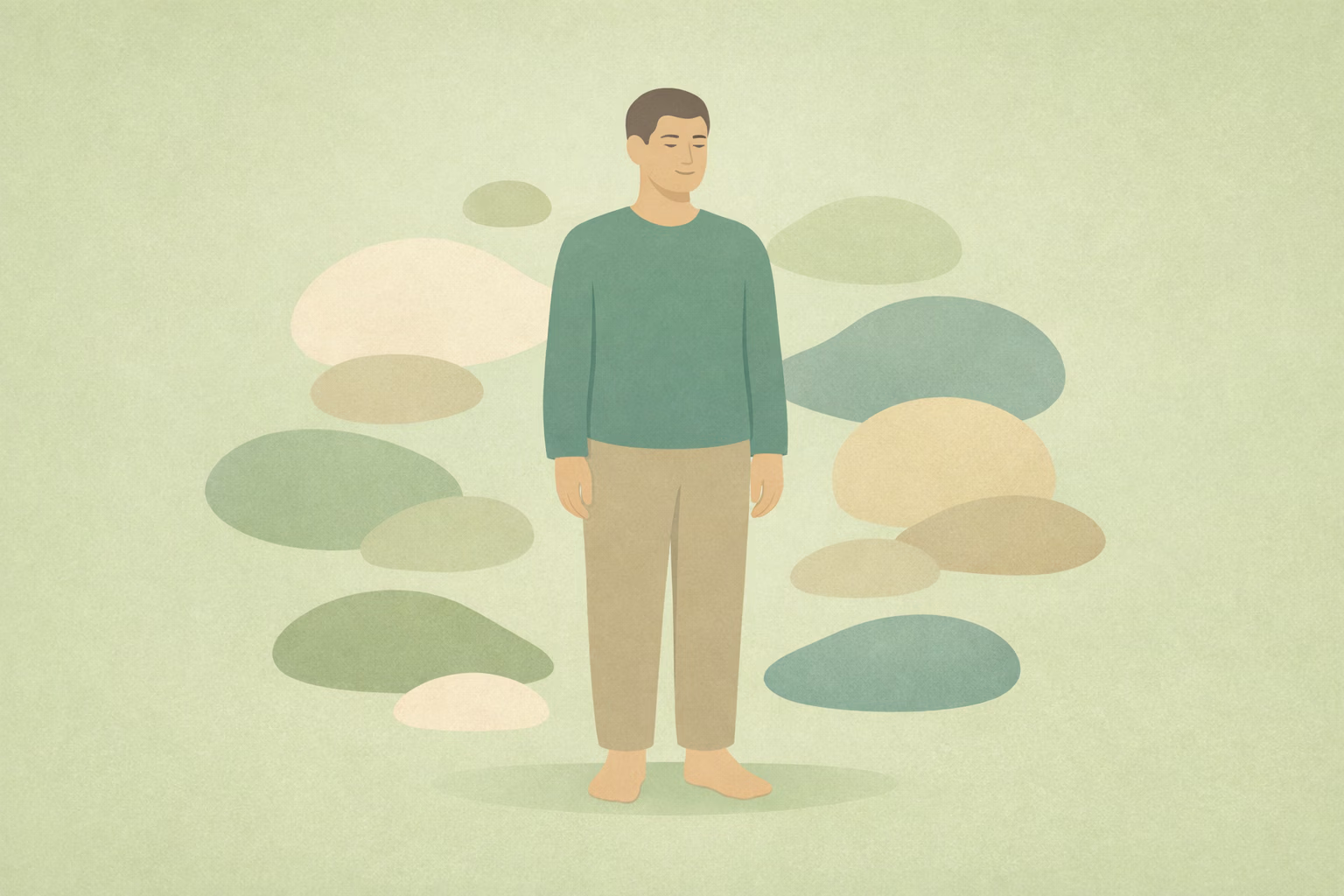
In short: Emotional nourishment isn’t a luxury add-on to a busy life. It’s a basic form of “fuel” that helps the nervous system register safety, restore capacity, and return to a workable sense of self.
Emotional nourishment isn’t a luxury add-on to a busy life. It’s a basic form of “fuel” that helps the nervous system register safety, restore capacity, and return to a workable sense of self.
What if the emptiness you keep trying to outwork is actually a depleted signal system asking for replenishment?
When emotional needs go unmet for long enough, people often blame themselves for becoming distant, irritable, flat, or unusually driven. But many of these shifts are not personality changes—they’re regulatory responses to missing closure, missing support, and sustained load.
Emotional hunger rarely announces itself as a single, obvious feeling. More often, it shows up as a low-grade hollowness: the sense that things are “fine” on paper, yet nothing lands inside you the way it used to.
In the body, unmet emotional needs can resemble a background state of alertness—like the system is scanning for something to complete. Social disconnection and perceived isolation, in particular, are associated with higher stress load and poorer health outcomes, which helps explain why this kind of emptiness can feel physical, not just psychological. [Ref-1]
Sometimes the hardest part is that nothing is technically wrong—there’s just no feeling of “enough.”
Emotional nourishment is not only about comfort. It’s also about biology: the nervous system shifts when it receives credible safety cues—signals of protection, belonging, and being responded to.
Supportive connection can buffer stress physiology, helping the body move out of persistent mobilization and into a state where repair and recovery are more available. [Ref-2]
When nourishment is present, the system is more likely to generate “completion signals”—the internal sense that you don’t have to keep proving, chasing, or bracing. This doesn’t require constant happiness; it requires enough safety and continuity for the body to stand down.
Humans are built to stabilize through relationships. Attachment isn’t merely an interpersonal preference; it’s a regulatory design—an evolved way the nervous system uses proximity, responsiveness, and shared reality to reduce load.
In that frame, emotional nourishment includes being able to rely on care (from others or from stable internal representations of care) in ways that create steadiness rather than more effort. Research linking attachment and self-related care suggests that feeling securely connected is associated with more supportive inner functioning. [Ref-3]
When this system is underfed, people don’t become “too needy.” They become resource-constrained—more likely to conserve, protect, and narrow life down to what seems manageable.
Many people learn to bypass emotional needs because it works in the short term. It can keep life moving, keep conflict low, and keep performance high. The nervous system can temporarily override signals for rest, contact, or reassurance when conditions demand it.
But bypassing is not the same as completion. If needs are repeatedly muted rather than met, the system doesn’t receive the “done” message. Over time, this can intensify internal strain: the person may look composed while their regulatory capacity quietly thins.
Work in emotion regulation and attachment contexts highlights how early adaptation can shape later regulation patterns—protective at one time, costly when it becomes the default. [Ref-4]
Emotional self-denial often tries to solve depletion with governance: tighter standards, more self-monitoring, fewer needs, less inconvenience. It can feel like maturity. It can also be a survival strategy in environments where needs were expensive.
Nourishment operates differently. It doesn’t aim to eliminate need; it aims to supply enough support that need stops dominating the system. This is why care tends to create real steadiness, while control tends to create temporary containment.
When care is chronically absent—internally or relationally—burnout risk rises, and health can be affected. That’s not a character issue; it’s what happens when load outpaces replenishment for too long. [Ref-5]
When nourishment is missing, the system often starts improvising. Not because you’re choosing the “wrong coping,” but because the body is trying to reduce discomfort and regain steadiness without the ingredients that usually make steadiness possible.
Over time, deprivation can form a self-reinforcing loop: reduced reserves make contact feel effortful; reduced contact reduces replenishment; reduced replenishment further lowers reserves. Emotional exhaustion and depersonalization-like distancing can emerge when demands continue without adequate restoration. [Ref-6]
Emotional undernourishment can present as a cluster of signals that are easy to moralize and hard to name. People may call it being “dramatic,” “cold,” “lazy,” or “too sensitive,” when it’s more accurately a system managing overload and insufficient closure.
In chronic stress states, allostatic load accumulates—the wear-and-tear of maintaining stability through ongoing adaptation. [Ref-7]
What if your irritability isn’t your personality—what if it’s your capacity limit showing itself?
If the system stays underfed long enough, it often shifts into conservation mode. This can resemble detachment, cynicism, or a narrowed range of interest—not because the person doesn’t care, but because caring requires energy and safety.
Chronic stress and allostatic load research describes how prolonged demand without adequate recovery changes physiology and resilience. [Ref-8]
In this state, even positive events may not register as restorative. Pleasure can feel thin. Connection can feel like work. The organism is not refusing life—it’s pacing itself to survive the next requirement.
Unmet needs don’t disappear; they lose clarity. The system still seeks completion, but it may do so through substitutes that change state without building stability—more scrolling, more busyness, more checking, more performing.
This is one reason “relief” can be so compelling: it offers quick downshifts. But relief doesn’t necessarily add reserves; it often just interrupts discomfort. Positive emotion research suggests that nourishing states can broaden attention and build resources over time, which is different from short-lived discharge. [Ref-9]
When nourishment is absent, the meaning system can contract. Life becomes about getting through, not arriving anywhere. And identity can start to feel like a job description rather than a lived home.
It can be tempting to treat nourishment as something you must earn—after you’ve been good enough, productive enough, helpful enough. But that framing keeps the nervous system in evaluation mode, which is inherently activating.
Self-attunement and self-kindness are often discussed as “mindset,” but their deeper significance is physiological: they reduce internal threat cues. When inner experience is met with less criticism, the system spends less energy on defense and can allocate more toward restoration. [Ref-10]
Importantly, understanding this is not the same as integration. Integration is what becomes visible later—when there’s a settled sense that your needs are real, your signals are credible, and your life contains enough completion that you don’t have to force yourself through every moment.
Attuned relationships don’t fix you. They feed the regulatory system. Validation, shared presence, and responsiveness provide cues that the world is workable and that your internal signals make sense in context.
This kind of connection is less about constant talking and more about accurate contact—being met at the right intensity, at the right time, in a way that doesn’t add pressure. Social support is linked with stress regulation via neuroendocrine pathways, which helps explain why being truly accompanied can feel like a bodily exhale rather than a mental insight. [Ref-14]
Research syntheses on self-compassion and well-being also point toward a gentler internal climate being associated with better psychological functioning—suggesting that “nutrition” can come from both relational and internal forms of care.
When nourishment accumulates, the change is often subtle at first. It may look like quicker recovery after stress, fewer spikes from small disruptions, and a wider window for normal human variability.
Rather than “feeling more,” many people notice they can return more easily—to baseline, to patience, to humor, to presence. Rest and recovery research describes how sustainable functioning depends on cycles of load and replenishment, not continuous output. [Ref-12]
Meaning isn’t something you think your way into. It emerges when life experiences complete—when the nervous system can register safety, when efforts have endpoints, and when who you are feels continuous across moments.
With nourishment, engagement stops being a draining performance and becomes a genuine participation. Social bonding and attachment neurobiology emphasizes how connection supports regulation and approach states—conditions that make meaningful engagement more available. [Ref-13]
Not everything is solved. But you’re no longer enduring your own life from the outside.
In a culture that rewards output and composure, emotional nourishment can be miscast as optional. But from a biological perspective, it’s part of how humans stay coherent—how we keep the capacity to love, notice, contribute, and repair.
Honoring emotional needs is not a demand for perfect conditions. It’s an acknowledgment that nervous systems require replenishment, and that support and bonding cues help the body carry stress without becoming shaped by it. [Ref-14]
When nourishment becomes more available, agency often returns as a byproduct: choices feel less forced, relationships feel less like labor, and identity feels less like a patchwork of obligations.
Wholeness isn’t a mood. It’s a settled state in which your signals can rise, be responded to, and then resolve—so the system doesn’t have to keep running unfinished loops.
When emotions are nourished, regulation becomes less of a project. The body carries fewer alarms, the mind needs fewer defenses, and the self feels more inhabitable—less like something to manage, more like somewhere to stand. [Ref-15]
From theory to practice — meaning forms when insight meets action.
It's basic fuel for the nervous system — not a luxury add-on. Emotional nourishment helps the body register safety, restore capacity, and return to a workable sense of self. It's not the same as constant happiness; it's about enough safety and continuity for the system to stand down. Attuned relationships, validation, shared presence, and being met at the right intensity all act as nutrition rather than just support. Internal forms count too — a gentler inner climate reduces threat cues so the system can spend less energy on defense and more on restoration. Wholeness is a settled state, not a mood.
Because emotional hunger rarely shows up as drama. More often it's a low-grade hollowness: things are fine, but nothing lands inside you the way it used to. In the body, unmet emotional needs can feel like background alertness — the system scanning for something to complete. Social disconnection and perceived isolation are linked with higher stress load, which is why this kind of emptiness can feel physical. Sometimes the hardest part is that nothing is technically wrong; there's just no feeling of enough. That's a depleted signal system asking for replenishment, not a personality flaw.
Because bypassing isn't the same as completion. Many people learn to override emotional needs because it works short-term — keeps life moving, conflict low, performance high. The system can temporarily mute signals for rest, contact, or reassurance when conditions demand it. But if needs are repeatedly suppressed rather than met, the system never receives the Done Signal. Strain intensifies underneath the composure. Over time, deprivation forms a self-reinforcing loop: reduced reserves make contact feel effortful, reduced contact reduces replenishment, reduced replenishment further lowers reserves. The person looks composed while regulatory capacity quietly thins.
Control aims to eliminate need; care supplies enough support that need stops dominating the system. Self-denial often tries to solve depletion with governance — tighter standards, more self-monitoring, less inconvenience. It can feel like maturity, but it's often a survival strategy from environments where needs were expensive. Nourishment operates differently. It doesn't aim to remove signals; it meets them. That's why care creates real steadiness while control creates temporary containment. When inner experience is met with less criticism, the system spends less energy on defense, and capacity returns as a byproduct: choices feel less forced, identity feels less like a job description.
From Science to Art.
Understanding explains what is happening. Art allows you to feel it—without fixing, judging, or naming. Pause here. Let the images work quietly. Sometimes meaning settles before words do.
One Quiet Window, one insight, one reflection — every Sunday