

Emotional Exhaustion: When Your Tank Is Empty but Life Keeps Going

In short: “Emotional refueling” can sound like a personality trait—something some people just have and others don’t. But most of the time, what feels like emptiness, irritability, or flatness is a predictable signal: internal reserves have been drawn down faster than they’ve been restored.
“Emotional refueling” can sound like a personality trait—something some people just have and others don’t. But most of the time, what feels like emptiness, irritability, or flatness is a predictable signal: internal reserves have been drawn down faster than they’ve been restored.
Refueling, in this sense, isn’t about becoming more motivated. It’s about the body and mind receiving enough closure, safety cues, and completion for your system to stand down—so your responsiveness can return on its own, without constant effort.
What if the problem isn’t you—what if it’s a system trying to function without a “done” signal?
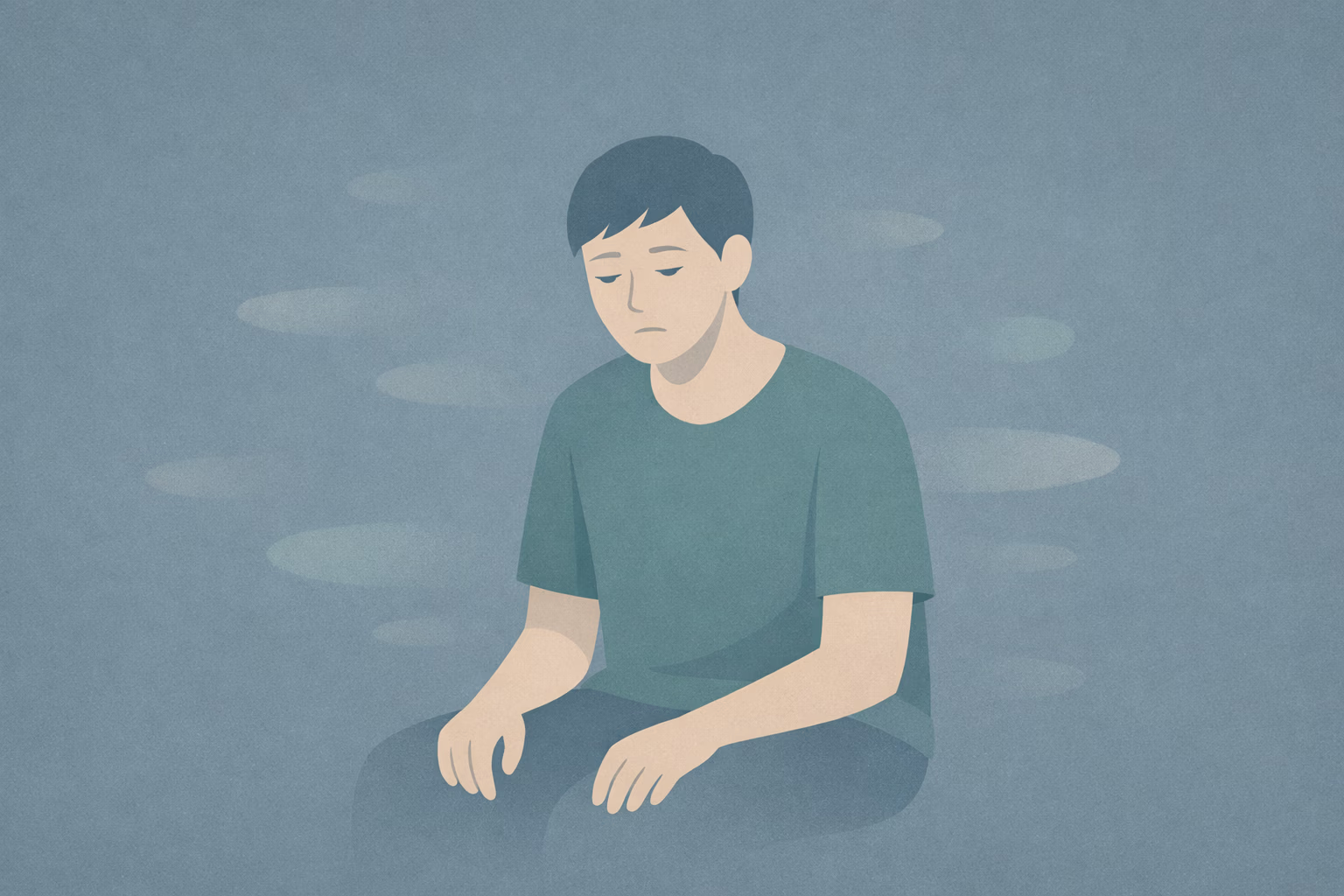
Emotional depletion often doesn’t arrive as dramatic sadness. It can arrive as a thinner version of you: less color in the day, less patience in your voice, less access to the part of you that naturally cares. The experience can be flat, foggy, or brittle—like everything is one request too many.
This isn’t a character flaw. It’s what happens when the body has been running a long time without enough completion. Burnout research often describes this as emotional exhaustion and a sense of distance from work, people, or even yourself. [Ref-1]
When reserves are drained, the nervous system tends to narrow its bandwidth. It conserves. It simplifies. It prioritizes getting through.
When people say they feel “refueled,” what’s often changing is not their attitude but their physiology: arousal drops, internal signaling becomes clearer, and the brain can spend less energy on monitoring and more on living. Emotional capacity is partly about available resources—sleep pressure, neurochemistry, and the nervous system’s ability to recover from sustained demand. [Ref-2]
In depletion, even small tasks can feel heavy because the system is already spending energy managing load. In refueling, the same task may not require a pep talk—it simply requires less internal bracing.
Refueled doesn’t always mean “happy.” It often means “I can respond again.”
Your body is designed to meet challenges and then come down from them. That downshift is not optional maintenance; it’s how the system prevents accumulated strain. When demands stay high and recovery stays partial, “wear and tear” builds—often described as allostatic load. [Ref-3]
Modern life can disrupt the rhythm that makes recovery possible. Many people live inside overlapping roles and constant partial attention, which means the body keeps receiving “not finished yet” signals. Without closure, the system can stay activated even during supposed rest.
Depletion, then, can be understood as a mismatch: high demand, low completion, interrupted recovery.
In the short term, pressure can create a kind of temporary scaffolding. Deadlines, urgency, and adrenaline can help the system override fatigue long enough to perform. But this is not replenishment—it’s borrowing.
When borrowing becomes the norm, the body adapts by raising baseline tension, narrowing attention, and keeping stress systems online longer than they were meant to be. Over time, this sustained load is associated with broader health and mood impacts, not because the person is failing, but because the recovery side of the equation is missing. [Ref-4]
What looks like “high functioning” from the outside can be a system running without a stand-down.
When energy is low, the mind naturally reaches for quick state changes: scrolling, snacking, shopping, constant background noise, even overworking. These can reduce discomfort or create brief stimulation. But often they don’t provide what the nervous system is actually seeking: resolution and restoration.
True refueling tends to leave a different aftertaste—less urgency, more steadiness. Numbing often leaves the original load intact, plus a faint sense of “still not done.” Under chronic stress, the brain can become more sensitive to cues that promise relief while still remaining physiologically keyed up. [Ref-5]
Once reserves are low, the nervous system begins to behave differently. It becomes faster to irritate, quicker to withdraw, more likely to seek immediate simplification. This isn’t because you’re secretly avoiding life; it’s because the system is reducing complexity to stay within its remaining capacity.
In stress neurobiology, prolonged activation can bias the brain toward threat detection and quick reactions. [Ref-6] In everyday terms, that can look like: “Everything feels like a problem,” even when nothing is objectively catastrophic.
As the loop continues, fewer experiences reach completion. More tasks stay half-open. More conversations feel unfinished. The load remains “live,” and the body keeps paying for it.
Emotional depletion isn’t always dramatic. Often it’s revealed by subtle changes in responsiveness—how quickly you return to baseline, how much warmth is available, how costly small decisions feel.
These patterns are not diagnoses. They’re understandable outcomes when recovery is insufficient and demand stays high. [Ref-7]
Chronic depletion doesn’t just make you tired—it can change what life feels like it’s for. When the system is continuously managing load, it has less room for the experiences that generate meaning: unhurried connection, absorbed attention, and the feeling of completion after effort.
Sleep disruption often enters the picture, not always as insomnia, but as sleep that doesn’t restore. Stress and sleep can reinforce each other in a bidirectional cycle, keeping the nervous system from fully downshifting. [Ref-8]
Over time, relationships can strain under the weight of reduced bandwidth. Not because people don’t love each other, but because everyone is operating closer to their limit, with fewer “extra” resources available for repair and presence.
The nervous system learns from repetition. If it repeatedly has to function without adequate restoration, it may begin to treat the deficit state as normal. The baseline becomes more vigilant, more compressed, more effortful.
This is one reason small positive experiences can feel unusually important when you’re depleted: they can briefly widen the system’s range and rebuild psychological resources over time. [Ref-9] Not as a pep talk, but as a gradual re-expansion of capacity when the load finally starts to close.
Without refueling, the body can become conservative with energy. It doesn’t “choose” disengagement as a personality—it shifts into a protective economy.
Many people can rest but can’t receive rest. They stop moving, yet their system doesn’t register completion. Emotional refueling is less about time off and more about experiences that feel metabolized—where the nervous system gets a clear signal: enough happened, and now it’s over.
In that sense, pleasure without guilt matters—not because pleasure is a reward for suffering, but because guilt keeps the loop open. When the body expects to be evaluated even while “resting,” it stays on duty. The most nourishing experiences often share a simple quality: they are not performative.
Supportive environments and cues of safety can help the stress response settle, making restoration more biologically available. [Ref-10]
Refueling is what it feels like when rest counts.
Not all social time restores. Some interaction adds load—more monitoring, more managing, more roles. But attuned connection can function like a nervous-system exhale: shared presence, mutual ease, and the sense of being received without having to prove anything.
Research on social relationships consistently links perceived connection with better health outcomes, while isolation (even when surrounded by people) can increase strain. [Ref-11] In practical terms, when connection is coherent—when it feels safe and mutually oriented—it can reduce internal vigilance.
It’s not “being around people” that refuels. It’s contact that reduces the need to brace.
As reserves rebuild, you may not become endlessly enthusiastic. A more realistic marker is that your signals start working again. Hunger feels clearer. “No” arrives earlier. Interest returns without being forced. Recovery becomes faster after stress.
Capacity can be understood as the nervous system’s ability to flex—mobilize when needed and then return. When regulation improves, the body spends less time stuck in high gear or shutdown, and more time in responsive range. [Ref-12]
In depletion, a lot of life becomes damage control: getting through, catching up, repairing. When refueling is present, something subtler becomes possible: actions begin to align with values again. Not as a motivational project, but as an identity-level orientation that feels natural to inhabit.
This is where agency quietly returns. You don’t need to force coherence; you begin to experience it—because fewer loops are left hanging open, and your system can afford to commit to what matters.
Self-kindness also becomes more realistic here. Not as a slogan, but as a structural shift: when the body isn’t in deficit mode, it’s easier to relate to yourself without constant criticism. [Ref-13]
Emotional refueling can be seen as a form of respect—for your biology, for your relationships, and for the life you’re trying to live. When restoration is missing, the system compensates with urgency, numbness, or overcontrol. When restoration is present, care becomes possible again—not heroic care, but ordinary, sustainable care.
In a world that keeps experiences open-ended, refueling is one of the ways a person’s inner world gets to reach completion. Over time, that reduces accumulated load and supports steadier regulation. [Ref-14]
Agency doesn’t always arrive as motivation. Sometimes it arrives as the simple sense that your energy belongs to you again.
Refueling isn’t a luxury item for people with easy lives. It’s the mechanism that allows nervous systems to keep caring, connecting, and creating without collapsing into permanent deficit.
When recovery experiences are repeatedly missing, emotional exhaustion becomes more likely—not as personal failure, but as predictable biology under chronic demand. [Ref-15] Protecting replenishment is, in the most human sense, protecting meaning: the part of life that can only appear when your system is no longer just surviving.
From theory to practice — meaning forms when insight meets action.
Many people can rest but can't receive rest. They stop moving, yet the system doesn't register completion. Emotional refueling isn't about time off — it's about experiences that feel metabolized, where the nervous system gets a clear signal: enough happened, and now it's over. Pleasure without guilt matters because guilt keeps the loop open. When the body expects to be evaluated even while resting, it stays on duty. Refueling is what it feels like when rest counts. The most nourishing experiences share a simple quality: they are not performative. Refueled doesn't always mean happy — it often means I can respond again.
When energy is low, the mind reaches for quick state changes — scrolling, snacking, shopping, constant background noise, even overworking. These reduce discomfort or create brief stimulation, but they don't provide what the nervous system is actually seeking: resolution and restoration. Numbing changes how it feels for a moment; refueling changes what your system can sustainably carry. True refueling leaves a different aftertaste — less urgency, more steadiness. Numbing leaves the original load intact plus a faint sense of still not done. Under chronic stress, the brain becomes more sensitive to cues that promise relief while still remaining physiologically keyed up.
Your body is designed to meet challenges and then come down from them. That downshift isn't optional maintenance — it's how the system prevents accumulated strain. When demands stay high and recovery stays partial, wear-and-tear builds (allostatic load). Modern life disrupts this rhythm. Many people live inside overlapping roles and constant partial attention, so the body keeps receiving not finished yet signals. Without closure, the system stays activated even during supposed rest. Pushing through borrows energy rather than replenishing it; depletion is a mismatch — high demand, low completion, interrupted recovery. This is Evolutionary Mismatch in everyday form.
Not all social time restores. Some interaction adds load — more monitoring, more managing, more roles. But attuned connection functions like a nervous-system exhale: shared presence, mutual ease, the sense of being received without having to prove anything. It's not being around people that refuels — it's contact that reduces the need to brace. As reserves rebuild, signals start working again. Hunger feels clearer. No arrives earlier. Interest returns without being forced. Recovery becomes faster after stress. Co-regulation through coherent connection reduces internal vigilance, while isolation (even surrounded by people) increases strain. The Meaning Loop becomes available because fewer loops are left hanging open.
From Science to Art.
Understanding explains what is happening. Art allows you to feel it—without fixing, judging, or naming. Pause here. Let the images work quietly. Sometimes meaning settles before words do.
One Quiet Window, one insight, one reflection — every Sunday