Why You Feel Pressure to Be Available Online
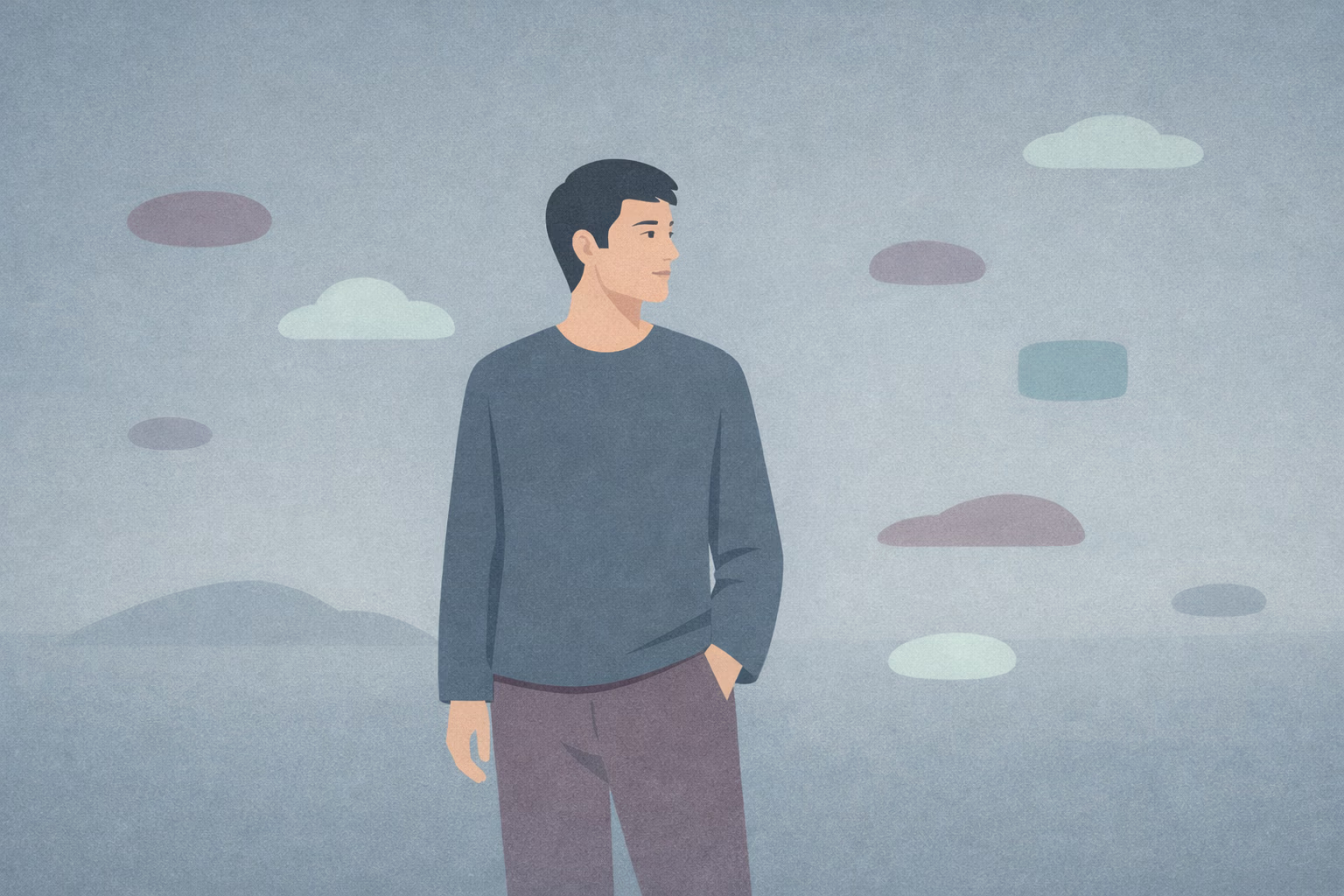
In short: FOMO is often described as “fear,” but many people experience it more like a restless monitoring state: a background sense that something important is happening elsewhere, and that staying still could cost you connection, status, or belonging. In a hyperconnected world, this state isn’t a personal flaw.
FOMO is often described as “fear,” but many people experience it more like a restless monitoring state: a background sense that something important is happening elsewhere, and that staying still could cost you connection, status, or belonging.
In a hyperconnected world, this state isn’t a personal flaw. It’s what can happen when a social nervous system—built for small groups, slow updates, and clear endings—gets placed inside an environment with endless social information and no natural “done” signal.
What if FOMO isn’t telling you you’re inadequate—what if it’s telling you your social world never truly closes?
FOMO tends to show up as a particular blend of sensations: urgency without a clear task, curiosity that doesn’t resolve, and a nagging sense that your current moment is only a placeholder until something more relevant appears.
It can also carry a quiet grief-like edge—regret for opportunities you didn’t even know you had, and the sense that other people’s lives are moving faster or landing better than yours. That mix can make ordinary evenings, weekends, or choices feel strangely unfinished. [Ref-1]
Human attention is not neutral. It prioritizes cues that might change your social standing: who’s included, who’s praised, who’s together, who’s advancing. In that sense, social comparison isn’t vanity—it’s a built-in tracking system designed to keep you calibrated to the group.
When the mind detects possible exclusion cues—being left out, not knowing, not being invited—your system can shift into protective mobilization. The body reads uncertainty as unfinished: “keep monitoring until safety is confirmed.” That’s why FOMO can feel like it’s happening to you, even when you “know better.” [Ref-2]
When your attention gets captured, it’s often because your system thinks something is at stake.
For most of human history, social exclusion wasn’t just emotionally painful—it could be materially dangerous. Belonging meant food access, protection, shared labor, and information. Being out of the loop could mean being out of the group.
So the nervous system evolved a fast, sensitive detection system for separation and diminished social rank. In modern terms, FOMO can be understood as that belonging alarm activating in response to signals of other people clustering, coordinating, or celebrating without you. The alarm is not an identity; it’s a response to conditions that imply social risk. [Ref-3]
FOMO is what it feels like when your social safety system can’t confirm, “I’m still included.”
Even when FOMO is exhausting, it often contains an understandable motive: staying connected, staying relevant, avoiding social loss, and remaining informed in a world where opportunities can appear and vanish quickly.
This is why FOMO doesn’t respond well to shame. The checking, the scanning, the keeping-up—these are regulatory attempts to reduce uncertainty and regain coherence in the social field. In many people, FOMO is paired with conscientiousness and care for relationships, not carelessness.
In other words, the system isn’t malfunctioning. It’s trying to solve a problem: “How do I stay connected when connection is always moving?” [Ref-4]
One of the hardest parts of hyperconnectivity is that it expands what you can know about others’ lives without expanding your capacity to live multiple lives at once. You can witness dozens of gatherings, achievements, trips, and inside jokes in a single scroll—without any natural completion or integration for what you just took in.
This creates a mismatch: your system absorbs social “signals,” but your life doesn’t get the matching closure moments that tell the nervous system, “I’m included enough; I’m resourced enough; I’m on track.” Over time, awareness increases while satisfaction can thin out, not because your life is worse, but because your comparison baseline keeps resetting. [Ref-5]
In digital spaces, status becomes unusually visible. Metrics, public moments, group photos, and professional wins are broadcast in a way that makes ranking feel constant—even when nobody explicitly ranks anyone.
This can create a “Power Loop” dynamic: you’re not only tracking connection, you’re tracking position. The nervous system doesn’t experience this as abstract sociology; it experiences it as load. The result can be a persistent readiness to update, respond, post, compare, or recalibrate—because the environment keeps offering new evidence about where you stand. [Ref-6]
When the social field feels unstable, many people develop a checking rhythm: not necessarily from “addiction” as an identity, but from an unfinished social loop. The mind reaches for the fastest available update to reduce uncertainty.
At the same time, commitment becomes harder. Choosing one plan can feel like closing a door on other possible plans, and the nervous system resists closure when it can’t verify safety on the other side. This is why people can feel pulled to keep options open, keep monitoring, keep reassessing—even during things they genuinely enjoy.
Research on ostracism and threatened social needs helps explain why exclusion cues can heighten reactivity and make social reassurance feel urgent. [Ref-7]
FOMO isn’t only uncomfortable; it can be disorganizing. When every choice is shadowed highlights of other choices, decision-making becomes expensive. You’re not just choosing what to do—you’re negotiating with an internal system that hasn’t received a “done” signal about what you’re not doing.
Over time, that can look like decision paralysis (too many parallel possibilities), social fatigue (too much tracking), and burnout (too much vigilance). Not because you’re incapable, but because your capacity is being spent on constant social orientation. When the nervous system stays mobilized, it has less room for restoration and follow-through. [Ref-8]
Burnout isn’t only about doing too much; it’s also about never getting to feel “complete.”
In a finite social world, updates arrive, then stop. There are natural endings: the gathering ends, the story is told, the day closes. Those endings are cues for physiological stand-down.
Infinite feeds change the structure. There is always another event, another group, another highlight, another inside joke you weren’t part of. That keeps exclusion perpetually possible, which keeps the system oriented outward for confirmation. The baseline of “normal” becomes inflated, and ordinary life can start to feel like it’s falling behind by default. [Ref-9]
This is why FOMO can intensify even when you’re socially active: the reference point is no longer your community; it’s the endless stream of curated moments.
FOMO often softens not through more information, but through more internal safety—an internal condition where the nervous system can hold uncertainty without needing immediate resolution. This isn’t positive thinking. It’s a deeper shift: the body learns, through repeated closure experiences, that missing an update is not the same as losing belonging.
In that state, “I’m not there” becomes a neutral fact rather than a social emergency. You still care about people and opportunities, but the urgency reduces because your system has enough coherence to stay with one chosen moment without constant cross-checking. This is less about insight and more about the return of a settled signal: “I am okay, even with incomplete information.” [Ref-10]
Coherence isn’t the absence of options—it’s the ability to live inside a choice.
FOMO thrives in ambiguity: unclear belonging, inconsistent feedback, and relationships that are mostly observed rather than felt. In contrast, close and attuned relationships provide repeated, concrete evidence of connection—signals that don’t depend on public visibility.
When connection is steady, the nervous system doesn’t need to constantly scan for proof of inclusion. The “belonging question” has more closure built into daily life: small acknowledgments, mutual reference points, a sense of being known in ways that don’t require performance. Resources that discuss FOMO often note how real-life connection and perspective can reduce its intensity. [Ref-11]
As load decreases and closure increases, a different pattern becomes possible. The mind still notices what others are doing, but it no longer converts every update into a self-evaluation. Comparison loses some of its bite because the system isn’t starving for completion.
Many people describe the shift as relief: fewer second-guesses, less compulsive checking, more capacity to stay present in a plan once it’s chosen. Not a dramatic transformation—more like the nervous system finally receiving enough “done” signals to stand down.
When the alarm quiets, energy that was used for tracking can return to living. This is one reason FoMO is discussed as a contributor to fatigue and burnout risk: removing the constant vigilance can restore capacity over time. [Ref-12]
One of the most meaningful shifts is when identity stops being assembled from other people’s updates and starts being stabilized by lived direction. This doesn’t require being certain about your entire future. It requires something simpler and deeper: a relationship with your own choices that can settle into “this is my life, on purpose.”
In a hyperconnected world, loneliness and FOMO can reinforce each other: the more you monitor, the more distant your own life can feel; the more distant your life feels, the more monitoring seems necessary. Research links FOMO with pathways that can increase loneliness, which helps explain why the loop can tighten over time. [Ref-13]
When meaning becomes denser—when experiences complete and belong to you—other people’s highlight reels stop feeling like instructions. They become information, not a referendum.
FOMO is often treated as a motivation problem: “be more grateful,” “be more disciplined,” “stop caring.” But the deeper story is structural. A nervous system designed for clear social closure is trying to find stability inside an environment that rarely ends.
When life contains more completion—more moments that register as real and finished—comparison loses oxygen. Commitment starts to feel less like deprivation and more like continuity. Depth becomes a form of orientation: not shutting the world out, but letting your own life become solid enough that it doesn’t vanish under other people’s updates. [Ref-14]
Hyperconnection sells a quiet myth: that peace comes from total awareness and total access. But human systems don’t stabilize through total access. They stabilize through coherence—through living experiences that can land, complete, and become part of who you are.
Missing out is not evidence that you’re doing life wrong. It’s evidence that life is finite, and meaning is built by being somewhere long enough for that “somewhere” to become yours. Chosen presence is not a consolation prize; it’s how a life becomes real. [Ref-15]
From theory to practice — meaning forms when insight meets action.
Because the belonging alarm is built in and old. For most of human history, social exclusion could mean material danger, so the nervous system evolved a fast, sensitive detection system for separation and diminished social rank. The Attachment & Belonging System scans for cues of clustering, coordinating, or celebrating without you, then mobilizes to reduce the gap. FOMO is what it feels like when the social safety system can't confirm "I'm still included." Your attention gets captured because something is at stake — or your body thinks it is. It's not a character defect; it's an alarm activating in a hyperconnected environment.
Because hyperconnectivity expands what you can know about others' lives without expanding your capacity to live multiple lives at once. You absorb dozens of social signals in a single scroll, but your life doesn't get the matching closure moments that would tell the nervous system "I'm included enough; I'm on track." Awareness increases while satisfaction thins, not because your life is worse, but because your comparison baseline keeps resetting. Infinite feeds keep exclusion permanently possible — there's always another event, another inside joke. The system stays oriented outward for confirmation that never fully arrives.
Because choosing one plan can feel like closing a door on other possible plans, and the Threat & Safety System resists closure when it can't verify safety on the other side. Compulsive checking isn't usually addiction-as-identity; it's an unfinished social loop reaching for the fastest available update. Decision fatigue stacks: every choice is shadowed by highlights of other choices, and the system hasn't received a Done Signal about what you're not doing. Burnout follows — not from doing too much, but from never getting to feel complete. Vigilance consumes the capacity that follow-through would need.
Internal safety — the capacity to hold uncertainty without needing immediate resolution. This isn't positive thinking. It's the body learning, through repeated closure experiences, that missing an update isn't the same as losing belonging. "I'm not there" becomes a neutral fact rather than a social emergency. Attuned relationships help because they provide repeated, concrete evidence of connection that doesn't depend on public visibility — being known reduces the need to be constantly seen. Coherence isn't the absence of options; it's the ability to live inside a choice. Depth becomes orientation: chosen presence is how a life becomes real.
From Science to Art.
Understanding explains what is happening. Art allows you to feel it—without fixing, judging, or naming. Pause here. Let the images work quietly. Sometimes meaning settles before words do.
One Quiet Window, one insight, one reflection — every Sunday