

Connection Without Closeness: Why Modern Relationships Feel Surface-Level

In short: Some interactions don’t just take time—they take capacity . You can leave a conversation feeling heavy, irritated, scattered, or strangely blank, even if nothing “bad” happened on the surface. That kind of exhaustion is often less about personality and more about what your nervous system had to do to stay steady.
Some interactions don’t just take time—they take capacity. You can leave a conversation feeling heavy, irritated, scattered, or strangely blank, even if nothing “bad” happened on the surface. That kind of exhaustion is often less about personality and more about what your nervous system had to do to stay steady.
Why do certain people leave you depleted, even when you care about them?
Relationship drain is what it feels like when connection repeatedly runs through vigilance, imbalance, or unsafety cues—without enough repair, reciprocity, or closure. Your system learns the pattern, and it starts budgeting energy around it.
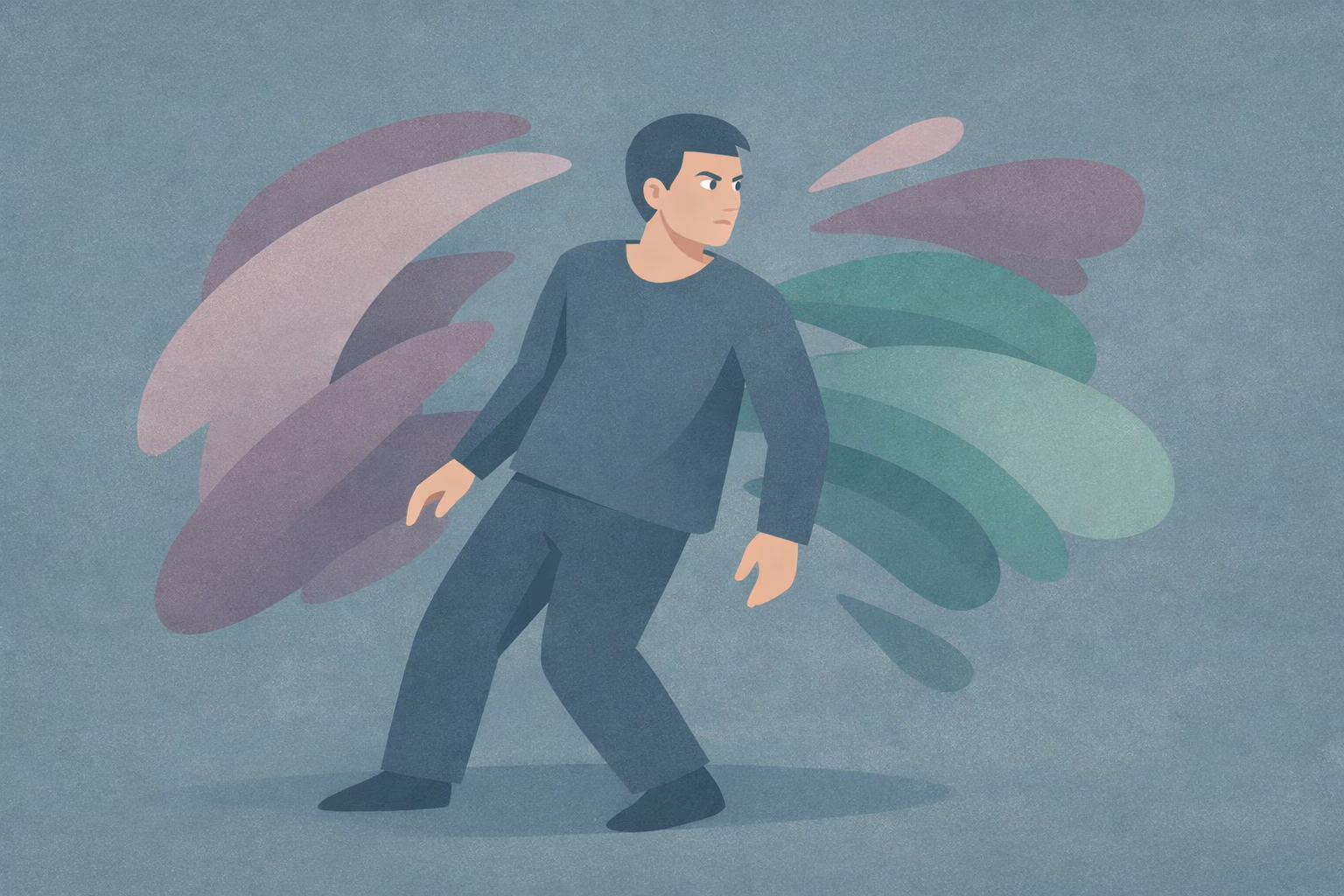
Relationship drain often shows up after contact: a tight chest, a buzzing mind, a hollow tiredness, or a sudden need to be alone. It can look like irritability, zoning out, or an urge to scroll—anything that helps your system downshift after running “on guard.” [Ref-1]
What’s striking is how predictable it can be. You might notice the same sequence: you brace beforehand, perform steadiness during the interaction, and then feel the cost afterward. That cost isn’t proof you’re fragile—it’s evidence that regulation was required.
Some conversations don’t feel like connection. They feel like effort masquerading as closeness.
Humans co-regulate through rhythm: tone, pace, mutual attention, and respect for limits. When that rhythm is repeatedly disrupted—through boundary crossings, unpredictable reactions, or a chronic “tilt” where one person takes more space—your nervous system has to compensate. That compensation is work. [Ref-2]
It can be subtle. A person may not be overtly cruel, yet the interaction contains frequent micro-ruptures: interruptions, probing questions, dismissals, or pressure to agree. Even small violations accumulate when they happen without acknowledgement or reset.
From an evolutionary standpoint, connection is supposed to reduce load. Safe social contact supports rest, digestion, learning, and flexible thinking. When connection becomes unreliable or one-sided, ancient threat-and-safety systems step forward to protect energy and attention. [Ref-3]
This is why “being nice” doesn’t always feel soothing. If the relationship requires constant monitoring—what you can say, how they’ll react, whether you’ll be blamed—your body treats the interaction as a context with consequences. Not moral consequences. Nervous-system consequences.
In other words: if connection doesn’t lower the cost of being human, your system starts pricing it like a risk.
When an interaction reliably spikes load, the system looks for exits. Sometimes the exit is distance—canceling, delaying, going quiet. Sometimes the exit is compliance—agreeing quickly, smoothing things over, staying “easy” to avoid friction. Either route can reduce immediate activation. [Ref-4]
But there’s a catch: these moves often remove the possibility of repair or clarity. The moment passes, the surface stays calm, and the underlying loop stays unfinished. The nervous system doesn’t get a “done” signal—it gets a “we survived it” signal, which is not the same thing.
Over time, this can create a strange double fatigue: the fatigue of the interaction and the fatigue of maintaining a strategy to get through it.
Many people stay in draining relational patterns because it appears to preserve peace: fewer arguments, fewer confrontations, fewer visible ruptures. On the outside, it can look like maturity or loyalty.
On the inside, endurance has a hidden cost. When your system repeatedly pays to keep things smooth, it can start to erode self-respect and internal trust—the sense that your signals matter and will be protected. This is one reason relationship drain can feel uniquely demoralizing: it doesn’t just tire you out, it blurs your orientation. [Ref-5]
Sometimes “keeping the peace” is just keeping the tab open.
Relationship drain often becomes an Avoidance Loop. A threat-tinged interaction increases vigilance. Vigilance makes you cautious, muted, or over-attentive. Afterward, you retreat or numb out to recover. That retreat lowers immediate load—but it also removes the conditions that could create repair, renegotiation, or closure. [Ref-6]
Without closure, the relationship remains “unresolved” in the body. The next contact arrives with pre-loaded tension, because your nervous system remembers: last time required work.
This is how exhaustion becomes stable: not because you lack willpower, but because the loop never reaches completion.
Relationship drain has recognizable signatures. They’re not character flaws; they’re patterns that often appear when connection stops functioning as a stabilizer.
These are all ways the system attempts to reduce friction and protect resources when reciprocity is inconsistent. [Ref-7]
When draining dynamics persist, your nervous system adapts by narrowing. Not as a choice, but as a conservation strategy. You may become less spontaneous, less curious, or less willing to initiate connection—because connection has started to predict cost. [Ref-8]
Over time, this can affect how you experience other relationships too. You may generalize the expectation of effort, becoming guarded even with safer people. Or you may keep showing up while feeling increasingly unreal, as if you’re present but not fully there.
Importantly, this isn’t about “not wanting intimacy.” It’s about diminished capacity for engagement when the system doesn’t receive consistent safety cues or repair.
Imbalanced dynamics often continue for structural reasons. If conflict tends to escalate, if disapproval lingers, or if affection becomes conditional, your system learns that asserting needs carries a high price. Under those conditions, avoidance and smoothing can become the least costly option in the short term. [Ref-9]
At the same time, depletion reduces your ability to reset boundaries. When you’re already worn down, even small negotiations can feel enormous. This can look like “I know what I need, but I can’t access the energy to name it,” which is not a moral failure—it’s a capacity issue.
The result is a feedback loop: the more you accommodate to preserve stability, the less stable you feel internally.
There’s a particular kind of internal grounding that returns when self-protection is no longer treated as optional. Not a rush of emotion. Not a mindset shift. More like a quiet re-alignment: your system begins to trust that your cues will be respected—by you, and eventually by the relationships you keep. [Ref-10]
This is where meaning starts to re-form. When your “yes” and “no” have coherence, your identity stops being a performance and starts feeling like an inhabited position. The body reads that as orientation, and orientation reduces background vigilance.
Relief is not the same as stimulation. It’s the nervous system recognizing: this makes sense.
Energizing relationships aren’t perfect—they’re regulating. They include reciprocity, room for disagreement, and repair after missteps. In these dynamics, you don’t have to spend constant effort predicting the other person’s reaction; there’s enough steadiness that your system can return to baseline. [Ref-11]
Boundaries in this context aren’t walls. They’re the edges that allow contact to be real rather than managed. When roles are clearer and responsibility is shared, connection stops being a drain and starts being a resource.
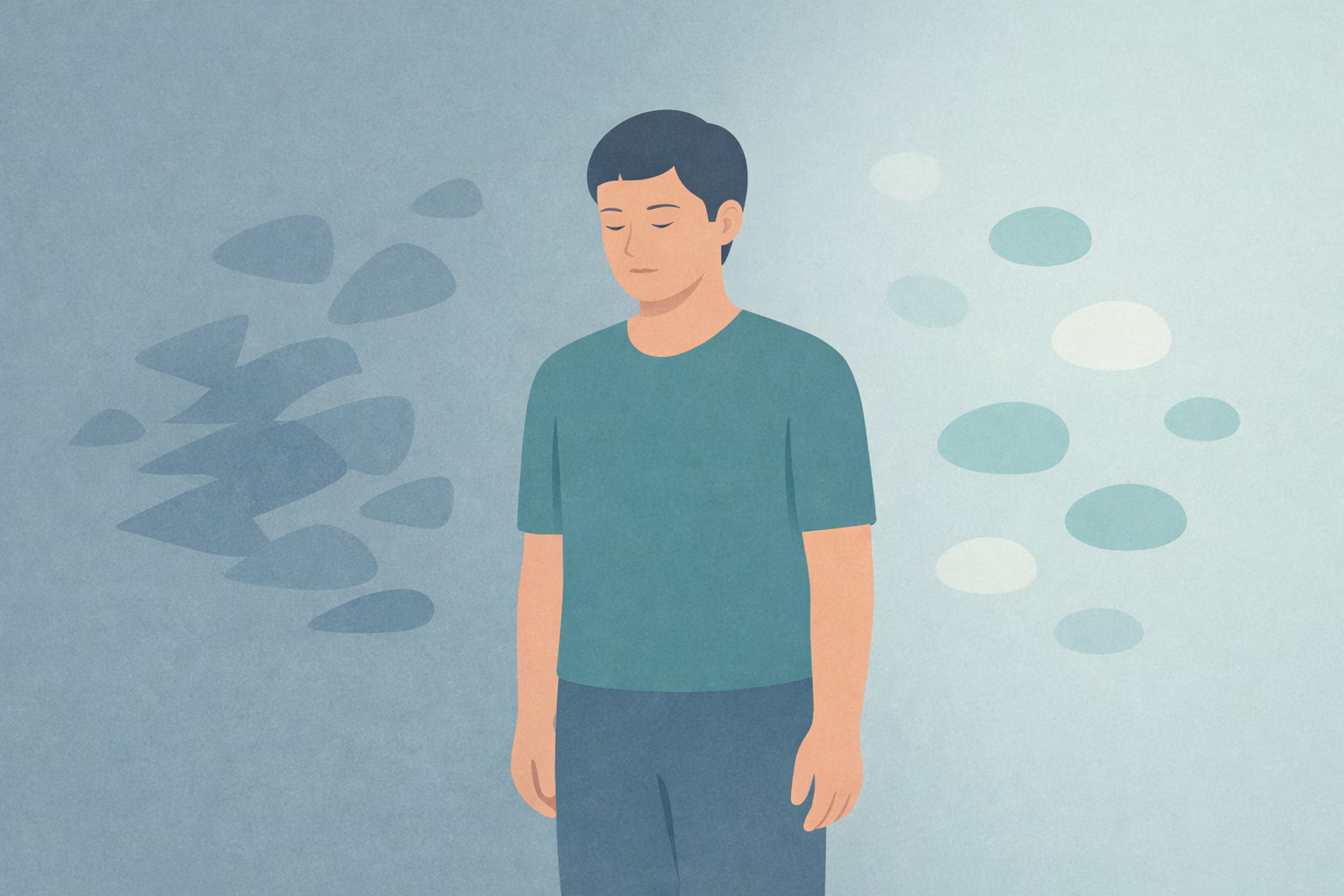
When a relationship stops triggering ongoing threat activation, the change is often surprisingly physical. Your breathing is less held. Your thoughts are less rehearsed. Your body doesn’t require as much recovery time after contact. The interaction may still be serious or vulnerable, but it doesn’t feel like a metabolic event. [Ref-12]
Clarity increases, not because you’ve analyzed everything, but because your system isn’t scrambling to stabilize while you’re speaking. You can track what you actually think. You can sense when something fits and when it doesn’t.
Less strain doesn’t mean less care. It means the relationship is no longer asking your nervous system to do the job of structure.
As load reduces and closure becomes more available, agency tends to return in a practical way. You can feel the difference between obligation and investment. You can notice which connections restore you and which ones consistently leave you smaller.
This is not about cutting everyone off or becoming harder. It’s about being able to choose with less distortion. When your system isn’t braced, you can evaluate relationships with more realism: what they cost, what they give, and what they allow you to be. [Ref-13]
Capacity makes discernment possible. Discernment makes meaning coherent.
If certain people exhaust you, it doesn’t automatically mean they’re “toxic,” and it doesn’t mean you’re failing at connection. It often means your nervous system has been doing extra work to maintain contact without enough reciprocity, safety cues, or closure.
Seen this way, the drain becomes information: a signal about fit, pacing, responsibility, and respect. When relationships align with those basics, people tend to feel more like themselves inside them. That’s not indulgence—it’s the biological foundation for sustainable belonging. [Ref-14]
Humans aren’t meant to earn rest by surviving relationships. We’re meant to be shaped by bonds that help us settle, orient, and continue—more intact than we arrived.
When you recognize relationship drain as a load problem rather than a personal defect, the story changes. Endurance stops being the only measure of care. And nourishment—reciprocal, steady, respectful connection—starts to look like a rightful part of a meaningful life. [Ref-15]
From theory to practice — meaning forms when insight meets action.
Because some interactions take capacity, not just time. The exhaustion shows up as a tight chest, a buzzing mind, a hollow tiredness, or a sudden need to be alone. You might notice the same sequence: you brace beforehand, perform steadiness during the interaction, feel the cost afterward. That cost isn't proof you're fragile — it's evidence regulation was required. Some conversations contain frequent micro-ruptures: interruptions, probing questions, dismissals, pressure to agree. Even small violations accumulate when they happen without acknowledgement or reset. Co-regulation depends on rhythm, mutual attention, and respect for limits. When that rhythm is repeatedly disrupted, your nervous system has to compensate, and compensation is work.
Because connection is supposed to reduce load. When the relationship requires constant monitoring — what you can say, how they'll react, whether you'll be blamed — your body treats it as a context with consequences. Not moral consequences. Nervous-system consequences. People-pleasing and compliance can reduce immediate activation, but they remove the possibility of repair or clarity. The moment passes, the surface stays calm, the underlying loop stays unfinished. The system gets a 'we survived it' signal, not a Done Signal — and those aren't the same thing. Over time this creates a double fatigue: the fatigue of the interaction plus the fatigue of maintaining a strategy to get through it.
Because relationship drain becomes an Avoidance Loop. A threat-tinged interaction increases vigilance. Vigilance makes you cautious, muted, or over-attentive. Afterward you retreat or numb out to recover. That retreat lowers immediate load, but it removes the conditions that could create repair, renegotiation, or closure. Without closure, the relationship remains unresolved in the body. The next contact arrives with pre-loaded tension because your nervous system remembers: last time required work. This is how exhaustion becomes stable — not from lack of willpower, but because the loop never reaches completion. Imbalanced dynamics persist because asserting needs feels too costly when you're already depleted.
Energizing relationships aren't perfect — they're regulating. They include reciprocity, room for disagreement, and repair after missteps. There's enough steadiness that your system can return to baseline; you don't have to spend constant effort predicting the other person's reaction. Boundaries here aren't walls — they're the edges that allow contact to be real rather than managed. When threat activation subsides, the change is physical: breathing is less held, thoughts are less rehearsed, recovery time after contact shrinks. Less strain doesn't mean less care. It means the relationship is no longer asking your nervous system to do the job of structure. Connection should support life, not consume it.
From Science to Art.
Understanding explains what is happening. Art allows you to feel it—without fixing, judging, or naming. Pause here. Let the images work quietly. Sometimes meaning settles before words do.
One Quiet Window, one insight, one reflection — every Sunday