

Workaholism & the Illusion of Success

In short: There’s a particular kind of letdown that doesn’t look like failure. You do the thing—ship the project, hit the number, get the offer, hear “congrats”—and for a moment your system lifts.
There’s a particular kind of letdown that doesn’t look like failure. You do the thing—ship the project, hit the number, get the offer, hear “congrats”—and for a moment your system lifts. Then, strangely fast, it’s gone. Not sadness exactly. More like the air leaving a room.
Why can success feel so real for five minutes and so irrelevant by tomorrow?
In a Meaning Density frame, this isn’t a character flaw or proof you’re “never satisfied.” It’s often what happens when a win functions as stimulation and relief—brief state-change—without providing closure that settles into identity. Modern achievement culture can deliver endless triggers for pursuit, while quietly withholding the “done” signal that lets the nervous system stand down.
Many people expect a milestone to create a stable landing: a sustained sense of safety, pride, or ease. But the lived experience is often more like a spike and a drop. The nervous system surges during the final stretch, then—once the outcome is known—releases that energy quickly, because the pursuit loop has ended.
This can feel disorienting because it’s not the same as “not caring.” You cared enough to mobilize. The drop is a fast withdrawal of activation, not an accurate measure of what the achievement meant to you.
In reward neuroscience terms, the brain’s signaling is tuned to changes—especially the moment something becomes certain—more than the ongoing presence of the thing. That’s why the emotional “volume” after success often fades faster than expected. [Ref-1]
Dopamine is often talked about as a “pleasure chemical,” but much of its role is about learning, pursuit, and updating expectations. When something is uncertain and potentially rewarding, dopamine signals help energize behavior and reinforce what led you there.
After you attain the goal—especially if the outcome is now expected—the signal changes. The system is essentially saying: “This is known now.” That update can flatten the felt intensity, even when the outcome is objectively good. In reinforcement-learning models, this is described through reward prediction error: the difference between what was expected and what occurred. [Ref-2]
So the drop after success is often a biochemical bookkeeping moment. The body isn’t commenting on your worth; it’s recalibrating the pursuit machinery.
From an evolutionary perspective, it would be risky if satisfaction stayed maximally high after every gain. Stable, long-lasting euphoria would reduce vigilance and exploration. A system that returns to baseline keeps an organism scanning, learning, and responding to shifting conditions.
Dopamine also supports the willingness to spend effort—mental and physical—when the brain estimates that effort could pay off. That makes it a powerful driver of cognitive work, persistence, and focus during pursuit. [Ref-3]
The issue is not that your brain adapts. The issue is that modern environments can stack “pursuit cues” continuously—deadlines, metrics, comparison—so the system is asked to sprint over and over without enough completion that registers as truly finished.
Achievement often delivers more than a reward. It can briefly reduce social uncertainty: Will I be respected? Am I secure? Did I do enough? When the answer turns positive, the nervous system reads it as a short-lived safety cue.
That’s why the “high” can include a rush of confidence, a loosening in the chest, or a sense of permission to rest—sometimes for the first time in weeks. This is less about vanity and more about how humans are built to track belonging, rank, and predictability in their environment.
But because reward systems are sensitive to prediction and change, the calming effect can diminish quickly once the outcome is absorbed and becomes the new normal. In learning terms, the system updates and moves on. [Ref-4]
When the high fades fast, the mind often generates an elegant explanation: the goal wasn’t big enough, the recognition wasn’t public enough, the offer wasn’t prestigious enough. The nervous system—still oriented toward completion—looks for a new target that might finally create lasting settle.
But reward signaling is designed to normalize repeated outcomes. What felt thrilling once can become “expected” surprisingly quickly, which reduces the size of the internal reward update even if the external reward increases.
Research on dopamine dynamics suggests these signals are tightly linked to shifting expectations and context—how the brain infers what state it’s in and what usually happens next. When success becomes part of the expected state, the internal surge shrinks. [Ref-5]
In a Pleasure Loop, the system starts using achievement as a state regulator: stress rises, pursuit creates focus and adrenaline, success produces a brief release, and then baseline returns—sometimes lower because of exhaustion. The next goal appears not as a choice, but as the quickest path back to “up.”
This is closely related to what popular psychology calls the hedonic treadmill: positive changes can boost mood temporarily, then the system adapts and returns toward baseline. [Ref-6]
What gets lost in the loop is closure. Not “understanding” what happened, but the deeper physiological sense that something has completed and can be carried as part of identity: I did that, it’s done, it counts, and my system can stand down.
When reward adaptation meets constant evaluation, people often develop predictable strategies to keep the system mobilized. These strategies can look impressive from the outside and feel exhausting on the inside.
Hedonic adaptation research repeatedly finds that people often return toward a baseline after positive events, which can make “more” feel necessary even when life is objectively improving. [Ref-7]
Over time, a life organized around external wins can thin out the quieter signals that make work feel naturally engaging: curiosity, craftsmanship, contribution, interest. Not because those qualities disappear, but because they get crowded out by urgency.
When the nervous system learns that only high-stakes outcomes provide relief or recognition, everyday effort can start to feel flat. The system waits for the next spike instead of settling into sustainable engagement.
This is one reason people can become less joyful even as they become more accomplished. The baseline keeps resetting, while the cost of pursuit rises. Summaries of hedonic adaptation describe this return toward baseline as a common human pattern, not a personal failure. [Ref-8]
As the internal reward signal diminishes, the system often compensates by increasing intensity: tighter deadlines, bigger visibility, higher risk, more comparison. The win has to be louder to cut through the normalization.
But louder wins usually require louder pressure. Pressure can mobilize performance in the short term, yet it also increases nervous system load—making recovery harder, attention narrower, and the drop after success more pronounced.
This creates diminishing returns: more output for less satisfaction. And because modern work often measures success continuously, there may be fewer natural endpoints where the system can register completion. Applied discussions of hedonic adaptation often describe this escalating chase after promotions or income gains—more achieved, less felt. [Ref-9]
There is a kind of steadiness that doesn’t come from winning more. It comes from not needing the win to change your state. In that steadiness, goals can still matter—sometimes deeply—but they aren’t the only doorway to relief, identity, or legitimacy.
Importantly, this isn’t a mindset trick and it isn’t “being grateful harder.” It’s a structural shift where motivation is less chemically dependent on spikes and more supported by coherence: the sense that what you do fits who you are and where you’re going.
Research on extrinsic rewards and intrinsic motivation suggests that when external contingencies dominate, internal engagement can weaken. When the system is less governed by external reward dependence, a calmer form of persistence becomes more available. [Ref-10]
Humans regulate not only through outcomes, but through social reality: being seen accurately, belonging to a shared project, knowing your effort mattered to someone. Metrics can measure performance, but they rarely provide the relational “completion cue” of being understood.
When recognition is purely numerical, the nervous system may stay vigilant—always awaiting the next evaluation. When recognition includes context and shared meaning, the system often registers it as safer and more settling, because it confirms continuity of identity: this is who I am among others.
Meta-analytic work on extrinsic rewards has long noted complex effects on intrinsic motivation and engagement, especially when rewards feel controlling or substitutive rather than acknowledging. [Ref-11]
Some forms of praise feel like a scoreboard. Other forms feel like being met as a person.
When a life is less organized around spikes, satisfaction often changes texture. It may be less fireworks and more steadiness: less “high,” more grounded. Not because you’ve lowered standards, but because the nervous system is no longer being asked to treat every milestone as a survival event.
This kind of satisfaction tends to arrive after completion has had time to settle—when experiences become integrated into the story of “my life,” not just “my performance.” It can coexist with ambition, but it’s less brittle.
Research discussing the negative effects of rewards on intrinsic motivation highlights that heavy reliance on external rewards can reduce sustained interest. When that reliance loosens, engagement can become more self-sustaining and less chemically driven. [Ref-12]
In an achievement-saturated world, it’s easy for goals to become primarily about keeping the system activated: a way to outrun uncertainty, secure belonging, or force a sense of aliveness. But goals can also function differently—as expressions of values, contribution, and chosen identity.
When goals are selected mainly for external payoff, the nervous system may learn that the work itself is secondary, which can quietly undercut intrinsic motivation over time. [Ref-13]
When goals are aligned with meaning—work that feels like a coherent extension of self—motivation often becomes less dependent on the “hit” of recognition. The system can still enjoy success, but it doesn’t need success to feel real.
The fading of the achievement high isn’t proof that you’re ungrateful or impossible to satisfy. It can be a signal that the reward system did what it’s designed to do: update, normalize, and move on.
What deserves attention is what the chase has been asked to carry—relief, identity, safety, legitimacy—and whether the environment offers true endpoints where completion can register. When those endpoints are scarce, the system naturally reaches for the next measurable win as a substitute for closure.
Effort and reward signals are shaped by context; when effort rises without lasting return, the nervous system tends to recalibrate what feels “worth it.” [Ref-14] Sometimes the most orienting question isn’t “How do I achieve more?” but “What kind of life would feel complete enough to inhabit?”
Achievement is not the problem. The problem is when achievement is forced to act like a regulator—providing the only reliable spikes of relief, the only proof of worth, the only doorway to rest.
A nervous system built for learning will keep updating after every win. Reward prediction errors teach the brain what to expect next, and they fade as certainty rises. [Ref-15] That’s not brokenness; it’s biology.
What tends to endure is not the high, but the coherence that forms when what you do can land as “done,” belong to your identity, and serve something you recognize as meaningful. In that kind of life, success still matters—just not as your only source of stability.
From theory to practice — meaning forms when insight meets action.
Because the empty moment after a win isn't mysterious — it's a system returning to baseline. The nervous system surges during the final stretch, then once the outcome is known, releases that energy quickly because the pursuit loop has ended. Dopamine isn't really a pleasure chemical; much of its role is about learning, pursuit, and updating expectations. After attainment, the signal essentially says 'this is known now,' which flattens felt intensity even when the outcome is objectively good. The drop is biochemical bookkeeping, not commentary on your worth. The body's reward system is tuned to changes more than to ongoing presence.
Not really. From an evolutionary standpoint, it would be risky if satisfaction stayed maximally high after every gain — stable euphoria reduces vigilance and exploration. A system that returns to baseline keeps the organism scanning, learning, and responding. That's adaptation, not dysfunction. The issue is that modern environments stack pursuit cues continuously — deadlines, metrics, comparison — so the system sprints over and over without enough completion that registers as truly finished. The story 'the next one will feel different' is a normal reward illusion: what felt thrilling once becomes 'expected' surprisingly quickly, shrinking the internal update even as external rewards rise.
When the system starts using achievement as a state regulator: stress rises, pursuit creates focus and adrenaline, success produces a brief release, baseline returns — sometimes lower because of exhaustion. The next goal appears not as a choice but as the quickest path back to 'up.' What gets lost is closure — not understanding what happened, but the deeper physiological sense that something has completed and can be carried as part of identity. Common patterns include goal escalation (a win immediately converts into a higher bar), dissatisfaction after success, productivity addiction, and difficulty celebrating — not because you can't feel, but because the system won't register completion.
There's a steadiness that doesn't come from winning more — it comes from not needing the win to change your state. Goals can still matter, sometimes deeply, but they aren't the only doorway to relief, identity, or legitimacy. This isn't gratitude harder; it's a structural shift where motivation is less chemically dependent on spikes and more supported by coherence — what you do fits who you are. When success serves contribution and identity rather than stimulation, satisfaction becomes quieter, deeper, less urgent. It can coexist with ambition, but it's less brittle. Success lasts when it serves a life, not a loop.
From Science to Art.
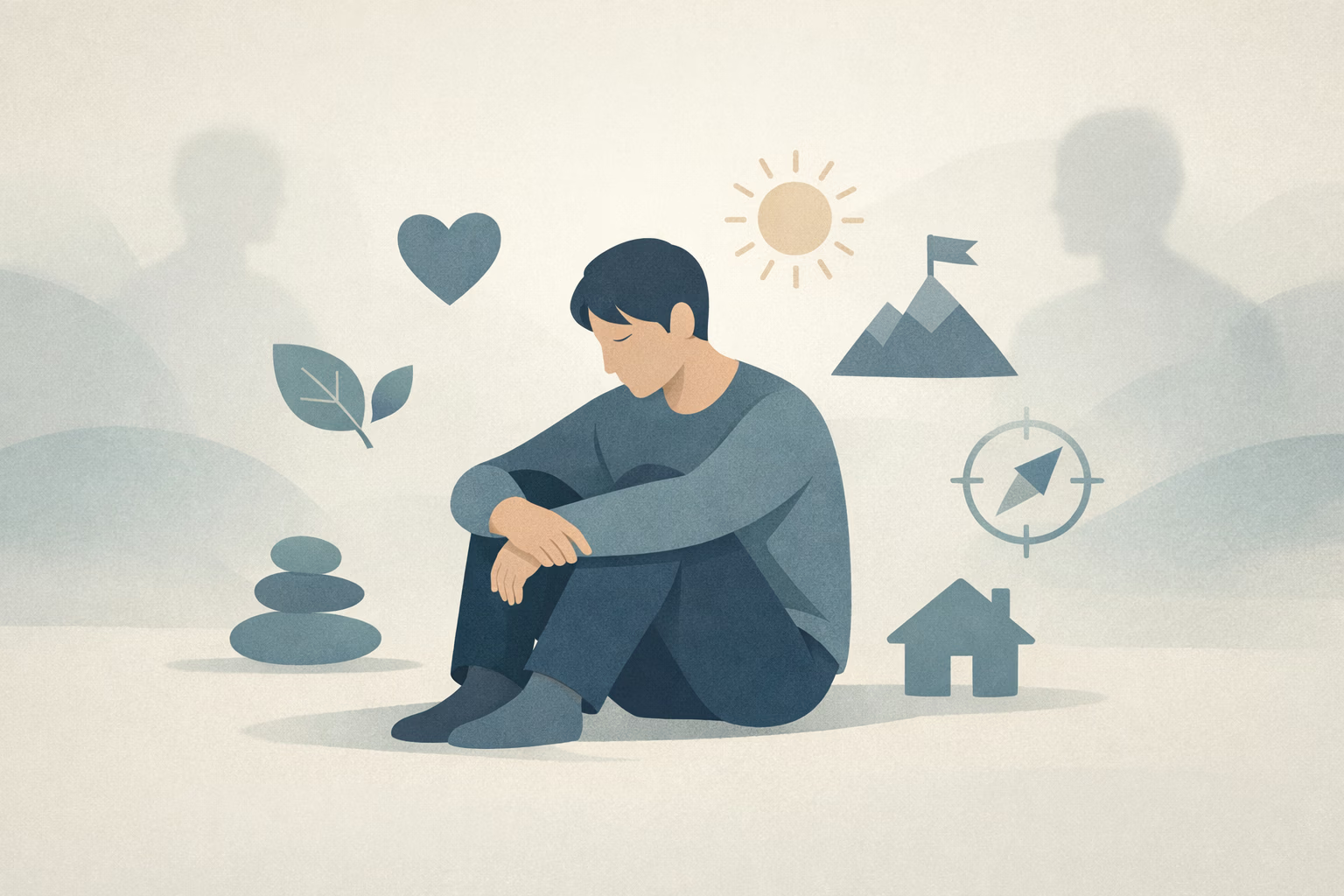
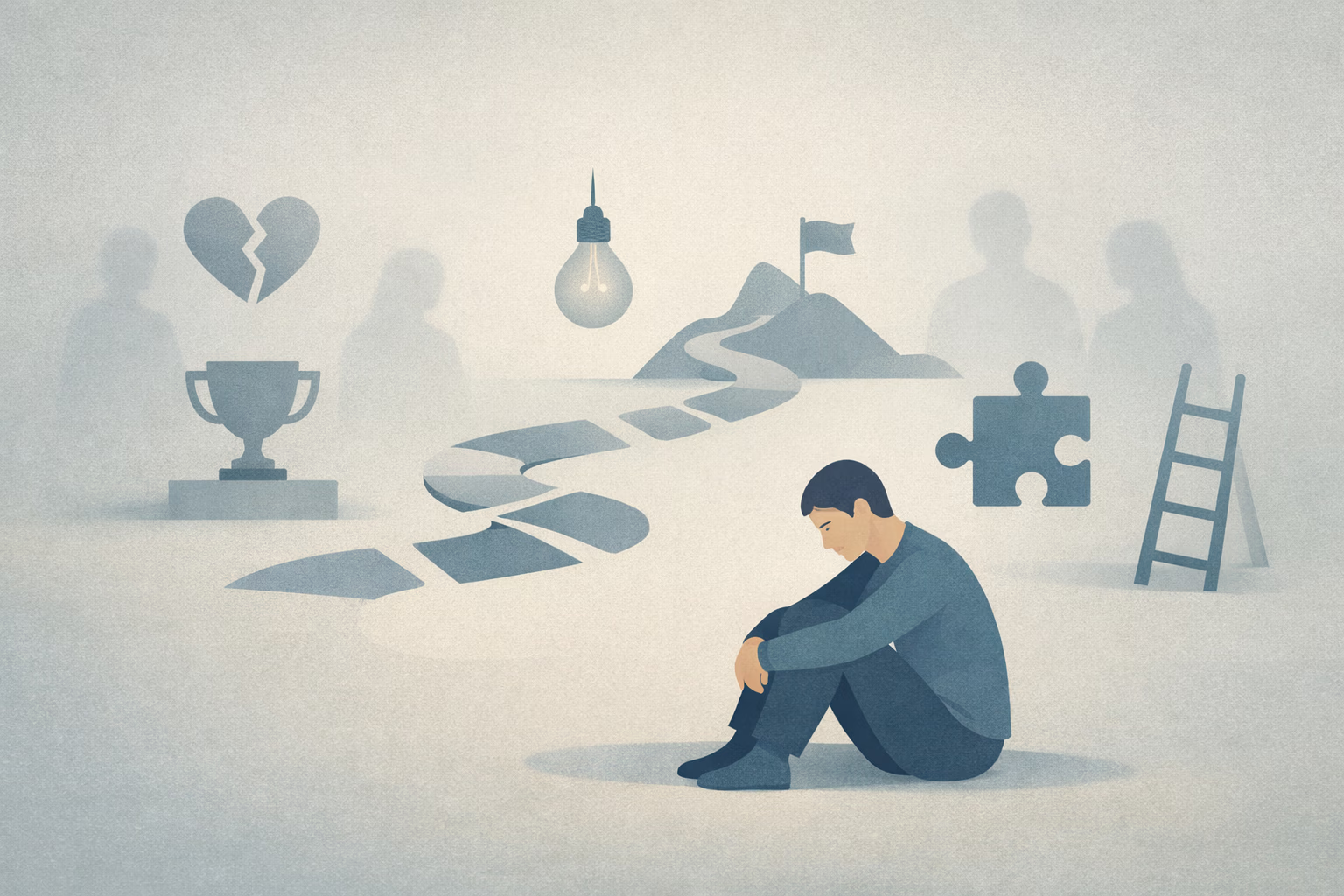
Understanding explains what is happening. Art allows you to feel it—without fixing, judging, or naming. Pause here. Let the images work quietly. Sometimes meaning settles before words do.
One Quiet Window, one insight, one reflection — every Sunday