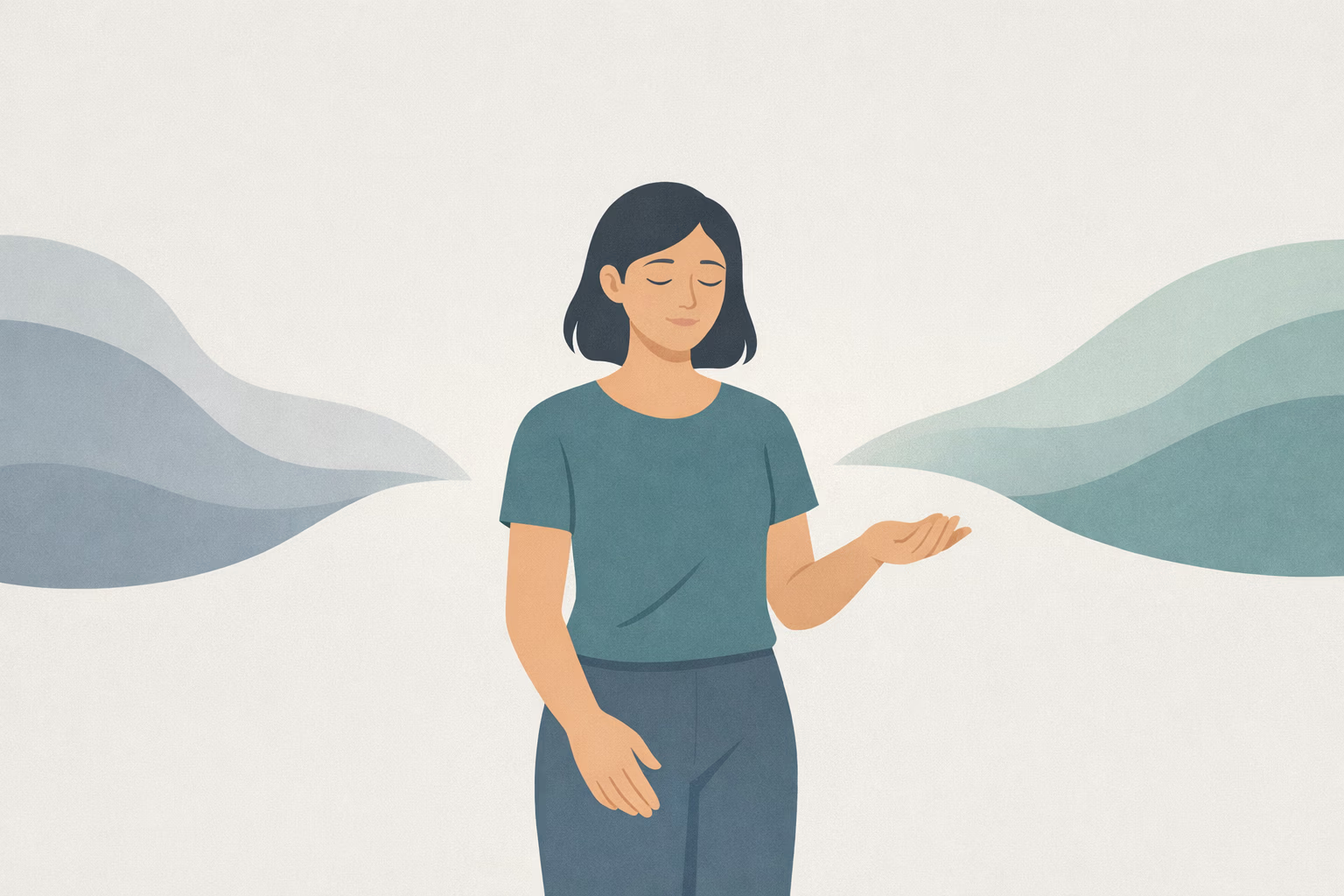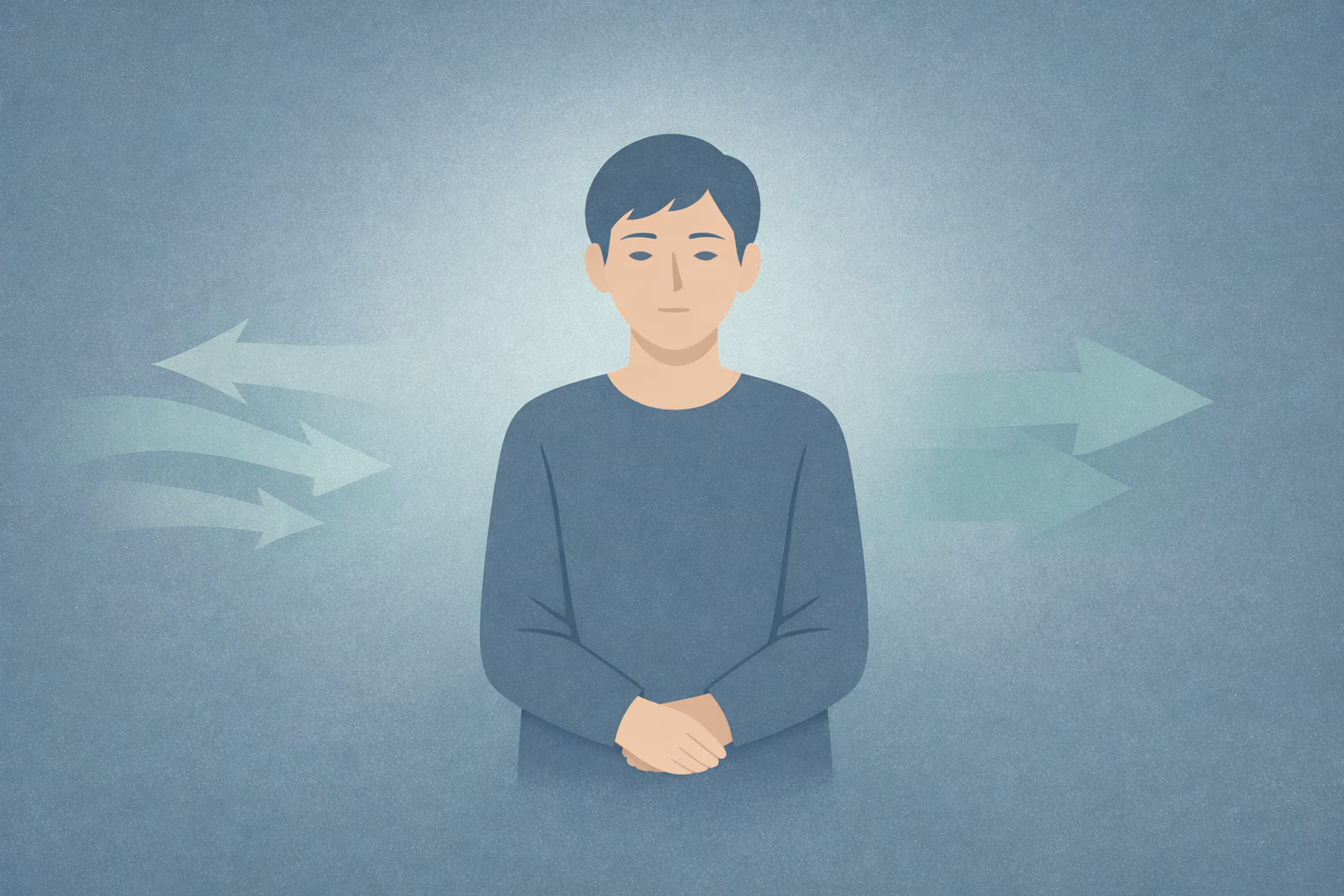
Fight, Flight, Freeze: Understanding Shutdown Mode
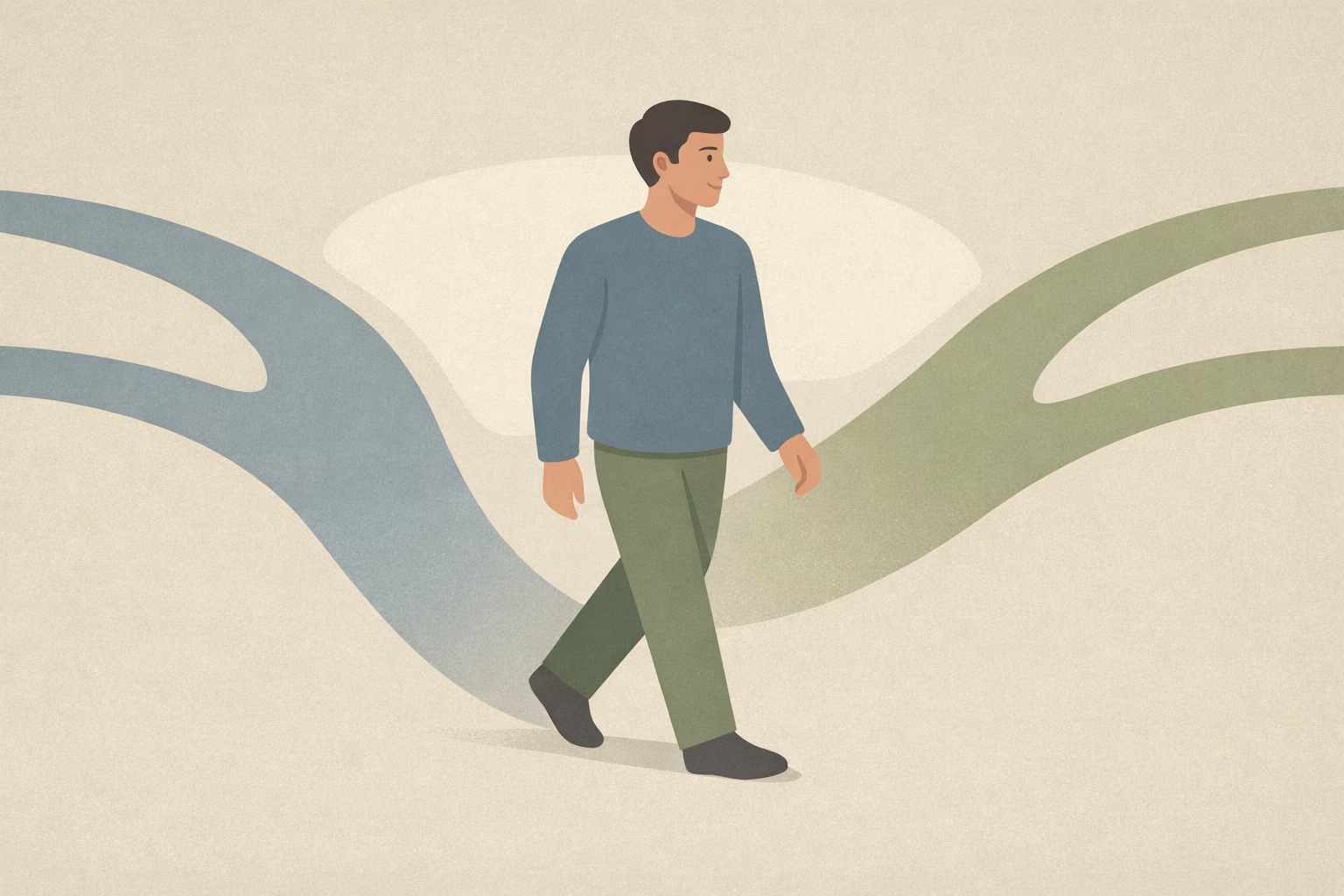
In short: Avoidance can look like procrastination, busyness, scrolling, over-planning, disappearing, or “I’ll deal with it tomorrow.” It often comes with a sharp second layer: self-judgment. But from a nervous-system perspective, avoidance is less about who you are and more about what your system has learned reduces load quickly.
Avoidance can look like procrastination, busyness, scrolling, over-planning, disappearing, or “I’ll deal with it tomorrow.” It often comes with a sharp second layer: self-judgment. But from a nervous-system perspective, avoidance is less about who you are and more about what your system has learned reduces load quickly.
When discomfort shows up—uncertainty, effort, conflict, vulnerability, boredom—your brain doesn’t treat it as a philosophical prompt. It treats it as a potential cost. If pulling away reliably brings relief, the brain marks that move as protective, and it starts to feel compelling and automatic.
What if the urge to escape isn’t you being weak—what if it’s your brain doing exactly what it was built to do?
Many people recognize the moment: you’re about to start something important, respond to a message, have a needed conversation, or sit down with a feeling that has been hovering for days. Then something in you shifts. Attention scatters. Your body looks for an off-ramp. A different task suddenly feels urgent.
What’s frustrating is how often this happens despite insight. You can understand what matters, care deeply, and still find yourself drifting into relief behaviors. That mismatch—between intention and action—can create a sense of being stuck, even when you’re trying hard to be “reasonable.”
From a neuroscience lens, this isn’t a moral failure. It’s a learned regulation pattern: discomfort cues activate protective circuits, and relief cues activate approach. Over time, the system becomes consistent: discomfort predicts load; escape predicts safety. [Ref-1]
When the brain detects potential threat—whether physical danger or social/psychological cost—it mobilizes resources: vigilance, tension, narrowed attention, urgency. This is a protective state designed to reduce risk. The key point is that the brain doesn’t require certainty that something is dangerous; it responds to signals that it might be costly.
Avoidance becomes powerful because it changes state quickly. Disengaging from the uncomfortable stimulus often drops arousal, reduces uncertainty, and creates an immediate “better” signal. That relief is not just pleasant; it is information. The brain learns: this move works. Over repeated pairings, relief functions as reinforcement, strengthening the tendency to withdraw the next time discomfort appears. [Ref-2]
So the loop isn’t “I avoid because I don’t care.” It’s often “my system has proof that escape reduces activation fast.”
Humans evolved in environments where many discomfort signals were tightly linked to real danger: predator presence, hostile groups, unstable shelter, injury, scarcity. In that context, speed mattered. Rapid disengagement from threat increased survival.
This is why avoidance can feel so bodily and non-negotiable. It’s not primarily a conscious choice; it’s a defensive behavior shaped by circuitry that prioritizes reducing harm and conserving resources. Modern tasks—emails, deadlines, health appointments, creative work, relationship repair—can recruit the same defensive architecture even when no physical threat exists. [Ref-3]
In other words: the brain doesn’t ask, “Is this meaningful?” first. It asks, “Is this safe and manageable?”
Avoidance works quickly because it changes what your nervous system is tracking. When you exit the uncomfortable situation, the body receives a drop in intensity. Heart rate and muscle tension may soften; cognitive pressure may loosen; your mind may regain a sense of room.
That shift can register as safety. And because safety is the platform for flexible thinking, the mind often interprets the change as control: “Now I can breathe. Now I can think. Now I’m okay.” In the moment, that’s not a delusion—it’s a real physiological downshift.
The complication is that the downshift arrives without completion. The loop closes at the level of immediate arousal, not at the level of resolution. So the system learns to pursue relief as a reliable regulator. [Ref-4]
Relief tells the nervous system, “Intensity decreased.” Resolution tells the nervous system, “This is done.” Those are different signals.
When something is repeatedly exited without completion, the brain may keep it tagged as unfinished: an open loop that could still carry cost. The result is often a strange persistence—background dread, repeated mental checking, or a growing sense that the avoided thing is getting “bigger,” even if the facts haven’t changed.
Neurobiologically, transitions from fear to safety are not just about getting away from a cue; they involve learning that safety is stable in the presence of the cue, and that the situation has reached an endpoint. Without that, the threat system stays easily reactivated. [Ref-5]
Avoidance tends to operate like a self-reinforcing circuit. The body experiences a spike of discomfort, then relief behavior reduces that spike. The brain updates: “This cue predicts threat; this exit predicts safety.” Over time, both sides strengthen—discomfort becomes a louder alarm, and relief becomes a more compelling reward.
This is one reason avoidance can expand. It doesn’t merely remove discomfort; it can increase the nervous system’s expectation that discomfort requires urgent reduction. The threshold for “too much” can drop, not because a person is fragile, but because the system has been trained to stand down only when it exits. [Ref-6]
“It’s not that I’m choosing the distraction. It’s like the distraction chooses me—because my body wants the pressure to stop.”
Avoidance is often misunderstood because it rarely announces itself as “I am avoiding.” It can look like problem-solving, preparation, caretaking, or being “responsible.” The common feature is not the content of the behavior, but the function: it reduces immediate activation and postpones contact with an unfinished edge. [Ref-7]
Common patterns include:
Notice how none of these require laziness. They require a nervous system that has learned which exits work quickly.
Capacity is not a personality trait—it’s a state-dependent resource. When threat circuits stay highly reactive, attention narrows and flexibility reduces. When relief is the main regulator, the system gets fewer chances to learn that it can remain organized through intensity.
Over time, this can create a structural narrowing: smaller stressors trigger bigger responses; minor discomfort feels disproportionately urgent; and the mind becomes more likely to interpret ordinary challenge as danger. This aligns with findings on how amygdala–prefrontal dynamics shape adaptive vs. maladaptive learning under stress load. [Ref-8]
This isn’t punishment. It’s the nervous system doing bookkeeping: it allocates resources away from challenge when challenge repeatedly ends in escape rather than completion.
In defensive behavior research, the brain is understood to organize responses along a threat-management sequence—orientation, vigilance, avoidance, and other protective modes. Which mode becomes dominant depends on what has worked before. [Ref-9]
When avoidance reliably produces relief, the brain begins to treat the earliest signs of discomfort as predictive: a message notification, a calendar reminder, the first paragraph of a difficult document, the first hint of disagreement in a conversation. The cue itself starts to carry threat value, even if the outcome is uncertain.
This helps explain why avoidance can feel instantaneous. The body is not waiting for the full problem; it’s responding to the prediction. If the nervous system has learned that “prediction of discomfort” equals “incoming cost,” it will mobilize an exit early.
It can be tempting to believe that if you understand your avoidance well enough, it will loosen. But nervous systems don’t de-escalate because an idea is correct. They de-escalate when the environment and the body register enough safety and closure for activation to stand down.
When baseline safety is higher—when load is lower, cues of support are present, and life has more “finished” moments—the urge for fast relief often becomes less urgent. Not because discomfort disappears, but because the system no longer treats it as an emergency that must be discharged immediately. [Ref-10]
What changes when your system expects that hard moments can end in completion—rather than escape?
Humans are social regulators. A steady, reassuring presence—someone attuned, non-escalating, not evaluating—can reduce threat activation in a way that solitary effort sometimes cannot. This isn’t about dependency; it’s about how mammalian nervous systems use relational cues as evidence of safety.
In learning terms, avoidance is strengthened by negative reinforcement: removing an aversive state increases the behavior that removed it. [Ref-11] Supportive co-regulation can interrupt that pattern by lowering the aversive state without requiring full disengagement. The brain gets new data: discomfort can soften while staying in contact with what matters.
That’s one reason difficult experiences often feel more workable in safe company. The load is shared, and the nervous system becomes less certain that escape is the only route to relief.
When avoidance loosens, it usually doesn’t look like constant bravery. It looks like more consistent access to “staying power.” You can remain oriented even when discomfort rises. You can track signals without immediately converting them into urgency.
This resembles what fear–avoidance frameworks describe: when threat appraisals and protective responses dominate, function narrows; when threat reactivity decreases, engagement and tolerance tend to widen. [Ref-12]
Markers of returning steadiness often include:
Importantly, this is not about feeling intensely. It’s about the system regaining its ability to return to baseline after challenge.
Avoidance narrows life because it makes immediate relief the primary decision criterion. The nervous system votes for what reduces activation now. Over time, that can pull behavior away from values—not because values are absent, but because the body doesn’t have enough safety to afford them.
As threat reactivity and reward reactivity settle, a different organizer can return: direction. Choices can become less about “What will quiet this sensation fastest?” and more about “What fits the life I recognize as mine?” This is where meaning becomes stabilizing—because actions end with completion and land inside identity, not just relief.
In fear-avoidance models, reduced threat coupling supports re-engagement and function. [Ref-13] The deeper shift is that engagement starts to produce its own closure signal, so the system learns: staying is survivable, and finishing is real.
If you run from discomfort, it may help to see the pattern with dignity: your nervous system is prioritizing safety using the tools it trusts. That trust was built through repetition—through moments where exiting truly did reduce load.
And because it’s learned, it can also be re-learned. Not through pressure, but through conditions that support completion: experiences that end, settle, and register as “handled.” When that happens, avoidance often loses its job description.
Meaning tends to return when life contains more coherent endings—when effort leads somewhere that feels real, and your choices begin to match the person you know yourself to be. In that context, discomfort is no longer proof of danger; it becomes part of the terrain of a directed life. [Ref-14]
Breaking an avoidance loop is not about eliminating the need for relief. Relief is a valid nervous-system language. The shift is when relief stops being the only language available.
As safety becomes more consistent and completion becomes more common, the brain generalizes value differently: fewer cues get tagged as danger, and more situations become approachable without the same urgency to exit. [Ref-15]
That’s not self-improvement. It’s restoration: the quiet return of agency that happens when your system finally believes, at a bodily level, that you can stay, finish, and come back to yourself.
From theory to practice — meaning forms when insight meets action.
Because relief works fast, and the brain learns from what works. When discomfort cues arrive, threat circuits mobilize — vigilance, tension, narrowed attention, urgency. Avoidance becomes powerful because it changes state quickly: disengaging drops arousal, reduces uncertainty, and creates an immediate 'better' signal. That relief functions as reinforcement. Over repeated pairings, your nervous system learns this move works. The mismatch between intention and action isn't moral failure. It's a learned regulation pattern: discomfort predicts load; escape predicts safety. It's not that you're choosing distraction. It's that your body has proof escape reduces activation, and the distraction chooses you when the pressure rises.
No, and that's the structural problem. Relief tells the nervous system 'intensity decreased.' Resolution tells it 'this is done.' Different signals. When something is repeatedly exited without completion, the brain keeps it tagged as unfinished — an open loop that could still carry cost. The result is often a strange persistence: background dread, repeated mental checking, a growing sense the avoided thing is getting bigger even if facts haven't changed. Transitions from fear to safety aren't just about getting away from a cue; they involve learning that safety is stable in the presence of the cue, and that the situation has reached an endpoint. Without that, the threat system stays easily reactivated.
Because the loop trains long sensitivity through quick relief. The body experiences a spike of discomfort, relief behavior reduces the spike, and the brain updates: this cue predicts threat, this exit predicts safety. Over time, both sides strengthen — discomfort becomes a louder alarm, and relief becomes a more compelling reward. The threshold for 'too much' drops, not because you're fragile, but because the system has been trained to stand down only when it exits. Avoidance also learns to fire on prediction, not outcome. A notification, a calendar reminder, the first paragraph of a hard document — these cues themselves carry threat value, so the body mobilizes an exit early, before the actual challenge arrives.
Through safety and completion, not understanding. Nervous systems don't de-escalate because an idea is correct — they de-escalate when the body registers enough safety and closure for activation to stand down. When baseline safety is higher and life contains more 'finished' moments, the urge for fast relief becomes less urgent. Co-regulation matters here: a steady, attuned, non-evaluating presence can lower the aversive state without requiring full disengagement. The brain gets new data: discomfort can soften while staying in contact with what matters. Markers of returning steadiness include fewer dramatic spikes from small stressors, more ability to pause before exiting, and more frequent Done Sensations after effort.
From Science to Art.
Understanding explains what is happening. Art allows you to feel it—without fixing, judging, or naming. Pause here. Let the images work quietly. Sometimes meaning settles before words do.
One Quiet Window, one insight, one reflection — every Sunday