Gambling Psychology: Why Uncertainty Is Addictive

In short: Loot boxes are game features that offer randomized rewards—often cosmetic items, power-ups, or rare collectibles—delivered through a “maybe this time” opening moment. On the surface, it can feel like harmless excitement layered onto play.
Loot boxes are game features that offer randomized rewards—often cosmetic items, power-ups, or rare collectibles—delivered through a “maybe this time” opening moment. On the surface, it can feel like harmless excitement layered onto play. Under the hood, it’s a very specific kind of learning environment: one that teaches the brain to stay engaged through uncertainty.
Why can something that takes seconds to open feel so hard to stop thinking about?
In a Meaning Density frame, this isn’t about personal weakness or “bad self-control.” It’s about how modern reward systems can interrupt closure. When the loop doesn’t complete—when the system never gets a true “done” signal—urgency, chasing, and repetitive checking can start to make sense as regulatory responses to ongoing activation.
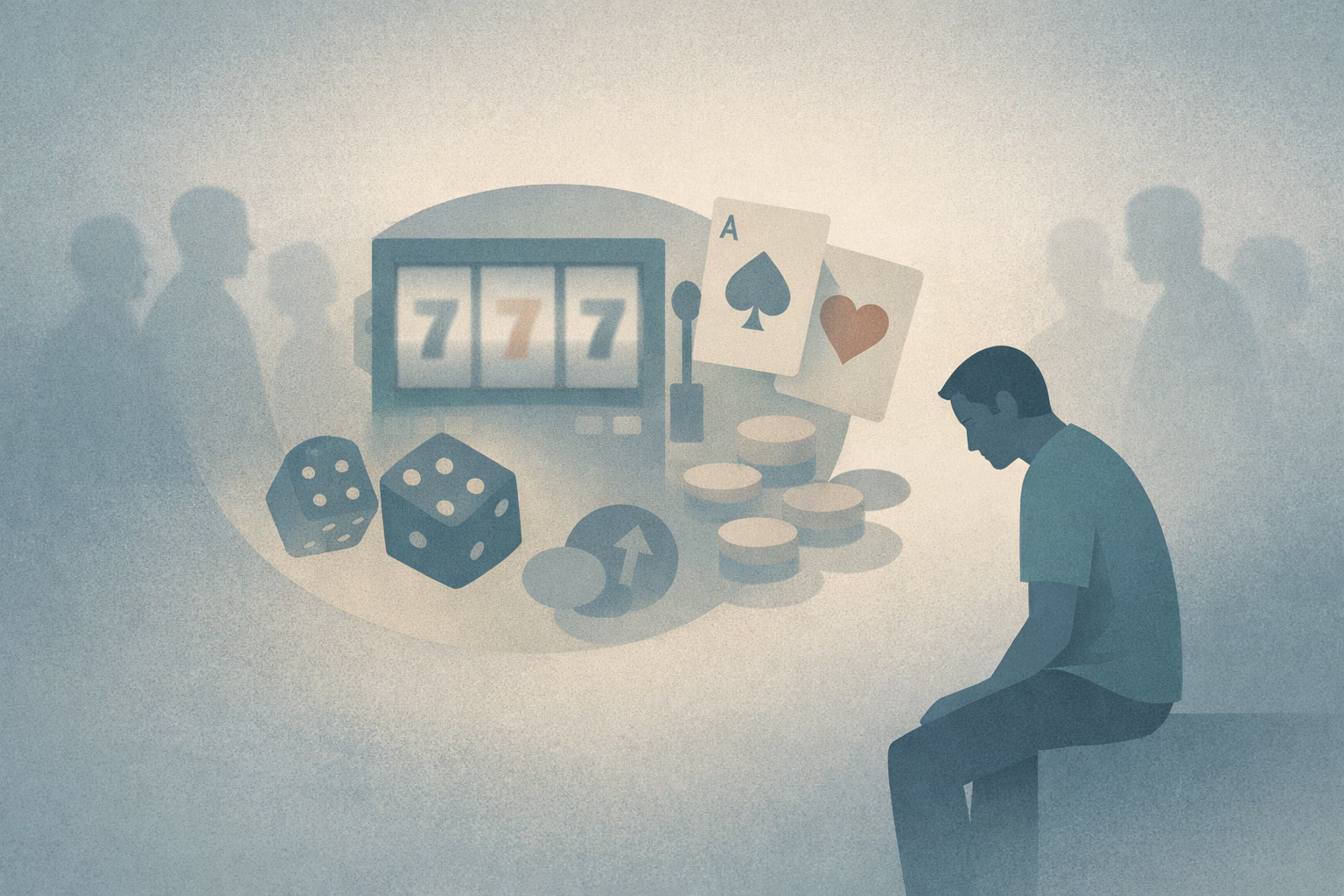
Loot boxes often create a recognizable rhythm: a spike of excitement before opening, a quick scan for what you got, then a drop—disappointment, neutrality, or brief relief—followed by the urge to open again. The nervous system is not only responding to the reward; it’s responding to the swing.
That swing matters because it mimics gambling-like arousal patterns: anticipation becomes the main event, and the outcome becomes a short landing pad before the next takeoff. Research observing physiological arousal during rare loot box rewards suggests that the opening moment can be unusually activating, especially when outcomes are rare and visually emphasized. [Ref-1]
“It wasn’t even the item—it was the moment right before it could be the item.”
Variable rewards—wins that arrive unpredictably—are powerful because they load the system with anticipation. Dopamine is often described as a “pleasure chemical,” but in many contexts it functions more like a salience-and-seeking signal: it flags something as worth pursuing, especially when the timing is uncertain.
With loot boxes, the brain learns that effort plus uncertainty sometimes pays off. The repeated pairing of opening → maybe → reveal can build a strong reinforcement loop, where the body mobilizes before the outcome is even known. Large-scale survey research has linked higher loot box spending with problem gambling indicators, suggesting the mechanism is not just “fun randomness” for a subset of players. [Ref-2]
From an evolutionary perspective, sensitivity to uncertain reward isn’t a character flaw—it’s a survival feature. In unpredictable environments, exploration had value: sometimes the next attempt did lead to food, shelter, status, or safety. Nervous systems evolved to stay engaged when a payoff is possible but not guaranteed.
Loot boxes can recruit that ancient “keep looking” circuitry while removing natural stopping points. In real life, opportunities often end: the tree is empty, the hunt is over, the season changes. In a digital economy, the opportunity can be endlessly regenerated, keeping the system oriented toward the next possibility rather than completion.
Clinical and observational discussions of gaming-related difficulties frequently note how reward structures can pull vulnerable systems into persistent loops—especially when stress load is already high and the environment offers few settling cues. [Ref-3]
Loot boxes don’t only promise an item; they promise a brief change of state. The opening sequence can deliver hope (“maybe I’ll finally get it”), a temporary break from boredom, or a clean hit of excitement inside a longer play session.
That matters because relief and stimulation can act like quick regulators when the broader day has been fragmented or pressurized. The moment can feel like a small tunnel out of heaviness or monotony—fast, bright, and uncomplicated. Research discussing loot boxes as gambling-like features highlights how these mechanics can resemble wagering in both structure and psychological pull. [Ref-4]
When the day is noisy, who wouldn’t want a clean, immediate spark?
Loot boxes often wear the costume of progress: rarity tiers, limited-time drops, “almost there” collections, or curated animations that make randomness feel like a personal trajectory. But because the outcome is not truly earned, the experience can quietly erode the sense of completion.
Over time, spending can creep—not necessarily through a conscious decision, but through repeated micro-justifications: one more try, one more bundle, one more event before it ends. Research has found associations between loot box engagement, problematic gaming, and gambling-related cognitions, suggesting that for some players the system shifts from entertainment to a strain pattern. [Ref-5]
In Meaning Density terms, the cost is often not just money. It can be coherence: the sense that your time, attention, and identity are moving toward something that actually settles.
In a classic pleasure loop, anticipation replaces satisfaction. The system learns that the “up” is reliable (the opening ritual), while the “down” is tolerable because a new “up” is always available. This doesn’t require dramatic emotion or conscious craving; it can run as a subtle tilt toward repetition.
When the nervous system repeatedly mobilizes without receiving a stable completion signal, it may stay semi-activated—restless, scanning, ready. Evidence summaries on loot boxes and problem gambling describe how gambling-like reinforcement patterns can condition ongoing engagement, even when the average value of outcomes is low. [Ref-6]
“It’s not that I enjoyed it. It’s that it kept me from feeling finished.”
Because this is a structural loop, it tends to produce recognizable shifts in behavior and experience. Not everyone will see all of these, and none of them mean “this is who you are.” They’re common outputs of an environment designed to keep the seeking system online.
Research discussions of loot boxes and related harms often emphasize these patterns as gradients—subtle at first, then more sticky as repetition builds and the loop becomes familiar. [Ref-7]
Autonomy isn’t only a decision in the mind; it’s also a state in the body. When reward variability is high and cues are frequent—flashy reveals, limited-time offers, “bonus” currency—the nervous system can shift into a narrower channel: focus tightens, time compresses, and reflective choice becomes harder to access in the moment.
Casino-style mechanics in games can also blur financial awareness. When purchases are routed through tokens, gems, or bundles, the spending signal becomes quieter. Evidence reviews and reports on loot boxes and problem gambling emphasize how these structures can undermine informed decision-making and increase risk for some players. [Ref-8]
In coherence terms, the issue isn’t morality. It’s that the environment reduces the chance of a clean, integrating “I did what I meant to do” endpoint.
Two features tend to supercharge persistence: near-misses (outcomes that feel close to a win) and rare wins (outcomes that are dramatic, celebratory, and memorable). Both can keep the seeking system active, because they imply that the next attempt is not only possible but due.
In a variable reward environment, a rare win can retroactively justify many losses. A near-miss can create a sense of momentum without delivering completion. Research on reward variability and frequency suggests these engineered patterns can act as drivers of persistent play, even when the expected value remains low. [Ref-9]
What looks like “irrational chasing” from the outside can be understood as the nervous system responding to cues that say: stay engaged; resolution is close.
When exposure to highly variable rewards decreases, something often shifts that is deeper than “better habits.” The system gets fewer false alarms—fewer spikes that demand resolution—and more opportunities for return. Attention can widen again. Time can feel less compressed. Decisions can feel more owned.
This is not the same as insight or willpower. It’s a different physiological backdrop: fewer activation loops competing for completion. Evidence linking loot boxes with problem gambling risk has also supported discussion about limiting access and reducing exposure as a harm-reduction pathway, especially for those who notice compulsive patterns. [Ref-10]
When the “maybe” stops shouting, what becomes audible again?
Humans regulate in groups. Social context can either amplify pressure (“everyone is opening boxes; don’t miss out”) or restore grounding (“we keep it visible; we talk plainly about what it costs”). When spending and odds are hidden, the loop thrives in ambiguity. When the reality is legible, the nervous system has more accurate information for closure.
Shared norms—like clear conversations among friends, families, or teams about what counts as acceptable spending—can reduce secrecy and reduce the fragmentation that keeps loops alive. Public-facing discussions about loot box psychology often highlight transparency and accountability as protective factors, especially for younger players. [Ref-11]
“Once it was out in the open, it didn’t have the same grip.”
When the variable-reward channel is less dominant, enjoyment often returns in a quieter form. Not as a constant high, but as steadier engagement: the game feels like a game again, rather than an endless open-ended task.
People commonly describe a reduced sense of urgency, fewer intrusive “one more” impulses, and clearer internal boundaries around spending—not as a forced rule, but as a more natural line that’s easier to feel. Educational summaries of random-reward psychology emphasize how anticipation-driven designs can distort enjoyment, and how reducing those triggers can allow satisfaction to land more fully. [Ref-12]
In Meaning Density terms, the marker isn’t excitement. It’s completion: play ends with a sense of “done,” not a lingering itch for resolution.
Games are deeply human: they’re practice arenas for skill, strategy, cooperation, and story. When the center of gravity shifts away from chance-based consumption, many players rediscover a more coherent relationship with play—one that supports identity instead of scattering it.
Meaningful play often has clearer contours: effort leads to growth; challenges have endings; rewards feel connected to mastery or contribution. This doesn’t remove excitement—it changes its source. It comes from earned competence, shared moments, and narratives that actually resolve.
More broadly, research and public health discussions about high-intensity digital reward systems (including adjacent forms of hyper-stimulation) describe how excessive exposure can correlate with distress and reduced well-being, reinforcing the value of environments that support coherence rather than perpetual activation. [Ref-13]
Loot boxes often attract the part of us that wants progress, novelty, and a clean signal that something good happened. That desire is not wrong. It’s a very reasonable response to lives that can feel repetitive, evaluated, or unfinished.
The trouble is that randomized reward can imitate progress without providing the settling that real progress gives. It can create motion without completion. When that happens, the “more” feeling isn’t greed—it’s an incomplete loop looking for an endpoint.
From a meaning-centered view, agency returns when excitement reconnects to things that can actually integrate: earned milestones, chosen challenges, and play that leaves a trace in identity—“that’s something I did”—instead of a residue of unresolved seeking. Gambling-help education resources note the structural overlap between loot boxes and gambling, which helps explain why the pull can be stronger than people expect. [Ref-14]
A good game doesn’t have to shout to hold attention. When rewards come through skill, time, and story—when effort reliably leads to outcome—the nervous system gets clearer information, and closure becomes possible.
Loot boxes show how easily a “maybe” can keep a person activated. But they also highlight something hopeful: satisfaction isn’t missing because you’re broken. It’s often missing because the environment is built to postpone “done.” Framing loot boxes as gambling-like mechanisms helps clarify why stepping out of that loop can make games feel fulfilling again. [Ref-15]
From theory to practice — meaning forms when insight meets action.
Because the opening moment, not the item, is doing most of the work. Loot boxes deliver a recognizable lift-drop-repeat rhythm: a spike of anticipation, a quick scan of the result, then a drop that calls for another try. The nervous system isn't just responding to the reward; it's responding to the swing. Variable-reward designs train the seeking system to stay engaged through uncertainty, so the body mobilizes before the outcome is even known. In a Pleasure Loop frame, the 'up' becomes reliable while completion never fully lands, which is why a thirty-second action can occupy hours of background mental space.
Structurally they share the core mechanics: variable rewards, near-misses, rare dramatic wins, and obscured spend through tokens or bundles. Large-scale survey research has linked higher loot box spending with problem gambling indicators, which suggests the psychological pull isn't limited to a small subgroup. The article frames this less as a moral question and more as an environmental one: when financial signals get quieted by in-game currency and reveal animations are emphasized, the conditions for a Pleasure Loop are engineered in. The Threat & Safety System narrows, reflective choice gets harder, and what looks like irrational chasing is often a nervous system responding to cues that say resolution is close.
Near-misses register as 'almost there' rather than 'no.' They imply momentum without delivering completion, which keeps the seeking circuitry online. Pair that with the occasional rare win, and a single dramatic outcome can retroactively justify a long string of losses. The body reads the pattern as: stay engaged, the next attempt is due. From a Meaning Density angle, the cost isn't only money. It's coherence. The loop produces motion without a clean Done Signal, so the system stays semi-activated, scanning for the resolution that the design is structured to postpone.
Often something quieter than 'better habits.' With fewer false alarms demanding resolution, attention can widen, time stops feeling compressed, and decisions feel more owned. The article frames this as a different physiological backdrop rather than insight or willpower. Enjoyment frequently returns, but in a steadier form: games feel like games again, not endless open-ended tasks. Earned rewards, finite challenges, and narratives that resolve give the nervous system clearer information, and closure becomes possible. In Meaning Density terms, the marker isn't excitement; it's completion. Play ends with 'done' rather than a lingering itch for the next maybe.
From Science to Art.
Understanding explains what is happening. Art allows you to feel it—without fixing, judging, or naming. Pause here. Let the images work quietly. Sometimes meaning settles before words do.
One Quiet Window, one insight, one reflection — every Sunday