Loot-Box Psychology: Gaming's Hidden Gambling Loop
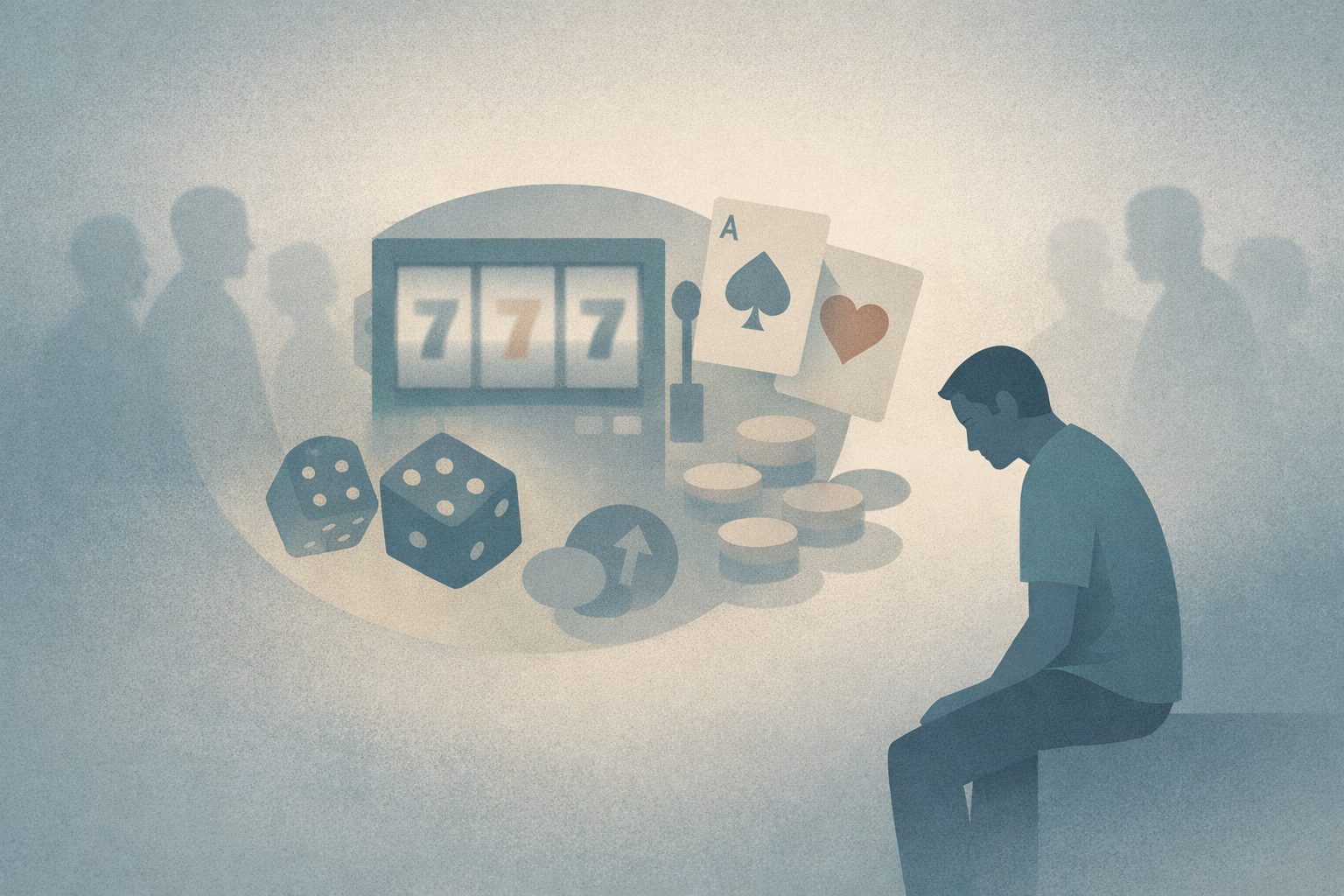
In short: Gambling doesn’t only “pull” because winning feels good. For many people, the strongest grip is the space before the outcome: the charged, bright moment of maybe . That anticipation can become a state the nervous system starts to prefer—especially when life elsewhere feels flat, pressured, or unfinished.
Gambling doesn’t only “pull” because winning feels good. For many people, the strongest grip is the space before the outcome: the charged, bright moment of maybe. That anticipation can become a state the nervous system starts to prefer—especially when life elsewhere feels flat, pressured, or unfinished.
What if the addictive part isn’t the win—but the uncertainty itself?
From a Meaning Density perspective, this isn’t a character flaw or a lack of self-control. It’s a predictable regulatory response to an environment that offers fast activation and delayed closure. When a loop can’t complete, the system stays open. Gambling is a loop designed to stay open.
People often describe gambling as a surge of focus: time narrows, the world fades, and attention locks onto the next outcome. The body can feel awake, sharpened, and oddly relieved—despite the risk and the losses.
That “can’t stop” feeling is frequently less about liking the consequences and more about the system getting recruited into a high-arousal sequence that keeps promising completion. Each bet offers a fresh chance for the loop to close: this one could settle it. When the loop doesn’t close, the system doesn’t stand down.
This is why stopping can feel strangely uncomfortable even when someone is exhausted by the pattern. The body has been trained to treat uncertainty as a cue for heightened readiness and continued pursuit. [Ref-1]
In many everyday activities, effort leads to a fairly predictable result. Gambling flips that. Rewards arrive on a variable schedule, which is unusually effective at keeping attention and action going.
Neuroscience research suggests dopamine signaling is strongly involved in learning and motivation, and it can rise with uncertainty and anticipation—sometimes more than with the reward itself. In other words, the “wanting” can become louder than the “having,” and the mind-body system keeps orienting toward the next chance. [Ref-2]
The result is a loop where the most compelling part is not the win, but the unresolved moment before the reveal. Uncertainty becomes a stimulant the nervous system learns to seek.
Humans evolved in environments where uncertain opportunities sometimes mattered: a new food source, a risky hunt, a changing season, a social alliance. Exploration and persistence could pay off—and a nervous system that could mobilize for “maybe” had advantages.
That doesn’t mean modern gambling is “natural.” It means the underlying sensitivity makes sense. The brain is built to learn from patterns of variability and to stay engaged when the payoff could be meaningful but is not guaranteed.
Modern games and platforms amplify this sensitivity by engineering rapid cycles of uncertainty and feedback. Variability and frequency can be powerful drivers of repetitive play, especially when outcomes are quick and emotionally charged. [Ref-3]
Gambling often provides a very specific state: energized, absorbed, and suspended from the rest of life. That can feel like relief—not because problems disappear, but because the nervous system is busy with a single, compelling signal.
For someone carrying chronic load (financial stress, loneliness, pressure, boredom, ongoing uncertainty), gambling can function like a short-term organizer. It creates an artificial storyline with clear stakes, immediate feedback, and the promise of a turning point.
When life feels scattered, a single high-stakes “maybe” can feel like the only thing that makes sense for a moment.
This is also why the urge can show up most strongly during quiet moments. Not because something is “wrong” inside, but because the environment has stopped offering structure, and the system reaches for a familiar loop that reliably creates activation. [Ref-4]
Many gambling formats deliver frequent cues that imply influence: near-misses, “hot streaks,” personalized bets, bonus rounds, and the sense that skill or timing could tip the outcome. These cues can create a feeling of imminent reward, even when the statistical reality is long-term loss.
This mismatch matters physiologically. When the brain expects closure and doesn’t get it, arousal stays elevated. Over time, repeated exposure to gambling-like reward schedules can sensitize dopamine-related systems, increasing reactivity to the cues themselves. [Ref-5]
So the person isn’t simply choosing against their interests. They’re contending with a system that has learned to respond intensely to uncertainty signals—while real-world agency (money, time, trust, stability) gets thinner.
In a stable meaning-rich life, rewards tend to land into something: relationships, competence, contribution, identity. The nervous system gets “done” signals—completion, rest, digestion, a sense that effort went somewhere.
In the gambling loop, the experience is designed to keep completion out of reach. Even after a win, the most reinforced moment is often the lead-up to the next bet. The system learns that activation is the goal, and fulfillment becomes secondary.
What happens when your brain starts treating anticipation as the payoff?
The loop can start to crowd out slower sources of satisfaction. Not because those sources aren’t real, but because they don’t deliver the same rapid spike of certainty-at-the-edge-of-uncertainty.
Once the uncertainty-reward loop is established, certain behaviors show up again and again. They aren’t moral failures or personality types. They’re what a sensitized system does when it’s being repeatedly cued.
Laboratory and behavioral research on slot-machine-like tasks shows dopamine involvement in reward expectancy and cue-driven persistence, especially under variable outcomes. [Ref-7]
Over time, gambling doesn’t just cost money. It can destabilize the systems that help a person feel coherent: sleep rhythms, emotional steadiness, attention, and the ability to make decisions without being pulled by urgency.
When resources become strained, the nervous system has less capacity for repair. That makes the next cue feel even louder. The person may start to mistrust their own judgment—not because they lack intelligence, but because their internal signals have been repeatedly overwritten by a high-salience loop.
Research across behavioral addictions describes shifts in brain function related to cue reactivity, reward processing, and regulation under chronic exposure to high-stimulation patterns. [Ref-8]
This is one way modern life fragments meaning: the future starts to feel less believable, and the immediate “maybe” becomes the most compelling thing in the room.
Intermittent reinforcement is powerful because it teaches the nervous system that stopping might mean missing the next payoff. A win that arrives “out of nowhere” doesn’t only feel good—it updates learning: keep going; it can happen anytime.
This conditioning effect can be strong enough that losses don’t fully weaken the behavior. Instead, they can keep the loop open: the system remains mobilized, oriented toward recouping, resolving, and completing.
Reviews of addiction neuroscience describe how cue-reactivity and reward learning can drive continued engagement despite negative consequences, with the cue itself becoming highly motivating. [Ref-9]
So the attachment isn’t irrational in the moment—it’s learned. The brain is doing what it does: repeating what has occasionally produced a powerful signal.
Compulsive anticipation thrives on high arousal and frequent variable cues. When those conditions ease, the pull often changes—not instantly as a thought, but gradually as the body stops treating uncertainty as an emergency opportunity.
This is not the same as “understanding the problem.” Insight can coexist with compulsion. What shifts the pattern is when the nervous system receives enough reduced load and enough closure that the cue no longer recruits the whole system.
In research on high-stimulation behavioral patterns, repeated exposure can sensitize responses to cues, while reduced cue exposure and stabilized states are associated with less reactivity over time. [Ref-10]
In plain terms: when activation isn’t being constantly re-triggered, the mind has more room to return to baseline—and baseline starts to feel more livable.
Gambling loops often intensify in private. Not because people are hiding “who they are,” but because isolation removes friction, feedback, and grounding. Alone, the cue is unopposed. There are fewer external signals that mark time, interrupt escalation, or restore perspective.
Relational contact can function as a stabilizer: a reminder of continuity, a cue of safety, a reduction in threat-load. Accountability isn’t meant as pressure—it’s a structural counterweight to a system that has learned to accelerate in secrecy.
Public health and recovery resources commonly describe intermittent reinforcement and isolation as factors that strengthen problematic gambling patterns, while support and shared awareness can reduce impulsive follow-through. [Ref-11]
As the loop loses dominance, people often report subtle but important shifts: the urge arrives with less authority, decision-making feels less foggy, and the body spends less time in that “leaning forward” state.
Not every day becomes calm. The key change is capacity: more ability to let signals rise and fall without automatically converting them into action. Less urgency. More space between cue and follow-through.
Clinically, gambling disorder descriptions often include the reduction of preoccupation and the return of clearer judgment as stabilization occurs. [Ref-12]
This is what coherence looks like from the inside: not constant control, but a nervous system that can complete a moment and move on.
Humans don’t need a life with zero uncertainty. We need uncertainty that is held—contained within values, relationship, time, and identity. When risk is chosen intentionally, it can serve growth, creativity, play, or challenge without consuming the whole system.
In compulsion, uncertainty runs you. In coherence, uncertainty becomes one ingredient among others: purpose, care, limits, and a sense of “enough.” The difference isn’t willpower; it’s whether the experience can reach completion and settle into identity rather than reopening the chase.
Many overviews of gambling psychology note that recovery is supported when risk and excitement are redirected into healthier, bounded forms and when decision-making becomes values-aligned rather than cue-driven. [Ref-13]
Underneath the pull of gambling is often something dignified: a desire for movement, aliveness, and a believable turning point. The nervous system reaches for the fastest doorway it knows into excitement and hope—especially when daily life has become repetitive, pressured, or incomplete.
From a Meaning Density lens, agency returns when “possibility” is no longer outsourced to a variable-reward machine, and when closure becomes available in real life—through experiences that actually land, conclude, and become part of who you are.
This reframing isn’t about blame or motivation. It’s about recognizing what the loop has been providing, and why the system got attached to it in the first place. Similar mechanisms of cue-driven anticipation show up across behavioral addictions, where uncertainty and novelty can become especially compelling under strain. [Ref-14]
There is nothing strange about a human brain being captivated by uncertainty. What’s costly is when uncertainty is engineered to keep you activated without allowing completion.
Fulfillment tends to arrive when experiences can finish—when the nervous system can stand down and the outcome, even if imperfect, can integrate into a stable sense of self. In that kind of life, uncertainty can exist without hijacking the whole system.
Over time, neuroscience accounts of addiction increasingly emphasize how repeated cue-reward cycles can reshape attention and motivation, and how stability returns as reactivity reduces and coherence rebuilds. [Ref-15]
From theory to practice — meaning forms when insight meets action.
Because the strongest grip is the space before the outcome — the charged, bright moment of maybe. Dopamine signaling rises with uncertainty and anticipation, sometimes more than with the reward itself. The 'wanting' becomes louder than the 'having.' The mind keeps orienting toward the next chance because each bet offers a fresh promise of completion: this one could settle it. When the loop doesn't close, the system doesn't stand down. That's why stopping feels uncomfortable even when you're exhausted by the pattern — the body has been trained to treat uncertainty as a cue for heightened readiness.
Often, no. Gambling provides a very specific state: energized, absorbed, suspended from the rest of life. For someone carrying chronic load — financial stress, loneliness, pressure, boredom — it functions like a short-term organizer. It creates an artificial storyline with clear stakes, immediate feedback, and the promise of a turning point. When life feels scattered, a single high-stakes 'maybe' can feel like the only thing that makes sense for a moment. The pull is often less about winning and more about wanting movement, aliveness, and a believable turning point.
Because intermittent reinforcement is powerful — a win that arrives 'out of nowhere' updates learning: keep going, it can happen anytime. Losses don't fully weaken the behavior; they keep the loop open. The system stays mobilized, oriented toward recouping and resolving. This isn't irrational; it's learned. Chasing losses means treating the next bet as the one that will finally close the gap. Near-misses, hot-streak feelings, and personalized cues create a feeling of imminent reward, even when the statistical reality is long-term loss. The brain repeats what has occasionally produced a powerful signal.
Subtle but important shifts: the urge arrives with less authority, decision-making feels less foggy, the body spends less time leaning forward into the next chance. As arousal settles, the 'maybe' loses some gravity. The point isn't to need uncertainty-free life — humans don't. It's that uncertainty becomes one ingredient among others (purpose, care, limits, enough), held within values rather than running you. Recovery often shows up not as dramatic willpower but as completion returning in real life — experiences that actually land and become part of who you are.
From Science to Art.
Understanding explains what is happening. Art allows you to feel it—without fixing, judging, or naming. Pause here. Let the images work quietly. Sometimes meaning settles before words do.
One Quiet Window, one insight, one reflection — every Sunday