The Newer-Better-Next Loop: Why You Always Want Upgrades
In short: For many people, decluttering feels like breathing out. The room looks calmer, your mind feels sharper, and for a moment it seems like you’ve finally found the lever that makes life feel manageable.
For many people, decluttering feels like breathing out. The room looks calmer, your mind feels sharper, and for a moment it seems like you’ve finally found the lever that makes life feel manageable.
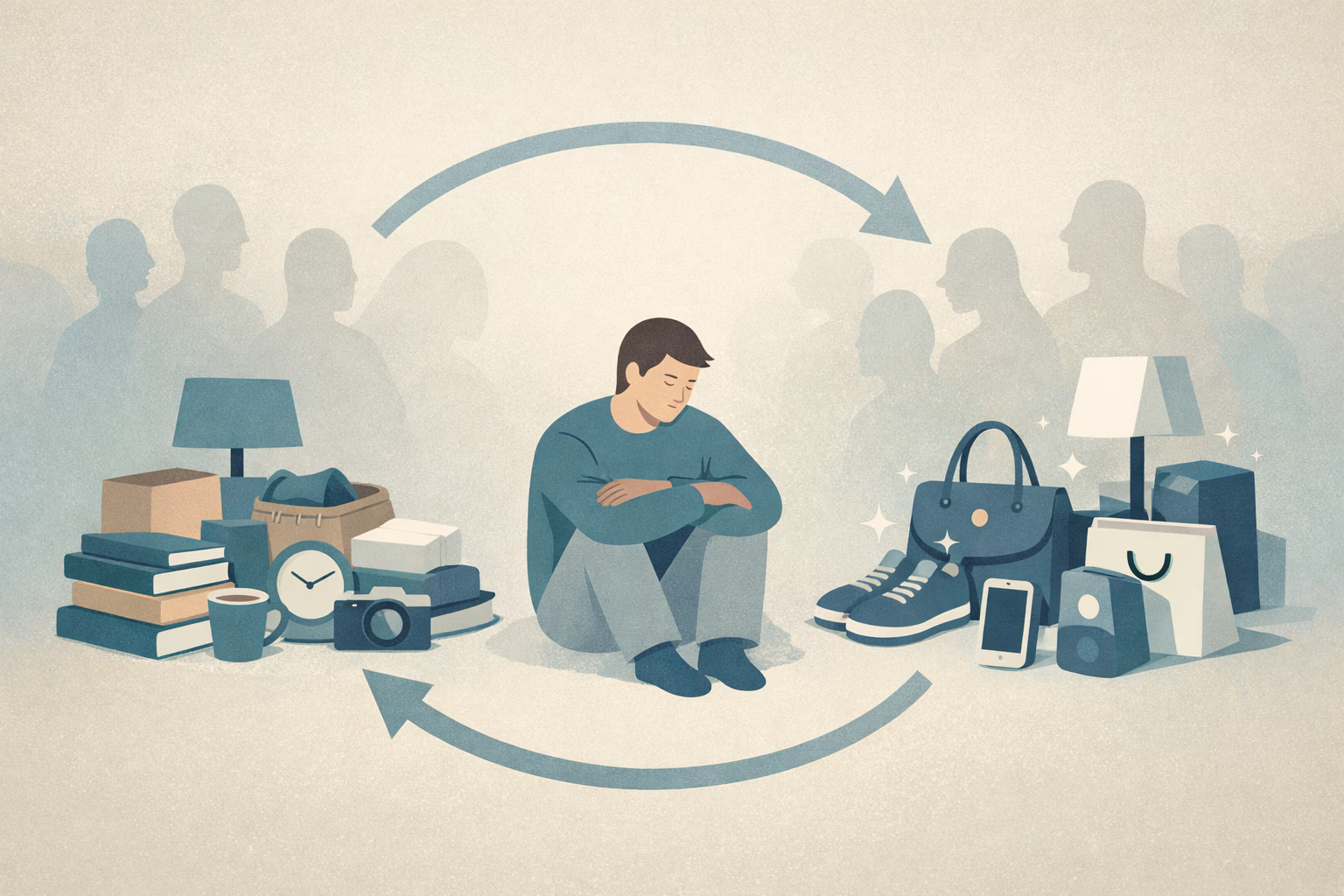
And then, slowly, the pile reappears. A few “necessary” replacements. A new hobby purchase. A duplicate you forgot you already owned. The cycle can feel confusing: If I know I like less, why do I keep ending up with more?
What if the urge to purge isn’t about stuff at all, but about your system seeking closure and clarity?
The declutter–rebuy cycle often shows up as a repeating sequence: a build-up of visual and mental noise, a decisive purge, a short window of relief, and then a gradual return of accumulation. People usually describe it as frustration with themselves, but the pattern is more mechanical than moral.
What’s striking is how consistent the emotional tone can be across different households and budgets: a sense of inner overwhelm that doesn’t fully match the actual amount of stuff. The clutter may be real, but the intensity often signals something else—an overloaded system looking for a “done” signal. [Ref-1]
“I can make it look clear, but I can’t make it feel finished.”
Decluttering creates immediate, visible change. It reduces sensory input, removes decisions, and produces a clear before-and-after contrast—exactly the kind of evidence the brain reads as progress. For a taxed nervous system, that contrast can register as safety: fewer cues to manage, fewer reminders of what’s unfinished.
But relief and resolution aren’t the same. Relief is a state shift: the body gets quieter when load drops. Resolution is deeper: it’s when the underlying loop that generated the pressure reaches completion, so the system can stand down without needing another reset.
When deeper needs—like identity stability, belonging, or “who I am now”—remain unresolved, the environment may look simple while the internal signal to re-orient stays active. [Ref-2]
Humans didn’t evolve to manage “stuff” as an abstract problem. We evolved to manage resources, signal competence, and shape a coherent sense of self within a group. Objects can function as evidence: this is who I am, what I value, what I’m capable of.
In that context, acquiring can act like a quick identity patch—especially when life roles are shifting, confidence is thin, or belonging feels uncertain. Purging can act like a different patch: a way to reassert authorship over one’s environment and self-story. Both moves can temporarily stabilize the reward system because they create a sense of direction and change. [Ref-3]
So the cycle isn’t “minimalist failure.” It’s two regulatory strategies pulling on the same system: one seeks clarity through removal, the other seeks coherence through acquisition.
Order is a strong safety cue. When objects leave a space, the brain has less to track: fewer visual prompts, fewer half-decisions, fewer reminders of tasks that never reached completion. The body often responds with a brief increase in capacity—more room to think, to initiate, to breathe.
This is why decluttering can feel like starting over. The environment becomes a simplified map, and the nervous system reads that simplification as “I can handle this.” For people carrying chronic load, the reset can be so powerful that it becomes the preferred route back to steadiness. [Ref-4]
But what happens when the reset becomes the only reliable off-switch?
Minimalism often promises a clean equation: fewer items equals fewer problems. Sometimes that’s true—less visual chaos can absolutely lower day-to-day load. But the declutter–rebuy cycle reveals a mismatch: you can remove objects and still feel internally unfinished.
When minimalism becomes an attempt to solve inner chaos externally, it can create an illusion of closure. The home looks complete, but the identity questions that were driving the pressure—What matters now? What am I building? What do I trust about myself?—don’t automatically resolve just because a drawer is empty.
In that gap, acquisition returns, not as “shopping addiction,” but as the system’s renewed attempt to create coherence with the tools it knows: new plans, new versions of the self, new evidence. [Ref-5]
An avoidance loop doesn’t require dramatic emotion or conscious denial. Structurally, it’s when a high-impact external move substitutes for a missing internal completion. Decluttering becomes the shortcut: a fast, controllable outcome that temporarily mutes the consequences of ongoing uncertainty.
In modern life, uncertainty can be constant—roles, work expectations, social comparison, shifting norms. When identity pressure has no clear endpoint, a purge provides a “finish line” the body can recognize. The loop forms because the relief is real.
Then, when the original uncertainty resurfaces, acquiring offers a different kind of shortcut: a way to re-aim the self with something tangible. The system toggles between two forms of external control, while the deeper “done” signal remains out of reach. [Ref-6]
This pattern isn’t always obvious, because it can look like normal life: replacing items, updating a wardrobe, reorganizing for a new season. The key feature is the sense of repetition without lasting settling—like the same chapter being rewritten with different props.
None of these are proof of brokenness. They are signs that the system is seeking coherence and closure in a context that rarely provides it. [Ref-7]
Even when individual purchases are small, the cycle carries a cumulative load. There’s the financial layer (replacing what was removed, buying duplicates, paying for storage). There’s also decision fatigue: researching, comparing, organizing, returning, donating, repeating.
But the most underestimated cost is self-trust. When you’ve “started over” many times, the nervous system can begin to treat your own intentions as unreliable data. You may hesitate to commit to preferences, aesthetics, or routines because the past suggests they won’t last.
Research on minimalism and well-being often notes benefits like reduced stress and increased satisfaction when simplicity is value-aligned and stable; the cycle tends to do the opposite, because it keeps the system in repeated activation and reorientation. [Ref-8]
Relief is persuasive. If decluttering reliably drops your stress load, your brain learns: When I feel too much pressure, remove things. That learning is not irrational—it’s the nervous system conserving resources by choosing what works quickly.
But because the relief comes from external change, the internal drivers remain partially open-ended. When the next wave of ambiguity arrives—social comparison, a new life phase, a dip in confidence—acquiring can start to feel inevitable. Not because you “can’t control yourself,” but because the system is reaching again for a tool that creates direction and identity evidence fast.
Minimalism and decluttering do show consistent short-term benefits for many people; the issue is when those benefits become the primary regulation strategy instead of a side effect of genuine completion. [Ref-9]
There’s a different way to understand the urge to purge: as a desire for internal quiet, not simply an aesthetic preference. The body may be asking for fewer open loops—fewer unfinished decisions, fewer unresolved identity drafts, fewer competing versions of “who I should be.”
When internal safety and clarity increase, the environment usually stops needing to carry so much of the regulatory work. The home can be imperfect without feeling threatening. Possessions can be present without feeling like an accusation.
This is not about “becoming more aware” in your head. It’s about the system genuinely settling after something completes—after life feels more authored, more coherent, more finished in the places where it used to keep restarting. Minimalism can support that, but it can’t substitute for it. [Ref-10]
Identity doesn’t stabilize in isolation. Humans regulate through shared reality—being seen, mirrored, and understood in ways that reduce the need to prove ourselves with symbols. When people feel socially anchored, consumption often becomes less urgent because the self no longer needs constant external confirmation.
Values-based conversations (with partners, friends, or communities) can also reduce the “identity search” pressure that shopping sometimes carries. When your priorities are held in language and relationship, they don’t need to be held as strongly in objects.
Studies and reviews on decluttering/minimalism frequently connect reduced stress to perceived control and psychological well-being; supportive contexts can strengthen that effect by making control less dependent on constant environmental management. [Ref-11]
“When my life felt understandable again, I stopped needing new stuff to explain me.”
When coherence returns, the relationship with belongings often becomes quieter. Not necessarily smaller overnight—just less charged. The home becomes a place to live rather than a dashboard that must always display “I’m okay.”
You may notice more natural stopping points: decisions that feel complete rather than provisional, purchases that don’t need a future purge to feel tolerable, and a steadier sense of what belongs in your life. This is a physiological shift as much as a psychological one: less background activation, more capacity for signals to return after everyday stress.
Some research describes minimalist lifestyles as supporting well-being and reducing environmental impact when they are integrated and sustained rather than driven by swings of urgency. That “sustained” quality is often the marker of coherence—simplicity that holds without constant effort. [Ref-12]
In the cycle, purchasing often functions like a state-change tool: it provides novelty, possibility, and a quick lift in direction. In coherence, purchasing becomes more like a translation of stable priorities—less about repairing a moment, more about supporting a life.
This alignment tends to show up as fewer identity “drafts” competing at once. Items are chosen because they match a lived trajectory, not because they promise a new one. You’re less likely to buy for an imagined self that exists only during stress spikes, and less likely to purge as a way to erase that spike afterward.
Over time, choices can become simpler not because you’re stricter, but because your preferences are less reactive. Consumption begins to reflect self-understanding rather than emotional weather. [Ref-13]
If you recognize yourself in this cycle, it can help to interpret the urge to purge as a message: I want clarity. I want completion. I want my life to feel more authored. That desire is dignified.
Many people describe this exact loop—declutter, feel better, buy again—as if it’s a personal inconsistency. But it’s often a predictable outcome of living in a world that keeps identity questions open and rewards quick resets. Naming the pattern can reduce shame and make the cycle feel less mysterious. [Ref-14]
Minimalism can be a supportive environment. The deeper shift is when clarity stops depending on dramatic removal—when the system finds steadiness through coherence rather than repeated restarts.
Endless decluttering can look like change while still functioning as repetition. Not because you’re doing it “wrong,” but because the body is trying to complete something that objects can’t finish.
When identity pressure settles and meaning becomes more continuous, the need for dramatic resets often fades on its own. Simplicity becomes less like a project and more like a side effect of an internally coherent life—one that feels increasingly finished in the places that used to keep restarting. [Ref-15]
From theory to practice — meaning forms when insight meets action.
Because the urge to declutter is often about closure, not stuff. The cycle goes: build-up of mental and visual noise, decisive purge, short window of relief, gradual re-accumulation. The intensity rarely matches the actual amount of stuff — it signals an overloaded system looking for a Done Signal. When deeper needs like identity stability, belonging, or 'who I am now' stay unresolved, the environment may look simple while the internal signal to re-orient stays active. You can make it look clear, but you can't make it feel finished. The clutter returns because the underlying loop never closed; only the surface did.
No, and conflating them is part of why the cycle repeats. Decluttering creates immediate, visible change: less sensory input, fewer decisions, a clear before-and-after the brain reads as progress. For a taxed nervous system, that contrast registers as safety. But relief and resolution are different mechanisms. Relief is a state shift; the body gets quieter when load drops. Resolution is deeper — when the underlying loop that generated the pressure reaches completion. Minimalism can lower day-to-day load. It can't substitute for the identity questions driving the pressure: what matters now, what am I building, what do I trust about myself?
Because both moves plug into identity and reward systems. Acquiring acts like a quick identity patch — especially when life roles are shifting or belonging feels uncertain. Purging acts like a different patch — a way to reassert authorship over your environment and self-story. Both temporarily stabilize the reward system because they create direction and visible change. Decluttering becomes the shortcut: a fast, controllable outcome that mutes ongoing uncertainty. Then when uncertainty resurfaces, acquiring offers another shortcut. The system toggles between two forms of external control while the deeper Done Signal stays out of reach. The cycle isn't minimalist failure — it's two regulatory strategies pulling on the same nervous system.
A quieter relationship with belongings, not necessarily a smaller one. The home becomes a place to live rather than a dashboard that must always display 'I'm okay.' You may notice more natural stopping points — decisions that feel complete rather than provisional, purchases that don't need a future purge to feel tolerable, a steadier sense of what belongs. This is a physiological shift as much as a psychological one: less background activation, more capacity for signals to return after everyday stress. When my life felt understandable again, I stopped needing new stuff to explain me. Simplicity becomes a side effect of an internally coherent life rather than a project.
From Science to Art.
Understanding explains what is happening. Art allows you to feel it—without fixing, judging, or naming. Pause here. Let the images work quietly. Sometimes meaning settles before words do.
One Quiet Window, one insight, one reflection — every Sunday