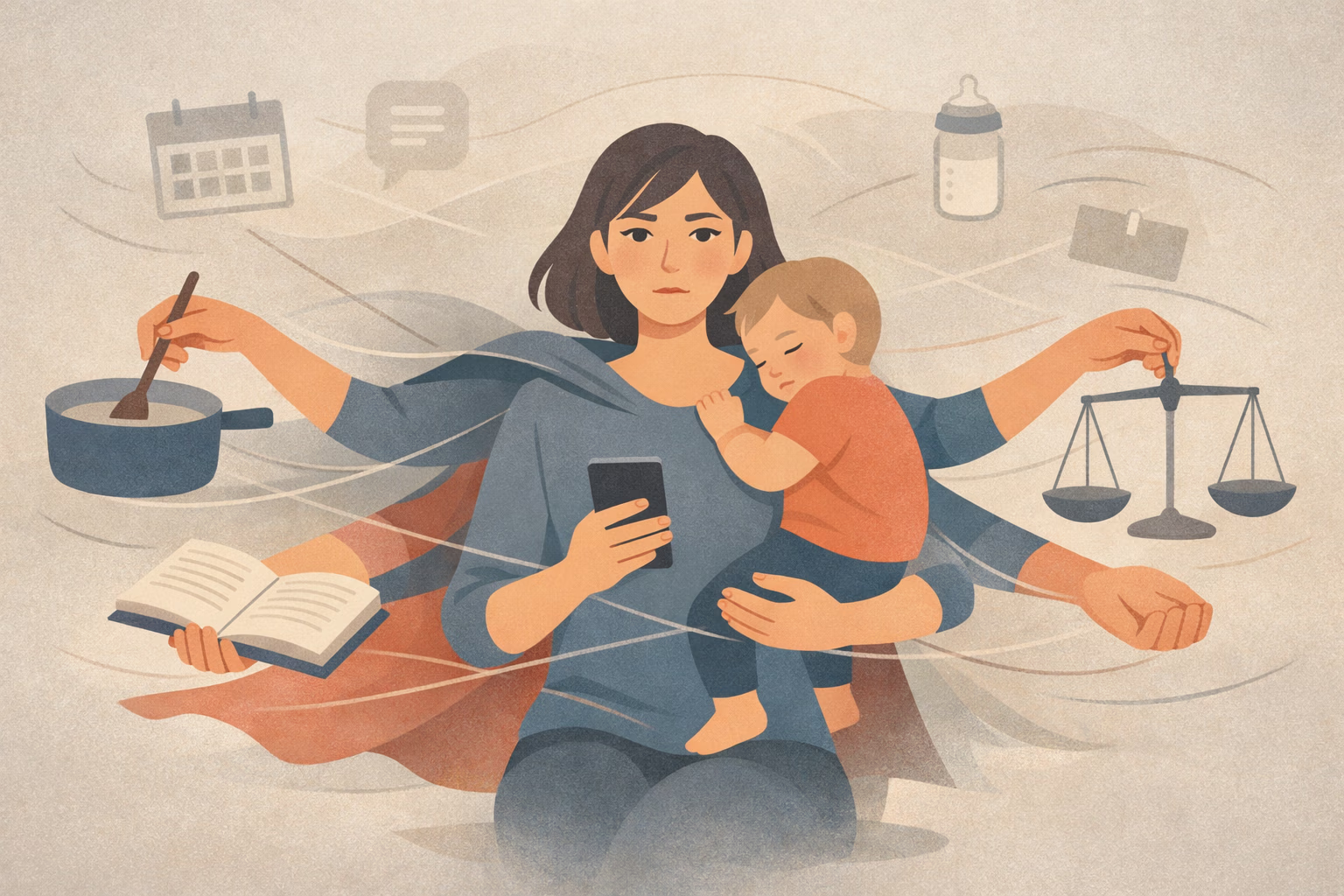
Perfectionism in Parenting: The Pressure to Be Everything
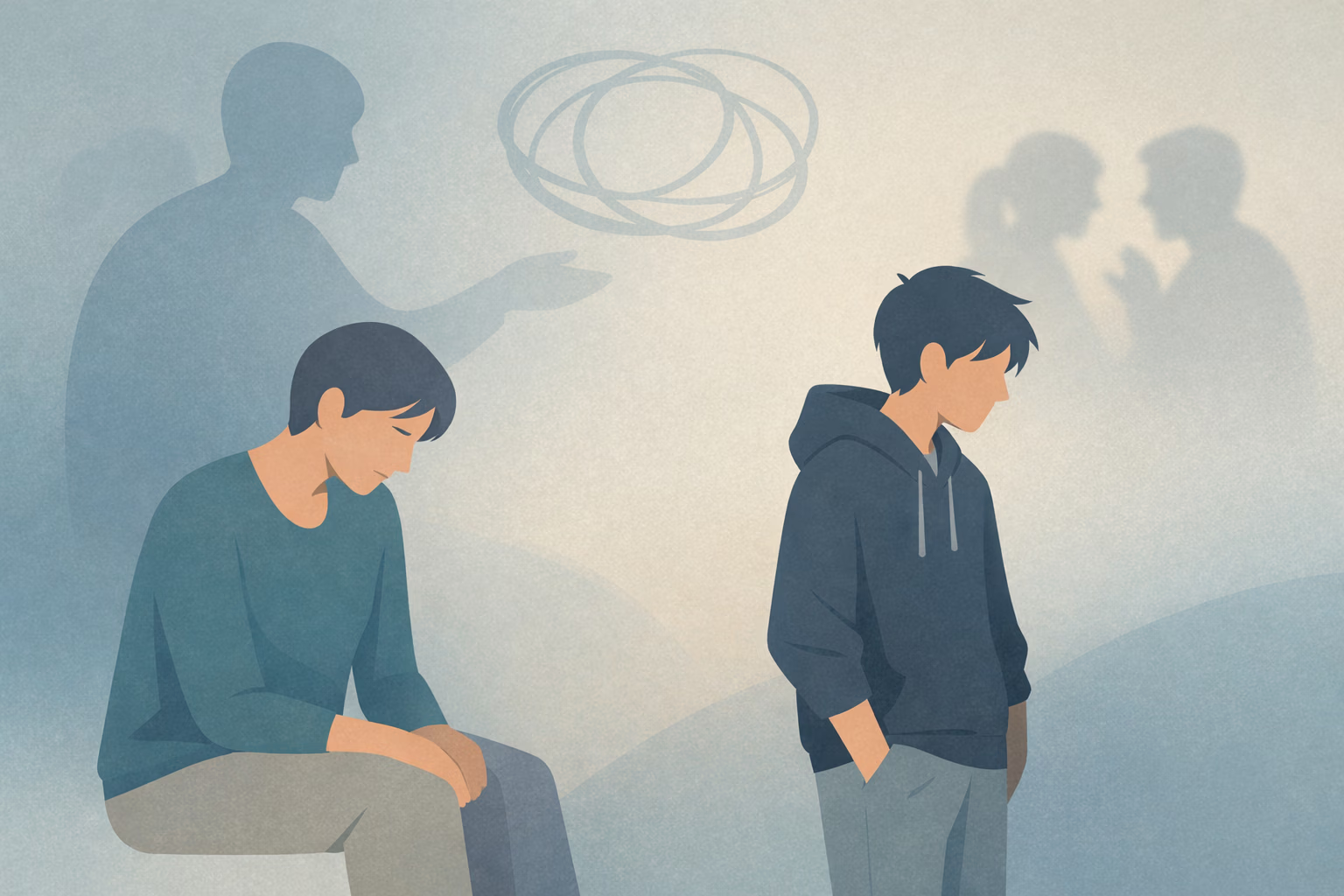
In short: Overinvolved parenting is often described as excessive monitoring, frequent checking, rapid intervention, or taking over decisions that a teen could otherwise attempt. It usually comes from devotion, not neglect: a deep wish to prevent pain, protect opportunities, and keep life on track.
Overinvolved parenting is often described as excessive monitoring, frequent checking, rapid intervention, or taking over decisions that a teen could otherwise attempt. It usually comes from devotion, not neglect: a deep wish to prevent pain, protect opportunities, and keep life on track.
What if the problem isn’t that anyone is “doing it wrong,” but that the family system is stuck without enough closure?
When a household runs on constant vigilance, everyone’s nervous system learns a specific lesson: safety depends on immediate control. The result can look like teen anxiety and dependence, alongside parental exhaustion and frustration—patterns that are understandable responses to sustained load, not fixed identities.
In many families, overinvolvement doesn’t announce itself as “control.” It shows up as relentless problem-tracking: reminders, corrections, hovering, negotiating, checking portals, monitoring moods, pre-solving conflicts, and scanning for risks. Over time, the teen may appear less confident and more unsure, while the parent feels more responsible, more alert, and more easily activated. [Ref-1]
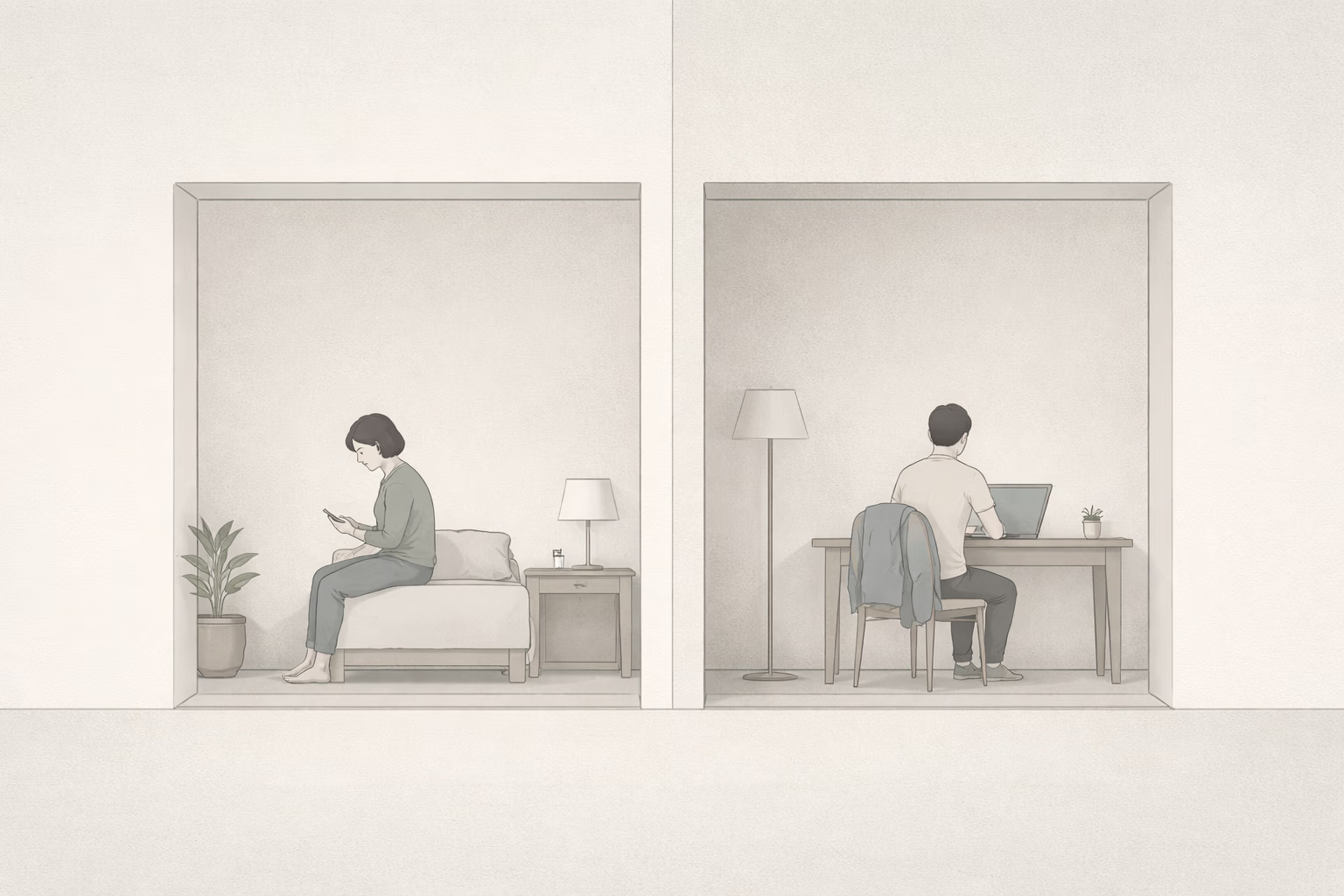
This can produce a confusing split: the parent is working harder than ever, yet things feel less stable. The teen’s nervous system can become dependent on external guidance to settle, and the parent’s nervous system can become dependent on oversight to feel safe. It’s not a lack of love—it’s a loop.
When every moment could be a tipping point, “help” can start to feel like prevention, and prevention can start to feel like the only kind of safety.
Adolescence is designed for skill acquisition under manageable stress: trying, wobbling, recalibrating, and learning that discomfort can complete. When adults repeatedly step in before the teen reaches a “done” signal—before a problem runs its course—an important kind of learning gets interrupted: the body’s recognition that effort can lead to closure. [Ref-2]
This matters for regulation. Planning, problem-solving, and impulse control are supported by developing prefrontal systems that strengthen through repeated cycles of challenge → attempt → outcome → integration. If the cycle is routinely shortened to challenge → adult takeover → immediate relief, the teen gets relief (state change) without completion (settling). Over time, uncertainty can feel louder and harder to carry.
Not because the teen is fragile—but because the nervous system didn’t get enough clean finishes.
Human adolescents evolved to expand territory while staying tethered to a secure base. The social brain learns, “I can explore because connection is available.” In healthy conditions, closeness and independence aren’t opposites; they are a coordinated system. [Ref-3]
When parenting becomes heavily surveillance-based, attachment can shift from “safe base” to “control tower.” The teen’s orientation becomes: “I’m okay when you’re tracking me.” That can reduce exploration and decision ownership—not due to defiance or immaturity, but because the system is trained to organize around proximity to regulation.
From a meaning standpoint, adolescence is also when identity consolidates through completed experiences: choices made, consequences met, repairs attempted, competence earned. Without enough completed loops, identity can stay thin—more managed than lived.
Overinvolvement often starts as a reasonable response to real pressures: academic stakes, social volatility, online exposure, safety concerns, or a teen who seems overwhelmed. Stepping in can quickly reduce uncertainty. It can lower immediate risk, prevent a blowup, or keep something from spiraling. That reduction in threat cues can calm a parent’s system fast. [Ref-4]
In the body, this is a powerful reinforcement: control creates an instant “stand down” sensation. The teen may also feel temporary relief: fewer decisions, fewer unknowns, fewer chances to fail publicly. Both nervous systems get a quick payoff—quiet now, consequences later.
Short-term safety is not imaginary. The issue is that repeated short-term soothing can become the only available route to calm.
There are two different kinds of “safe.” One is safety-by-management: calm arrives when the environment is tightly controlled. The other is safety-by-capacity: calm becomes possible because the person can carry uncertainty and still return to baseline.
Overinvolvement tends to expand the first kind while quietly shrinking the second. The teen gets fewer chances to build internal sequencing—notice signal, choose, act, adjust, finish. The parent gets fewer chances to witness the teen complete a loop without supervision. Over time, both can conclude (without words) that independence is dangerous, because the system has less evidence of completion. [Ref-5]
This is how care can accidentally teach “I can’t” on both sides.
In the Meaning Density view, a “power loop” forms when control is used to manage uncertainty faster than life can naturally resolve it. The loop doesn’t require anyone to be domineering. It can be made of love, fear-of-loss, and responsibility under pressure.
The sequence often looks like this: a teen shows distress or stalls; the parent increases monitoring; the teen’s decision-making load is reduced; the teen becomes more dependent on cues and permission; the parent sees dependence as evidence that more monitoring is needed. Each step makes sense inside the moment, and each step makes the next one more likely. [Ref-6]
Because the relief is immediate, the loop can feel like “good parenting.” The cost is delayed: fewer completed experiences that would have created stable confidence.
Overinvolvement is rarely one dramatic behavior. It’s a style of coordination where the parent becomes the teen’s external regulator and executive system. It can show up in many small, reasonable acts that add up. [Ref-7]
These patterns often intensify during transitions—new schools, exams, social ruptures—when the family’s tolerance for uncertainty is already taxed.
When a teen rarely gets to run a full loop—initiate, struggle, repair, and finish—the nervous system may stay in a “not done” state. That can look like ongoing anxiety, procrastination, irritability, or shutdown. The teen isn’t choosing dysfunction; the system is organized around incomplete closure.
At the relationship level, chronic oversight can quietly distort trust. The parent may feel, “If I don’t watch, things fall apart.” The teen may feel, “If you watch, you don’t believe I can.” Even when both people care deeply, the shared storyline can become thinner: more management, less mutual confidence. [Ref-8]
Over time, the household can lose something precious: a felt sense that challenges end, that efforts resolve, that mistakes become learning instead of emergencies.
Parental anxiety often isn’t a single emotion—it’s a sustained alertness shaped by real stakes and real love. Under load, the mind starts scanning for gaps: missed assignments, social threats, mental health signs, future outcomes. The body reads each gap as urgency.
In that state, stepping back can feel like neglect, even when it’s not. Control becomes the parent’s quickest path to a “done for now” sensation. Then, when the teen hesitates or avoids, it can be interpreted as proof that the oversight is necessary—when it may also be the downstream effect of fewer chances to complete hard things independently. [Ref-9]
When worry becomes the steering wheel, everyone adjusts their posture around it.
The loop persists not because anyone is stubborn, but because the system is trying to manufacture certainty in an uncertain world.
Self-regulation isn’t a trait you either have or don’t have. It’s a capacity that stabilizes when experiences reliably complete. A teen becomes steadier when their actions lead to outcomes they can metabolize—successes that land, mistakes that resolve, repairs that count.
“Safe autonomy” is not abandonment and not a sudden push into the deep end. It’s a developmental condition where exploration happens with connection in the background, not control in the foreground. In that condition, the teen’s nervous system gets to practice: tolerating uncertainty long enough for the situation to finish, and learning, at a body level, that discomfort can move toward closure. [Ref-10]
Meaning forms when “I handled it” becomes lived history, not a pep talk.
Families often imagine only two options: micromanage or “let go.” But many systems re-stabilize through a different pattern: co-regulation without takeover. That means the parent remains a steady signal—available, interested, and boundaried—while the teen becomes the primary actor in their own daily loops.
This shift can restore trust because it changes the implicit message. The parent’s presence communicates, “You’re not alone,” while the structure communicates, “This is yours to carry.” Over time, the teen’s competence becomes visible, and the parent’s nervous system receives new evidence that safety can exist without constant monitoring. [Ref-11]
Notably, this isn’t created by more insight or better arguments. It tends to emerge when daily life produces more completed cycles and fewer emergency interruptions.
As safe autonomy accumulates, many teens show a specific kind of shift: not constant confidence, but faster recovery. They may still feel uncertainty, but the signal returns sooner. They can stay engaged longer before escaping, and they can move from “I can’t” to “I don’t know yet” without collapsing. That’s a capacity change, not a personality change. [Ref-12]
In practical terms, this can look like more flexible responses to stress: trying again after a setback, asking for support without surrendering ownership, and tolerating ambiguity without immediate urgency. The teen’s sense of self becomes less dependent on external management because their nervous system has more proof of completion.
When anxiety reduces under these conditions, it’s often because the system is no longer running so many unfinished loops at once.
In a stabilized system, parental power shifts from “prevent every fall” to “support the climber.” The parent’s role becomes less about constant intervention and more about maintaining a reliable base: consistency, values, and a clear relational signal that the teen belongs even while struggling.
This change doesn’t remove limits or expectations. It changes how limits function: not as moment-to-moment steering, but as scaffolding that allows the teen to meet life directly and finish experiences with dignity. Over time, the family’s story can reorganize around competence and trust rather than vigilance and rescue. [Ref-13]
When the teen can complete more of their own loops, the parent can finally stand down.
Overinvolved parenting is frequently a sign of care meeting a high-threat environment: real stakes, real uncertainty, and a nervous system trying to keep a child safe. Seen this way, the pattern doesn’t require blame. It invites orientation—toward the difference between protection that calms the moment and capacity that calms the future.
When families begin to value completion over constant prevention, a new kind of meaning becomes possible: the teen’s life feels more authored, and the parent’s care feels less like emergency management and more like steady connection. Research on overprotection suggests that high control can interfere with adolescents’ self-exploration, which is one pathway through which confidence and identity consolidate. [Ref-14]
Agency often returns not through intensity, but through coherence: fewer mixed signals, fewer interrupted cycles, and more experiences that get to finish.
Resilient teens aren’t the ones who never wobble. They’re the ones whose wobble can resolve—because they have both a secure relational base and enough room to complete their own learning loops.
When autonomy is cultivated alongside belonging, regulation becomes less dependent on surveillance and more anchored in lived capability. Over time, that combination tends to produce a quieter strength: flexibility under stress, clearer values, and a steadier sense of self that doesn’t need constant management to hold together. [Ref-15]
From theory to practice — meaning forms when insight meets action.
By interrupting the body's recognition that effort can lead to closure. Adolescence is built for skill acquisition under manageable stress: trying, wobbling, recalibrating, learning that discomfort can complete. When adults step in before a problem runs its course, the cycle gets shortened from challenge-attempt-outcome-integration to challenge-adult-takeover-immediate-relief. The teen gets state change but not completion. Over time, uncertainty feels louder and harder to carry — not because the teen is fragile, but because the nervous system didn't get enough clean finishes. Anxiety is the body running unfinished loops, not a personality defect.
Because in the body, control creates an instant stand-down sensation — a powerful reinforcement. The parent's nervous system gets a quick payoff of reduced uncertainty, and the teen often feels temporary relief too: fewer decisions, fewer unknowns, fewer chances to fail. Both nervous systems get quiet now and consequences later. The article frames this as a Power Loop where control is used to manage uncertainty faster than life can naturally resolve it. The loop doesn't require anyone to be domineering — it can be made entirely of love, fear-of-loss, and responsibility under pressure. That's why it feels like good parenting even as it shrinks capacity.
Safety-by-management means calm arrives when the environment is tightly controlled. Safety-by-capacity means calm becomes possible because the person can carry uncertainty and still return to baseline. The article frames overinvolvement as expanding the first kind while shrinking the second. The teen gets fewer chances to build internal sequencing — notice signal, choose, act, adjust, finish. The parent gets fewer chances to witness the teen complete a loop without supervision. Over time both can conclude without words that independence is dangerous, because the system has less evidence of completion. Care can accidentally teach 'I can't' on both sides.
Co-regulation without takeover. The parent remains a steady signal — available, interested, boundaried — while the teen becomes the primary actor in their own daily loops. The implicit message changes: presence says 'you're not alone,' structure says 'this is yours to carry.' The article frames this not as a sudden push into the deep end but as a developmental condition where exploration happens with connection in the background, not control in the foreground. The teen's nervous system gets to practice carrying uncertainty long enough for situations to finish — and 'I handled it' becomes lived history rather than a pep talk.
From Science to Art.
Understanding explains what is happening. Art allows you to feel it—without fixing, judging, or naming. Pause here. Let the images work quietly. Sometimes meaning settles before words do.
One Quiet Window, one insight, one reflection — every Sunday