
Porn Overstimulation: When Pleasure Exceeds What the Brain Evolved For
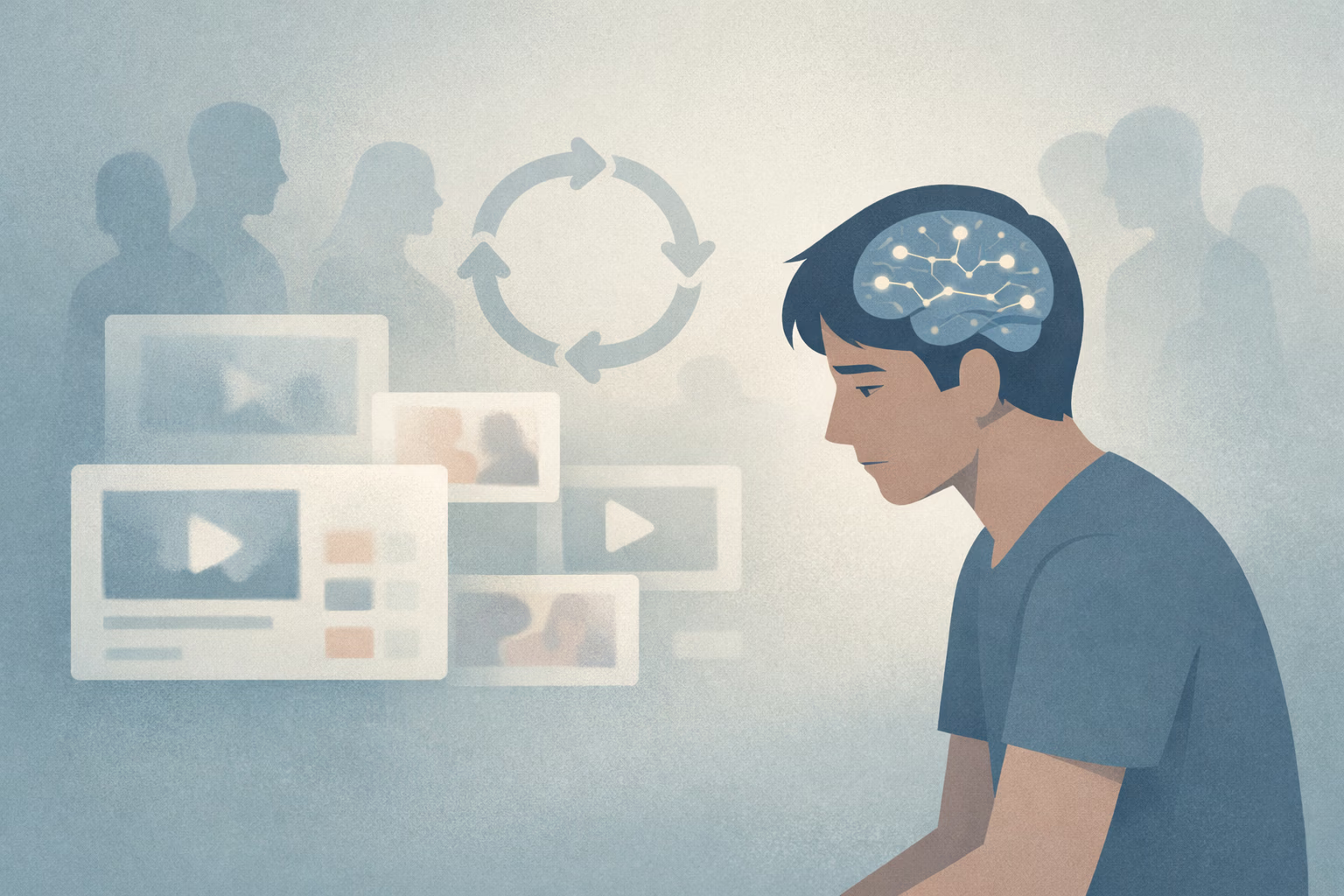
In short: “Porn overstimulation” isn’t a character flaw or a sign you’re broken. It’s a predictable nervous-system response to repeated exposure to extremely high-intensity, high-novelty sexual cues—delivered with almost no friction, effort, or interpersonal complexity.
“Porn overstimulation” isn’t a character flaw or a sign you’re broken. It’s a predictable nervous-system response to repeated exposure to extremely high-intensity, high-novelty sexual cues—delivered with almost no friction, effort, or interpersonal complexity.
Over time, the brain can start treating these cues as the easiest path to reward, relief, and shutdown. That shift can quietly change what feels engaging, what feels “enough,” and what kind of closeness your system can actually register as rewarding.
What if the problem isn’t your desire—but the kind of stimulus your reward system has been trained to expect?
One of the most confusing parts of porn overstimulation is that it can show up as less sensation, not more: less arousal, less interest, less presence. People often describe a strange split where their mind can be pulled toward screens, while real-life sexual experiences feel muted, effortful, or hard to sustain. [Ref-1]
This isn’t a moral issue. It’s what happens when the reward system begins to associate sexual activation with rapid novelty, tight control of pacing, and instant escalation. In that context, embodied intimacy—with its slower feedback, unpredictability, and relational signals—can land as “not enough,” even when it matters deeply.
Dopamine is often described as a pleasure chemical, but it’s more accurate to think of it as a “pursuit and learning” signal: it helps the brain tag experiences as worth repeating. When stimulation is intense and novel, dopamine tends to spike, and the brain updates its expectations about what counts as rewarding. [Ref-2]
With sustained high-dopamine exposure, the system can adapt. The same stimulus produces a smaller response, and the threshold for “interesting” rises. This is a normal protective adjustment in neural systems—an attempt to keep balance in the face of repeated flooding.
The lived experience of that adaptation can look like: a need for more intensity to get the same level of activation, and less responsiveness to subtler rewards like touch, warmth, eye contact, and slow-building anticipation.
Human reward circuits evolved under conditions where sexual novelty was limited, opportunities were relatively rare, and mating effort required time, risk, and social negotiation. In that environment, strong reward signals helped prioritize reproduction. [Ref-3]
High-novelty porn is a radically different input: effectively limitless variation, immediate access, rapid switching, and escalating intensity with minimal cost. The brain doesn’t interpret that as “pixels on a screen.” It interprets it as a dense stream of sexual opportunity—an evolutionary super-stimulus that can outcompete slower, real-world rewards.
In other words, the pull isn’t mysterious. It’s a predictable match between a powerful learning system and a modern stimulus that removes natural stopping points.
Porn can deliver more than arousal. It can deliver state change: a quick shift away from stress, loneliness, pressure, uncertainty, or the friction of real connection. This matters because the nervous system often seeks the fastest available route to downshift or distract when load is high. [Ref-4]
Unlike partnered intimacy, porn asks very little of the social nervous system. There’s no need to track another person’s needs, read micro-signals, negotiate consent in real time, risk disappointment, or tolerate awkwardness. The loop can complete in private, on demand, with total control over intensity and timing.
When life feels like too much, the brain doesn’t search for what’s “best.” It searches for what reliably works—fast.
High-intensity stimulation can feel like enhanced pleasure in the moment. But when the system repeatedly uses intense reward to regulate stress load, everyday rewards can start to lose their pull. The result isn’t simply “too much porn.” It’s a broader flattening: less drive for effortful joys, less appetite for slow closeness, and less satisfaction from experiences that once felt meaningful. [Ref-5]
This can show up outside sex, too—difficulty starting tasks, reduced interest in dating or connection, irritability, or a sense that nothing “lands.” Not because you lack willpower, but because the reward system is recalibrated around quick spikes and quick closure.
When the brain learns that relief is one click away, what happens to the value of slow-earned reward?
Porn overstimulation often functions as a classic pleasure loop: cue → stimulation → temporary relief → reinforced learning → higher threshold next time. The loop is tight, efficient, and repeatable, which is exactly what reward learning prefers—especially under stress. [Ref-6]
Over time, the loop can begin to crowd out the conditions that support deeper satisfaction: gradual buildup, mutual responsiveness, and the sense of being safely “with” someone rather than performing for an outcome. In this way, overstimulation isn’t just about sex—it’s about what your nervous system is using sex-like stimulation for: regulation, escape, or a predictable “done” signal.
And because the loop completes quickly, it can teach the body to expect completion without the slower integration that comes from real connection.
People often recognize porn overstimulation not by a single behavior, but by a cluster of shifts: escalating novelty, difficulty maintaining arousal offline, or a growing sense of distance from one’s own desire. Research has explored associations between pornography use and sexual functioning difficulties for some users, though experiences vary widely. [Ref-7]
These patterns are not “who you are.” They are regulatory strategies shaped by repetition and accessibility—what the brain practiced becoming easiest.
When the reward system repeatedly trains on high-intensity cues, it can become harder to trust your own regulation. People may start doubting their desire, their attraction, or their ability to be present with another person. That doubt can add additional load—more monitoring, more pressure, more self-evaluation—right where intimacy usually needs safety cues. [Ref-8]
It can also reshape intimacy capacity: not as a moral loss, but as a capacity issue. Attuned connection requires bandwidth—attention, patience, and room for ambiguity. Chronic overstimulation and chronic self-judgment both reduce that bandwidth.
In Meaning Density terms, a person can end up with plenty of stimulation but less coherence: the body is activated, yet the experience doesn’t settle into a stable “this is me, and this is what I’m doing with my life” feeling. It remains unfinished.
As sensitivity drops, the nervous system often seeks a stronger input to get the same effect. That can be experienced as craving, urgency, or repetitive checking—less like choice and more like momentum. While popular explanations focus on “lack of control,” a structural view is simpler: the brain is following the shortest path it knows to reach a familiar state change. [Ref-9]
The loop can also become self-protecting. If real-life intimacy carries uncertainty—timing, rejection, performance pressure, emotional complexity—the screen becomes not only stimulating but predictable. Predictability is a powerful safety cue for an overloaded system.
Sometimes the craving isn’t for pleasure. It’s for a guaranteed ending.
The nervous system doesn’t resensitize through insight alone. It resensitizes when the environment stops demanding constant peaks—when intensity drops enough for smaller signals to matter again. This is a biological process: thresholds can shift, cue-reactivity can soften, and attention can reattach to subtler rewards over time. [Ref-10]
In a coherent life, reward isn’t only “high.” It’s layered: warmth, curiosity, affection, pride, tenderness, playful anticipation. These are lower-intensity signals that become available when the system isn’t constantly chasing a spike to feel anything at all.
This is also where meaning matters. When stimulation is the main path to closure, identity can start to feel like a collection of urges and private loops. When closure comes through aligned connection and lived values, behavior tends to stabilize without constant internal negotiation.
Connection has its own neurobiology. Safe, responsive intimacy provides cues of social safety: pacing, reciprocity, and the sense that you’re not managing everything alone. Those cues can gradually re-link arousal to being-with rather than to novelty-chasing or outcome pressure. [Ref-11]
This isn’t about becoming more emotional or forcing vulnerability. It’s about the body learning, again, that subtle inputs are sufficient: touch that isn’t rushed, attention that isn’t split, desire that doesn’t need escalation to stay online.
When intimacy becomes a place where the nervous system can complete an experience—start, build, resolve, rest—it offers a “done” signal that doesn’t require ever-higher intensity.
As conditioning shifts, people often describe a return of responsiveness that is quieter than they expected: more interest in real touch, more capacity to stay present, more enjoyment of anticipation, and less need to constantly scan for the next hit of novelty. This aligns with what we know about sexual conditioning and how repeated pairings of cues shape arousal pathways. [Ref-12]
Importantly, this return tends to feel like increased signal return—the body registering smaller rewards again—rather than a dramatic transformation. The system becomes less “all or nothing.” Pleasure becomes more sustainable because it’s not dependent on maximum intensity.
What changes when your brain can register “enough” again?
Overstimulation often pushes desire into a narrow channel: more novelty, more intensity, more control. As the loop loosens, desire can broaden. It may orient toward embodied experience, shared meaning, and the kind of intimacy that leaves you feeling settled afterward—not just activated. Findings and commentary in neuroscience reporting have discussed how repeated porn consumption may relate to shifts in sexual responding and arousal patterns, especially around novelty and stimulus preference. [Ref-13]
In Meaning Density terms, desire becomes less about chasing a sensation and more about expressing an identity: who you are with, what you value, and what kind of closeness fits your life. That shift isn’t a “thought.” It’s a lived coherence that emerges when experiences complete and the nervous system can stand down.
Not less desire—just less dependence on extremes to feel real.
Porn overstimulation makes sense in a world built around high-speed reward. When a supernormal stimulus is always available, the reward system predictably learns it. And when life is stressful, fragmented, or lonely, predictable relief becomes even more compelling. That’s not weakness—it’s biology meeting modern conditions. [Ref-14]
Shame tends to increase load and fragmentation, which keeps the loop relevant. Respect tends to increase coherence: it makes room for a story that includes your nervous system, your environment, your values, and your relationships—without reducing you to a label.
Agency often returns not as a grand decision, but as a quiet reorientation: when what you do starts matching what you want your life to mean, and your body can finally register completion.
Pleasure was never meant to be a constant peak. It’s meant to move through cycles—interest, engagement, satisfaction, and release—so the system can return to baseline. When reward is honored rather than overwhelmed, the capacity for real enjoyment tends to come back in forms that don’t require escalation to feel worthwhile. [Ref-15]
And when pleasure reconnects to coherence—values, intimacy, identity, and closure—it stops being a treadmill. It becomes something your life can actually hold.
From theory to practice — meaning forms when insight meets action.
Because the reward system begins associating sexual activation with rapid novelty, tight pacing control, and instant escalation. In that context, embodied intimacy — with its slower feedback, unpredictability, and relational signals — can land as 'not enough,' even when it matters deeply. Overstimulation often shows up as less sensation, not more: less arousal, less interest, less presence. People describe a strange split where the mind is pulled toward screens while real-life sex feels muted or hard to sustain. This isn't moral; it's the reward circuitry recalibrated around supernormal input. Arousal becomes reliable with a screen, less reliable without one.
Dopamine isn't really a pleasure chemical — it's the brain's pursuit and learning signal, tagging experiences as worth repeating. When stimulation is intense and novel, dopamine spikes and the brain updates its expectations about what counts as rewarding. With sustained high-dopamine exposure, the same stimulus produces a smaller response, and the threshold for 'interesting' rises. That's normal protective adaptation in neural systems. The lived experience: needing more intensity for the same activation, and less responsiveness to subtler rewards like touch, warmth, eye contact, slow-building anticipation. The Pleasure Loop tightens around quick spikes and quick closure.
Because it delivers state change — a quick shift away from stress, loneliness, pressure, uncertainty, or the friction of real connection. The nervous system seeks the fastest available route to downshift when load is high. Unlike partnered intimacy, porn asks little of the social nervous system: no need to track another person's needs, read micro-signals, negotiate consent in real time, risk disappointment. The loop completes in private, on demand, with total control over intensity and timing. Sometimes the craving isn't for pleasure — it's for a guaranteed ending. That's an Avoidance Loop dressed as a Pleasure Loop, and predictability is a powerful safety cue for an overloaded system.
Yes — but not primarily through insight or willpower. The system resensitizes when the environment stops demanding constant peaks, so smaller signals can matter again. Thresholds shift, cue-reactivity softens, attention reattaches to subtler rewards. Restoration feels quieter than expected: more interest in real touch, more capacity to stay present, less need to scan for novelty. The return is signal return — the body registering smaller rewards again — rather than dramatic transformation. Attuned intimacy provides cues of social safety that gradually re-link arousal to being-with rather than novelty-chasing. Pleasure becomes sustainable because it no longer depends on maximum intensity.
From Science to Art.
Understanding explains what is happening. Art allows you to feel it—without fixing, judging, or naming. Pause here. Let the images work quietly. Sometimes meaning settles before words do.
One Quiet Window, one insight, one reflection — every Sunday