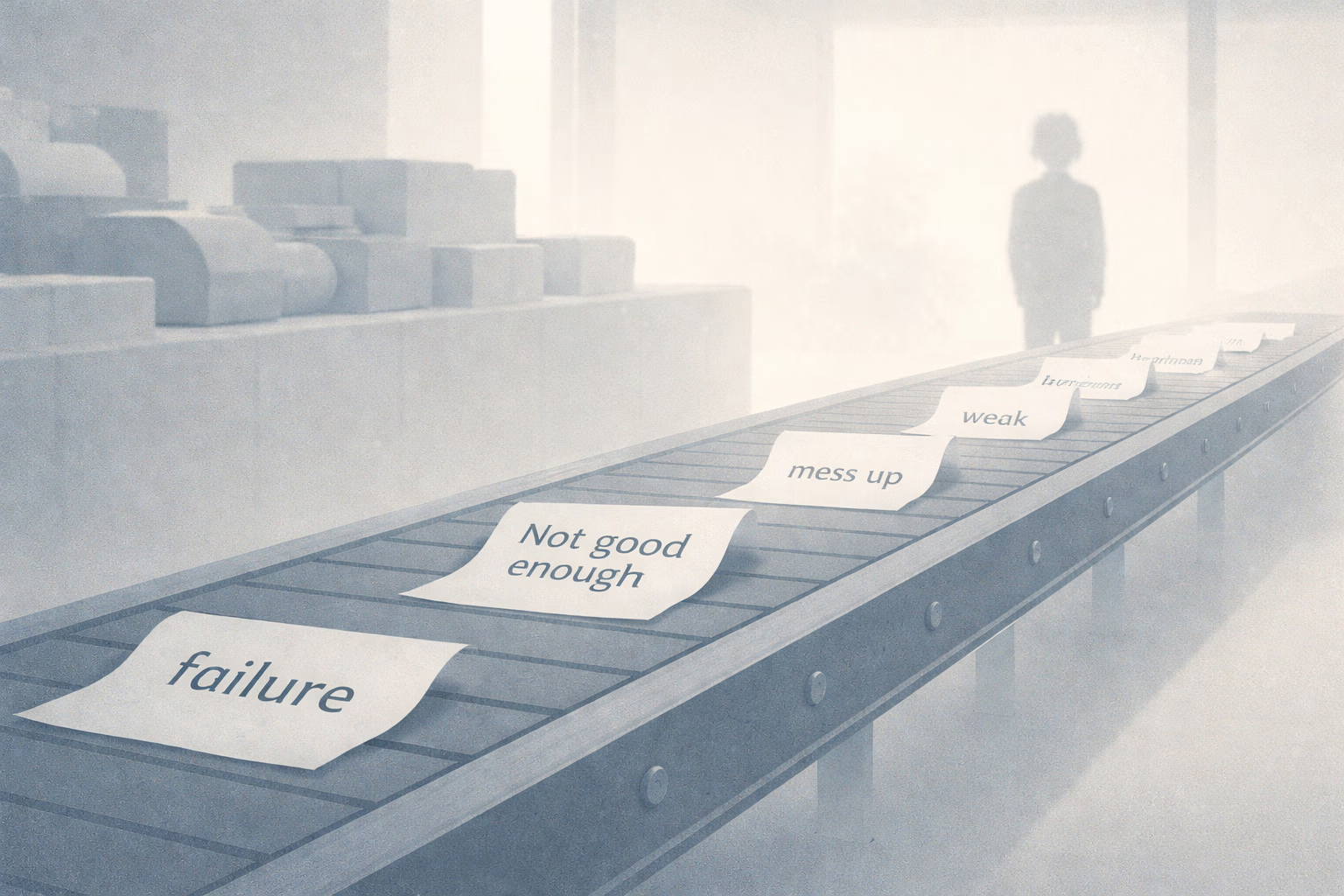
The Lure of Fantasy & Daydreaming: Escaping What Hurts

In short: The mind rehearses, plays, and explores. But sometimes imagination stops being a side room in the house and becomes the whole house—where relief, excitement, and even a sense of safety happen more reliably than they do in real connection.
Sexual fantasy is a normal human capacity: the mind rehearses, plays, and explores. But sometimes imagination stops being a side room in the house and becomes the whole house—where relief, excitement, and even a sense of safety happen more reliably than they do in real connection.
When that happens, it can look like “too much fantasizing,” but the deeper pattern is often simpler: a nervous system choosing the fastest available closure and reward, in a world that keeps many loops unfinished.
What if the pull into fantasy isn’t a character flaw, but a system looking for steadiness?
Fantasy overload often shows up as a quiet retreat: you might be physically present with a partner (or with friends, at work, in daily life) while your attention keeps slipping into an internal scene that feels more vivid, more responsive, and more “complete.” The outside world can start to feel slow, uncertain, or oddly distant.
This isn’t a mystery when you consider what fantasy offers: immediate entry, predictable reward, and a sense of being met without negotiation. In moments where real life asks for timing, coordination, and exposure to another person’s reality, fantasy can feel like the smoothest available regulation. [Ref-1]
Sometimes the mind isn’t chasing pleasure as much as it’s chasing a place where nothing is unresolved.
Sexual fantasy can activate reward circuitry—anticipation, dopamine-driven salience, and a quick shift in state. At the same time, it can simulate attachment cues: being wanted, chosen, admired, safe, special. The body can respond as if connection is happening, even when no real-time interaction is occurring.
The key structural feature is that fantasy delivers “connection-like” signals while bypassing the parts of relationship that require uncertainty tolerance: waiting, misattunement, repair, consent, differing preferences, and the reality that another nervous system is involved. That bypass can be especially compelling when life already feels crowded, evaluated, or emotionally expensive. [Ref-2]
Imagination is one of the mind’s oldest tools for survival and belonging. Humans rehearse possible futures, revisit past interactions, and simulate social outcomes. In small doses, this helps orientation: it can organize experience and prepare the system for real contact.
But simulation has a loophole: unlike many real-world tasks, it doesn’t have built-in endpoints. A conversation ends. A date ends. A disagreement resolves (or at least pauses). Fantasy can keep generating novelty and “nearly complete” satisfaction without requiring a finished arc. When the environment provides unlimited cues—images, stories, feeds, private recall—the simulator can stay on. [Ref-3]
Real intimacy includes variables you can’t control: another person’s mood, pace, boundaries, and attention. Even in loving relationships, closeness contains micro-uncertainties. The body registers those uncertainties as load.
Fantasy reduces that load by design. You control the pacing, the outcome, the level of intensity, the storyline, and the ending. The nervous system gets a clean, curated sequence of cues—often with immediate reward—while avoiding the friction of real-time coordination. Over time, the contrast can make ordinary connection feel unusually effortful, not because it is “bad,” but because it is real. [Ref-4]
When your system has been carrying a lot, why wouldn’t it choose the option with fewer variables?
Fantasy can mimic the sensations of being close—arousal, warmth, relief, excitement, the feeling of being desired. That can create a convincing internal message: need met. Yet many people notice a second message later: a flatness, a loneliness, or a sense that something didn’t actually land.
This is one of the hardest parts to name without shame. The system wasn’t doing something “wrong.” It was taking a substitute that offers fast state change. But substitutes often don’t produce the “done” signal that comes from mutuality—two people affecting each other and then settling. When that completion is missing, the mind may return to fantasy again, not out of defect, but because the loop didn’t truly close. [Ref-5]
A pleasure loop is not just “liking something.” It’s a repeated pairing of a cue (stress, boredom, rejection, uncertainty, fatigue) with a rapid internal solution (fantasy) that reliably shifts state. The relief teaches the nervous system: this is the way out.
Over time, the body starts to prefer the path with the shortest distance between cue and payoff. Real connection becomes the longer route: more steps, more timing, more negotiation, more ambiguity. In that context, increased fantasy isn’t evidence of low character—it’s what systems do when they learn a fast regulator. [Ref-6]
Fantasy overload can be subtle. Many people function well externally while internally relying on imagined scenarios as the primary place where desire, safety, or being “enough” gets confirmed. It can also be episodic—spiking during high stress, conflict, or disconnection.
Patterns often include: [Ref-7]
None of these are identities. They’re signals about what has become the most efficient route to regulation in your current conditions.
Intimacy is a skill-set the nervous system learns through repeated micro-completions: reaching, being received (or not), adjusting, repairing, and settling. When fantasy becomes the main arena, fewer of those real-time cycles occur.
The result isn’t that someone becomes “incapable” of closeness. It’s more like deconditioning: the body has less practice holding the natural intensity of closeness while staying present for uncertainty and mutual influence. Some people then experience real intimacy as strangely loud—too many signals at once—while fantasy feels clean and organized. [Ref-8]
When the world outside doesn’t offer reliable closure, the mind starts manufacturing it.
Corrective experiences are not insights. They’re lived sequences where the system learns, through completion, that a feared outcome isn’t inevitable—or that discomfort can crest and resolve without needing an escape hatch. They tend to happen in real time, with real consequences and real repair.
When fantasy becomes the main regulator, many of those sequences don’t fully occur. The person may bypass moments of relational friction or vulnerability, not because of a single emotion like “fear,” but because the system has learned to mute consequence and reduce exposure quickly. The body then lacks fresh evidence that real connection can be survivable, stabilizing, and complete. That absence of completion strengthens reliance on the internal route. [Ref-9]
Many people approach fantasy overload like a self-control problem: Why can’t I just stop? But self-regulation works more like physical fatigue than like moral resolve. When load is high and recovery is incomplete, the system defaults to the most efficient relief pathway. [Ref-10]
From a meaning perspective, fantasy can also function as a coherence patch. It supplies a storyline where things make sense: you are desired, you are in control, you are safe, you are chosen. If real life currently feels fragmenting—lots of effort, little completion—then fantasy isn’t merely “tempting.” It’s organizing.
If the pattern is doing a job, what job is it completing for you?
Attachment systems settle through repeated experiences of being in contact while the body stays within tolerable ranges. Not dramatic intensity—reliable attunement. Over time, this is what updates the internal prediction: connection can be steady, not just thrilling or risky.
When fantasy has carried the bulk of safety and reward, real connection may initially feel underpowered. That doesn’t mean it’s “not enough.” It often means the system is recalibrating from high-control simulation back to mutual reality. Gradual, safe contact—where signals are readable and repair is possible—gives the nervous system something fantasy cannot fully provide: shared completion. [Ref-11]
As load decreases and completion becomes more available in real life, many people notice a particular shift: the urgency to escape into fantasy softens. Not because fantasy becomes “forbidden,” but because it becomes less necessary as a regulator.
Restoration is often felt as increased capacity for signal return. In other words: more ability to stay with the ordinary pace of a real relationship, more tolerance for imperfect moments, and more settling after contact. The mind may still imagine—because that’s human—but the imagination is no longer the only place where desire and safety feel coherent. [Ref-12]
Imagination doesn’t need to be eliminated to be healthy. At its best, fantasy can enrich lived intimacy: adding play, curiosity, and creativity. The shift is structural: imagination supports relationship rather than replacing it.
In that role, fantasy becomes less like an escape hatch and more like an internal art form—something that can coexist with real connection, real repair, and real mutuality. The system begins to recognize two different experiences: simulation (private, controlled, fast) and intimacy (shared, imperfect, completing). When that distinction becomes embodied, the compulsion often loses leverage. [Ref-13]
If sexual fantasy has become a primary refuge, it may be pointing to something quietly intelligent: a longing for safety, completion, and being met without strain. In a fragmented environment, the mind will often build the closest substitute it can.
Seen through that lens, the pattern doesn’t have to be a verdict about you or your relationship. It can be information about where life has stopped feeling coherent—where too many experiences remain “open,” and where the nervous system has learned to seek closure alone.
Meaning tends to return when connection becomes less like a test and more like a place where real-time experience can finish—where your system can stand down because something actually completed. [Ref-14]
Imagination is a human inheritance. It becomes heavy when it has to carry what real life is not currently completing. And it becomes light again when it can return to its natural role: adding color and possibility to a life that already contains real contact, real repair, and real “done” signals.
When imagination supports connection instead of substituting for it, it often feels less like an escape—and more like a companion to a coherent life. [Ref-15]
From theory to practice — meaning forms when insight meets action.
Because it offers immediate entry, predictable reward, and a sense of being met without negotiation. In real life, intimacy includes variables you can't control — another person's mood, pace, attention, boundaries. Even loving closeness contains micro-uncertainties the body registers as load. Fantasy reduces that load by design: you control pacing, outcome, intensity, storyline, ending. The nervous system gets a clean curated sequence of cues, often with immediate reward, while avoiding real-time coordination. Over time, ordinary connection feels unusually effortful — not because it's bad, but because it's real. Sometimes the mind isn't chasing pleasure as much as a place where nothing is unresolved.
Because the loop didn't truly close. Fantasy can mimic the sensations of being close — arousal, warmth, relief, the feeling of being desired — and the system reads that as 'need met.' But many people notice a second message later: flatness, loneliness, a sense that something didn't actually land. Substitutes offer fast state change, but they don't produce the Done Signal that comes from mutuality — two people affecting each other and then settling. When that completion is missing, the mind returns to fantasy not from defect, but because the loop didn't close. The system has learned a fast regulator and prefers the path with the shortest distance between cue and payoff.
Because the body has been practicing high-control simulation more than mutual reality. Intimacy is a skill-set the nervous system learns through repeated micro-completions: reaching, being received or not, adjusting, repairing, settling. When fantasy becomes the main arena, fewer of those real-time cycles occur. This isn't incapability — it's deconditioning. Some people experience real intimacy as strangely loud, too many signals at once, while fantasy feels clean and organized. When fantasy has carried the bulk of safety and reward, real connection initially feels underpowered. That doesn't mean it's not enough. It means the system is recalibrating from controlled simulation back to attunement, which delivers something fantasy cannot: shared completion.
How it's being used. Imagination is one of the mind's oldest tools — a side room in the house, not the whole house. Fantasy becomes heavy when it has to carry what real life isn't currently completing. Self-regulation works more like physical fatigue than moral resolve: when load is high and recovery is incomplete, the system defaults to the most efficient relief pathway. Fantasy can also function as a coherence patch, supplying a storyline where you are desired, in control, safe, chosen. Restoration isn't elimination. As real-life completion becomes more available, fantasy returns to its natural role — adding play and curiosity to a coherent life rather than substituting for one.
From Science to Art.
Understanding explains what is happening. Art allows you to feel it—without fixing, judging, or naming. Pause here. Let the images work quietly. Sometimes meaning settles before words do.
One Quiet Window, one insight, one reflection — every Sunday