

Porn Overstimulation: When Pleasure Exceeds What the Brain Evolved For

In short: Hyper-stimulation sexual loops aren’t a character flaw, and they aren’t a mystery. They’re what can happen when sexual access becomes instant, intense, and effortless—available on demand, with near-infinite novelty, and with very little friction.
Hyper-stimulation sexual loops aren’t a character flaw, and they aren’t a mystery. They’re what can happen when sexual access becomes instant, intense, and effortless—available on demand, with near-infinite novelty, and with very little friction.
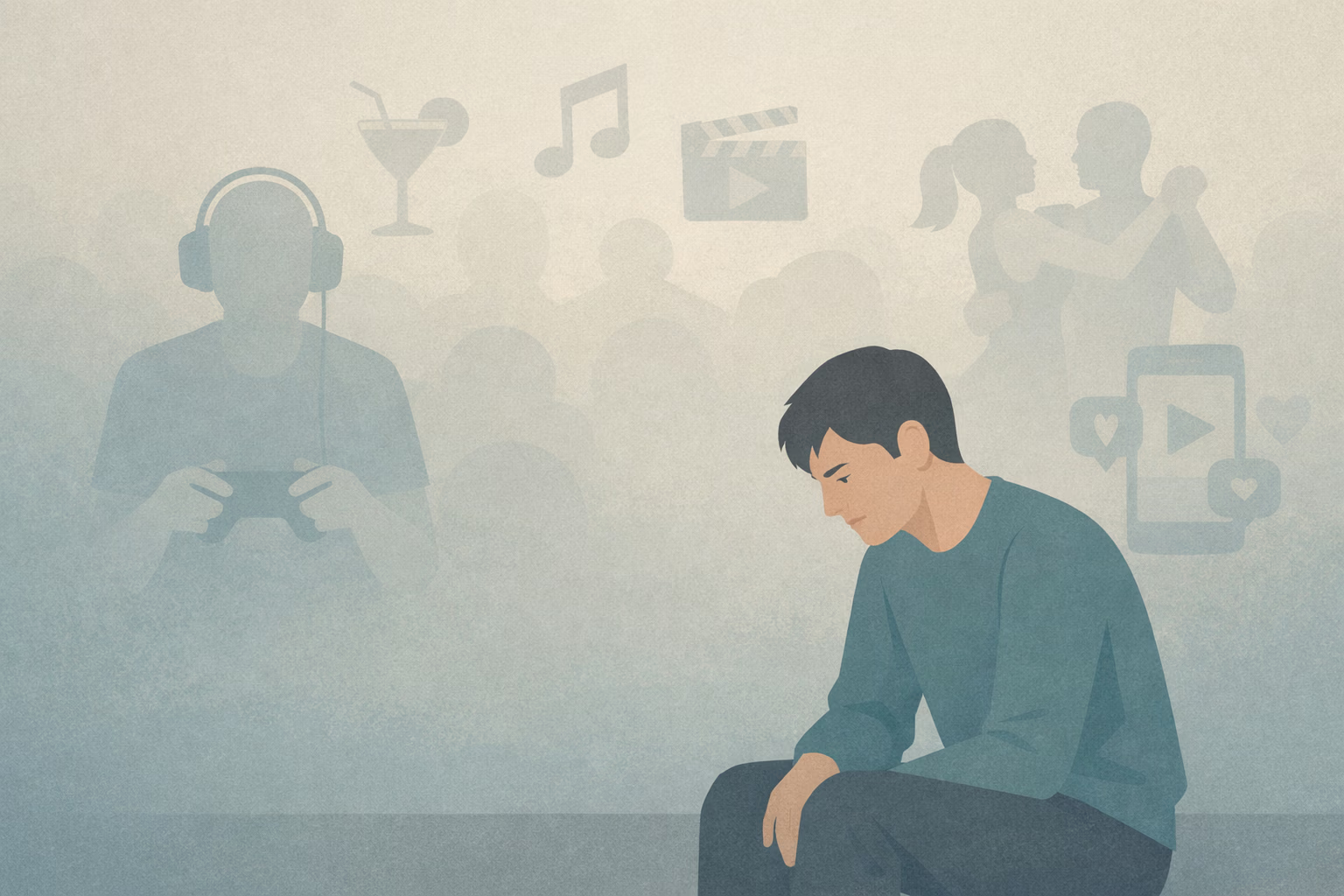
Over time, this kind of high-speed stimulation can quietly reshape what your nervous system expects from sexual cues: faster ramp-up, higher peaks, more novelty, more certainty. Then, when real-life intimacy asks for pacing, mutual rhythm, or small signals, the body can register it as “not enough,” even when the relationship is caring and safe.
What if the problem isn’t your desire—what if it’s the pace your system has been trained to need?
A common experience in hyper-stimulation loops is not a lack of sexuality, but a shift in threshold. The system begins to require stronger inputs—more speed, more novelty, more intensity—to register the same level of arousal or satisfaction. [Ref-1]
This can show up as impatience with gradual arousal, difficulty staying engaged with slower stimulation, or a sense of disconnection during partnered sex—like the body is present, but the signal isn’t landing. None of this is proof of brokenness. It’s what nervous systems do when they learn that “sexual” means “fast and maximal.”
Reward systems are prediction machines. They update based on repeated patterns: what tends to happen next, how quickly, and how intensely. When stimulation repeatedly arrives with high novelty and immediate payoff, the brain learns to expect that tempo. [Ref-2]
Over time, everyday erotic cues—touch, scent, eye contact, shared anticipation—may not create the same “signal strength,” not because they’re meaningless, but because they’re operating on a different timescale. The issue isn’t willpower; it’s conditioning. A system trained on sprinting can struggle with pacing, even when pacing is what connection requires.
In this frame, reduced responsiveness isn’t a moral failure. It’s a recalibrated baseline.
Human reward architecture evolved in environments where sexual opportunities were typically bounded by context: effort, social consequences, time, and availability. Novelty existed, but not in endless, instantly accessible streams.
Hyper-available sexual novelty can function like a “supernormal” stimulus—an amplified version of a cue the nervous system is built to respond to. That doesn’t make the person weak; it means the input is unusually potent. [Ref-3]
When an evolved system meets an environment that supplies high intensity without natural limits, the system adapts—often by raising the threshold for what counts as “enough.”
Hyper-stimulation isn’t only about pleasure. It can also deliver something the nervous system craves under pressure: quick certainty. There’s a predictable sequence—cue, ramp, peak, release—without negotiation, vulnerability, or waiting.
In modern life, many people carry chronic cognitive load: deadlines, loneliness, comparison, background stress. In that context, instant sexual stimulation can become a reliable state-shift: boredom turns into intensity; numbness turns into sensation; restlessness collapses into a single track. [Ref-4]
This isn’t best understood as “avoiding feelings.” Structurally, it’s a loop that offers immediate closure-like relief without requiring real completion in life—so the system learns to return to it whenever activation builds.
At first, the loop can feel like an upgrade—more excitement, more options, more control. But the nervous system often pays for repeated peaks with a quieter baseline. What once felt rewarding becomes ordinary; what once felt intimate becomes slow; what once felt satisfying becomes brief.
This is where the mismatch becomes painful: the person may still want closeness, but the body’s reward calibration has been pulled toward intensity rather than nuance. Reports of sexual dissatisfaction, reduced arousal with partnered sex, and difficulty sustaining engagement can cluster here. [Ref-5]
“It’s not that I don’t want connection. It’s that my system only recognizes the loudest signal.”
Intimacy is a slower technology. It relies on micro-cues, reciprocity, safety, timing, and the gradual building of shared rhythm. Hyper-stimulation, by contrast, can train desire toward immediacy: a quick spike rather than a layered experience.
Over repeated exposures, the nervous system can begin pairing sexual anticipation with novelty, speed, and rapid escalation—more than with relational presence. That pairing is a form of conditioning: the system learns what “counts” as arousing and how fast it should arrive. [Ref-6]
In this way, the loop is not just about what someone consumes. It’s about what their reward system has been taught to expect from sexuality itself.
People often describe these loops as escalating—not necessarily in frequency, but in intensity and specificity. The system looks for a stronger lever to pull, because yesterday’s lever no longer moves the needle. [Ref-7]
What does escalation look like in real life?
These aren’t identities. They’re learned regulatory routes—paths the nervous system recognizes as efficient under modern conditions.
Nuanced pleasure depends on bandwidth. It requires the nervous system to register small shifts—subtle touch, slow build, mutual timing. When stimulation is chronically high-intensity, those small shifts can stop registering as meaningful.
Relational sexuality also involves “shared pacing”: reading another person, adapting, waiting, adjusting. Hyper-stimulation can make that feel like friction rather than richness, because the system has been trained to equate sexual reward with immediate certainty. Over time, this can reduce relational satisfaction and strain connection. [Ref-8]
Importantly, this is not a failure of love or attraction. It’s a capacity issue: a system trained for peaks has less tolerance for quiet signals.
Once responsiveness drops, a predictable structural problem appears: the person needs stronger stimulation to get the same effect, but stronger stimulation further narrows what the system responds to. The range of “enough” shrinks.
This is how dependence can form without dramatic cravings. The loop becomes the most reliable route to a certain state—especially when life elsewhere doesn’t provide completion, reward, or “done” signals. People may also notice regret, secrecy, or a sense of life feeling slightly unreal afterward—not because they’re “bad,” but because the nervous system got a spike without integration into identity or relationship. [Ref-9]
In Meaning Density terms, the loop delivers relief, but not coherence.
There’s a crucial distinction between stimulation and stability. Stimulation changes state quickly; stability comes when the system can settle after completion—when it no longer has to keep chasing a peak to feel organized.
When arousal systems are less pressured by constant novelty and speed, many people report that responsiveness to ordinary cues can gradually reappear: more tolerance for gradual build, less urgency for extremes, more capacity to stay with a single thread. This is not “thinking differently.” It’s a physiological recalibration that tends to follow reduced load and restored closure. [Ref-10]
In other words, the nervous system can relearn that sexuality doesn’t have to be a sprint to be real.
Partnered intimacy has ingredients that high-speed stimulation often removes: mutual timing, safety cues, and the sense of being with a real person who has their own pace. When pressure dominates—pressure to perform, to respond instantly, to “match” an imagined intensity—shared rhythm collapses.
But when connection is present, the nervous system can start associating arousal with attunement rather than novelty. Not as a pep talk, but as a repeated lived sequence: signal, response, reciprocity, settling. This supports a different kind of learning—one that makes room for gradual build without turning it into a test. [Ref-11]
“The most regulating part wasn’t intensity. It was feeling met.”
When sensitivity begins to return, people often notice a widening of the arousal spectrum. Not higher peaks, but more range: subtle cues land again, anticipation feels possible, and satisfaction isn’t so tightly tied to novelty.
This shift is easy to misunderstand as “being more emotional.” It’s more accurately described as increased capacity for signal return—your system can register quiet inputs because it isn’t constantly braced for the next spike.
Many relationship-oriented accounts describe improved intimacy when the nervous system is not competing with constant high-intensity conditioning. [Ref-12]
Desire becomes more stable when it’s connected to identity and meaning: “This is the kind of intimacy I live inside,” not “This is the fastest way to change my state.” That reorientation isn’t a mindset trick. It’s what tends to happen when repeated experiences finally complete—when sexuality stops being an endless open loop and starts feeling like a coherent part of a life.
In that coherence, intensity can still exist, but it stops being the price of entry. Pleasure becomes less about chasing the loudest signal and more about an embodied, relational experience that leaves the system settled rather than hungry. Accounts of pornography’s impact on intimacy often point to this contrast: connection deepens when expectations shift from constant novelty toward shared presence. [Ref-13]
Not “less desire”—different desire.
Hyper-stimulation sexual loops make sense in the environment we’re in: high access, high novelty, low friction, constant evaluation. When the nervous system is offered fast peaks with minimal cost, it will often take that route—especially under stress load or fragmentation.
This is the same structural logic seen in other modern reward loops: the system gets rapid relief without the deeper closure that creates lasting stability. The result isn’t “weakness.” It’s a predictable adaptation to inputs that outpace biology. [Ref-14]
When people start moving back toward coherence—where sexuality is paced by real life, real values, real relationship, and real completion—the system often stops needing constant intensity to feel organized. Agency returns not as force, but as orientation: a felt sense of what actually fits.
Sexuality tends to feel most satisfying when it can land inside a life—when it has context, reciprocity, and a nervous system that can stand down afterward. Hyper-stimulation can temporarily mimic fulfillment, but it often leaves the deeper circuits still searching.
As the system regains tolerance for slower cues and shared rhythm, intimacy can become pleasurable again in a quieter, sturdier way—less like a chase, more like a homecoming. [Ref-15]
From theory to practice — meaning forms when insight meets action.
Because reward systems learn speed, novelty, and peak intensity. When sexual stimulation repeatedly arrives with high novelty and immediate payoff, the brain updates to expect that tempo. Everyday erotic cues — touch, scent, eye contact, shared anticipation — operate on a different timescale and may not create the same signal strength. It isn't willpower failure; it's conditioning. A system trained on sprinting can struggle with pacing, even when pacing is what connection requires. Reduced responsiveness isn't a moral failure. It's a recalibrated baseline. The Reward & Stimulation System trained on peaks has less tolerance for nuance.
Because hyper-stimulation delivers something the nervous system craves under pressure: quick certainty. There's a predictable sequence — cue, ramp, peak, release — without negotiation, vulnerability, or waiting. Under chronic cognitive load (deadlines, loneliness, comparison), instant stimulation becomes a reliable state-shift: boredom turns into intensity, numbness into sensation, restlessness collapses into a single track. This isn't best understood as avoiding feelings. Structurally, it's a Pleasure Loop offering immediate closure-like relief without requiring real completion in life — so the system learns to return whenever activation builds.
The illusion is more pleasure; the reality is often less sensitivity. The nervous system pays for repeated peaks with a quieter baseline. What was rewarding becomes ordinary; what was intimate becomes slow; what was satisfying becomes brief. The mismatch becomes painful: you may still want closeness, but reward calibration has been pulled toward intensity rather than nuance. The loop tightens because lower response leads to higher intensity-seeking, which further narrows what the system responds to. The Pleasure Loop delivers relief, but not coherence — spike without integration into identity or relationship.
Yes, through recalibration rather than willpower. Stimulation changes state quickly; stability comes when the system can settle after completion. As arousal systems are less pressured by constant novelty, responsiveness to ordinary cues can gradually reappear: more tolerance for gradual build, less urgency for extremes, more capacity to stay with a single thread. Partnered intimacy retrains expectation through shared rhythm and safety cues — the body starts associating arousal with attunement rather than novelty. Desire reorients from peak-seeking to meaningful experience: less like a chase, more like a homecoming. Different desire, not less desire.
From Science to Art.
Understanding explains what is happening. Art allows you to feel it—without fixing, judging, or naming. Pause here. Let the images work quietly. Sometimes meaning settles before words do.
One Quiet Window, one insight, one reflection — every Sunday